
Generic drugs save the American healthcare system billions of dollars every year. They are cheaper, accessible, and legally required to work just as well as their brand-name counterparts. But how does a manufacturer prove that a $5 pill is truly equivalent to a $500 one? The answer lies in Bioequivalence studies, which are clinical trials designed to demonstrate that a generic drug performs comparably to its brand-name version. These rigorous tests are the backbone of the U.S. Food and Drug Administration’s (FDA) approval process for generics.
If you are a pharmaceutical manufacturer, a regulatory affairs specialist, or simply curious about drug safety, understanding what the FDA demands is critical. This isn't just paperwork; it's a scientific hurdle that ensures patient safety. Below, we break down exactly what manufacturers must prove, the statistical rules they must follow, and the exceptions that exist for complex drugs.
The Core Requirement: Matching the Reference Listed Drug
To get a generic drug approved, you cannot just show that your drug contains the same active ingredient. You have to prove that the body absorbs it in the exact same way as the original brand-name product. In FDA terms, this original product is called the Reference Listed Drug (RLD), which is the brand-name drug against which all generic versions are compared.
The legal foundation for this comes from the Hatch-Waxman Amendments of 1984. This law created the Abbreviated New Drug Application (ANDA) pathway. Under this system, generic manufacturers don't need to repeat expensive clinical trials proving efficacy-they only need to prove bioequivalence. The FDA defines bioequivalence as the absence of a significant difference in the rate and extent to which the active ingredient becomes available at the site of action when administered at the same molar dose under similar conditions.
In plain English: if you take the brand drug and the generic drug, your blood levels of that medication should look nearly identical over time. If they do, the FDA assumes the therapeutic effect will be the same. This is known as the Fundamental Bioequivalence Assumption.
The 80/125 Rule: The Statistical Gold Standard
How close is "close enough"? The FDA uses a strict statistical benchmark known as the 80/125 rule. This is not a guess; it is a mathematical boundary that has been the industry standard since 1992. To pass, the generic drug must meet specific criteria for two primary pharmacokinetic endpoints:
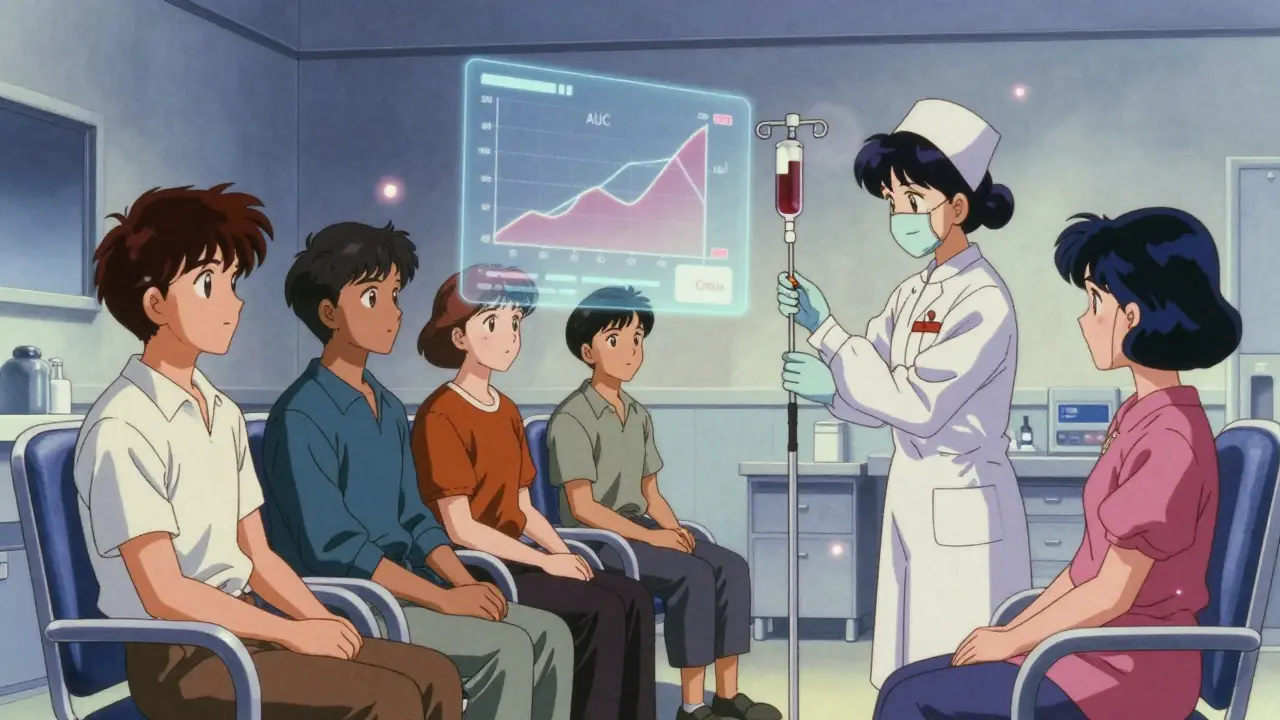
- AUC (Area Under the Curve): This measures the total amount of drug absorbed into the bloodstream over time. It reflects the extent of absorption.
- Cmax (Maximum Plasma Concentration): This measures the peak level of the drug in the blood. It reflects the rate of absorption.
Manufacturers calculate the geometric mean ratio of the test (generic) formulation to the reference (brand) formulation. Then, they compute a 90% confidence interval. For the drug to be approved, this entire confidence interval must fall between 80% and 125%. If the interval dips below 80% or rises above 125%, the generic is rejected. This narrow window ensures that the generic is neither too weak nor too strong compared to the brand.
Study Design: Who, Where, and How?
Proving these numbers requires careful planning. The FDA mandates that most bioequivalence studies be conducted in vivo-meaning inside living human subjects. Here is what a standard study looks like:
- Participants: Typically 24 to 36 healthy volunteers. They must be free of diseases that could affect drug metabolism.
- Conditions: Studies are usually done under fasting conditions. However, if the drug is meant to be taken with food, or if food significantly affects absorption, a fed-state study is also required.
- Design: Most studies use a crossover design. Each participant takes both the generic and the brand drug, separated by a washout period to ensure the first drug is fully eliminated before the second is taken. This controls for individual biological differences.
- Compliance: The study must follow Good Laboratory Practice (GLP) regulations (21 CFR Part 58). Sample handling, storage, and analysis methods must be meticulously documented.
These studies are expensive. A single bioequivalence trial can cost between $500,000 and $2 million. This is why getting the study design right the first time is crucial. The FDA reports that companies following Product-Specific Guidances (PSGs) see a 68% first-cycle approval rate, compared to just 29% for those who don't.
Biowaivers: When You Don’t Need a Clinical Trial
Not every generic drug needs a full-scale human trial. The FDA allows Biowaivers, which are regulatory exemptions from conducting in vivo bioequivalence studies. These are granted when the science suggests that two products will perform identically based on their physical properties alone.
To qualify for a biowaiver, the generic must meet the Q1-Q2-Q3 framework:
- Q1: Identical active ingredients.
- Q2: Same dosage form and concentration.
- Q3: Equivalent pH and physico-chemical characteristics.
Common candidates for biowaivers include parenteral solutions (IV drugs), ophthalmic solutions, and some topical products intended for local effects rather than systemic absorption. For example, a simple saline eye drop solution might get a biowaiver because there is no risk of systemic variation affecting the patient. Using a biowaiver can speed up approval by 6 to 12 months, saving significant time and money.
Special Cases: Narrow Therapeutic Index Drugs
Some drugs are unforgiving. A small change in blood concentration can lead to toxicity or treatment failure. These are called Narrow Therapeutic Index Drugs (NTIDs), such as warfarin or levothyroxine. For these medications, the standard 80/125% rule is too loose.
The FDA applies tighter acceptance criteria for NTIDs. Instead of 80-125%, the 90% confidence interval must often fall within 90% to 111%. This means the generic must be almost perfectly matched to the brand. Manufacturers dealing with NTIDs face higher scrutiny and more complex statistical requirements, including scaled average bioequivalence (SABE) approaches for highly variable drugs.
Complex Generics and Modern Tools
As drug delivery systems become more sophisticated, so do the testing methods. Inhalers, transdermal patches, and drug-device combinations pose unique challenges. You can't always measure blood levels accurately for a patch that releases drug slowly over weeks. In these cases, the FDA is increasingly accepting alternative approaches:
- In Vitro Testing: For topical creams, researchers may use skin models to measure permeation (IVPT) instead of human trials.
- PBPK Modeling: Physiologically Based Pharmacokinetic modeling uses computer simulations to predict how a drug behaves in the body, reducing the need for large clinical trials in certain scenarios.
The FDA has issued over 2,147 Product-Specific Guidances to help manufacturers navigate these complexities. Ignoring these guidances is a common pitfall. In 2022, 78% of complete response letters for topical generics cited bioequivalence deficiencies, often because manufacturers failed to follow the specific guidance for that drug class.
| Drug Category | Primary Endpoint | Acceptance Criteria | Study Type |
|---|---|---|---|
| Standard Systemic Oral Drugs | AUC & Cmax | 80% - 125% | In Vivo (Human Trials) |
| Narrow Therapeutic Index (NTID) | AUC & Cmax | 90% - 111% | In Vivo (Strict Monitoring) |
| Eligible Biowaiver Products | Dissolution Profiles | Q1-Q2-Q3 Match | In Vitro (No Human Trials) |
| Topical Local Effects | Permeation/Release | Product-Specific Guidance | In Vitro / Small Scale In Vivo |
Why First-Cycle Approval Matters
The FDA’s review process is intense. The average time from submission to approval for an ANDA is now 14 to 18 months, down from 36 months in the 1990s. However, many submissions fail the first review cycle. Common reasons include inadequate sample sizes, poor analytical methodology, or incomplete documentation of sample handling.
Under the Generic Drug User Fee Amendments (GDUFA III), the FDA has committed to faster reviews for domestic manufacturers. If you source your Active Pharmaceutical Ingredients (APIs) in the U.S. and conduct your bioequivalence testing here, you may benefit from expedited review. But speed doesn't mean leniency. The scientific standards remain high. A well-organized submission that strictly follows the latest Product-Specific Guidance is your best bet for avoiding costly delays.
What is the difference between bioavailability and bioequivalence?
Bioavailability refers to the rate and extent to which the active ingredient enters the circulation. Bioequivalence is a comparison of the bioavailability of two different formulations (usually a generic vs. a brand) to determine if they are therapeutically equivalent.
Why does the FDA use the 80-125% rule?
The 80-125% range is statistically derived to ensure that any difference between the generic and brand drug is clinically insignificant. It accounts for natural variability in human metabolism while ensuring the generic is not substantially weaker or stronger than the reference drug.
Can I get a generic drug approved without a clinical trial?
Yes, if you qualify for a biowaiver. This applies to certain simple dosage forms like IV solutions or some topical products where in vitro testing can reliably predict performance. The generic must match the brand in active ingredient, dosage form, and concentration.
What happens if my bioequivalence study fails?
If the 90% confidence interval falls outside the acceptance limits, the FDA will issue a Complete Response Letter. You must then investigate the cause, potentially redesign the study, and resubmit. This adds significant time and cost to the development process.
How long does FDA approval for a generic drug take?
Currently, the process typically takes 14 to 18 months from submission to approval. Following Product-Specific Guidances can reduce this time by several months, as these drugs are reviewed more efficiently.