
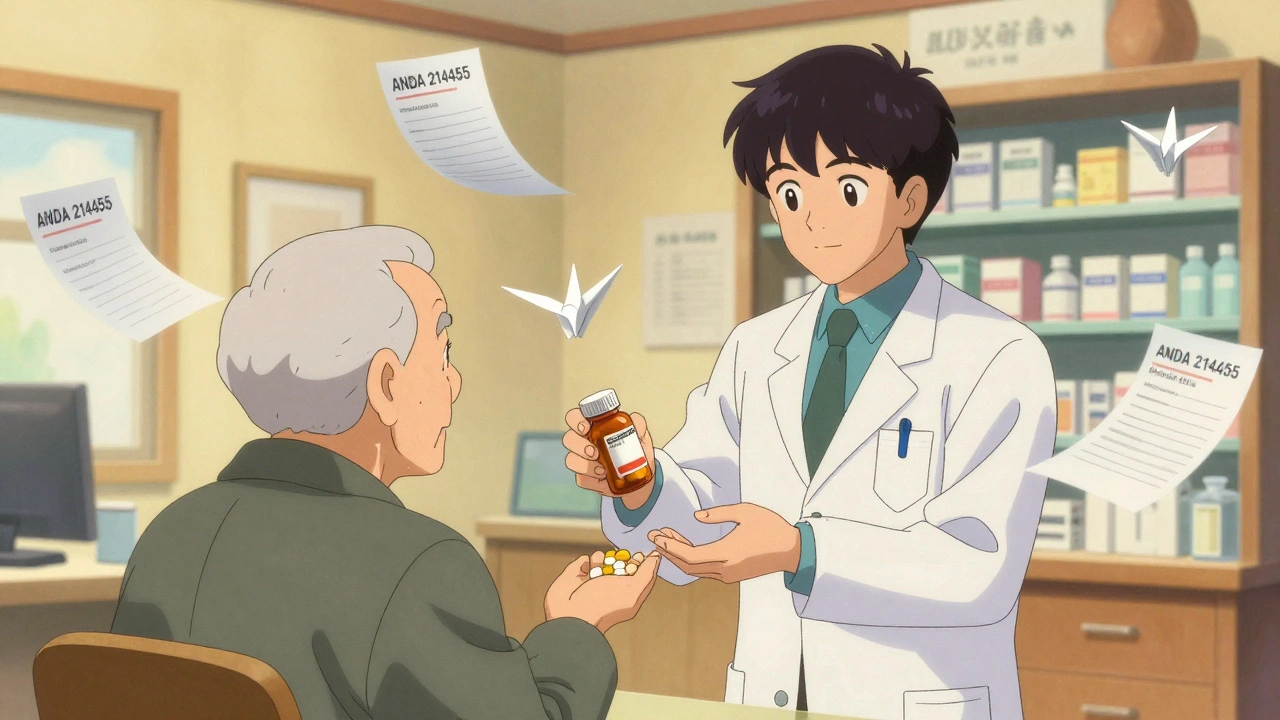
Every time you pick up a prescription and see a lower price than expected, chances are you’re holding a drug approved through an ANDA. But what exactly is an ANDA? And why does it matter so much to your wallet and your health?
An Abbreviated New Drug Application, or ANDA, is the paperwork a company files with the U.S. Food and Drug Administration (FDA) to get permission to sell a generic version of a brand-name drug. It’s not a shortcut-it’s a smart, science-backed system designed to get safe, effective, low-cost medicines to millions of people without forcing every new company to start from scratch.
How the ANDA Pathway Works
The ANDA system wasn’t always around. Before 1984, if you wanted to make a copy of a brand-name drug, you had to run the same expensive clinical trials the original maker did. That meant no one bothered-until Congress passed the Hatch-Waxman Act. Signed by President Ronald Reagan on September 24, 1984, this law created two paths: one for new drugs (called NDAs) and one for generics (ANDAs).
Here’s the key difference: an NDA needs full proof of safety and effectiveness from animal and human trials. An ANDA doesn’t. Instead, it proves that the generic version is the same as the original in every way that matters: same active ingredient, same strength, same way it’s taken (pill, injection, cream), and same effect on the body.
That’s where bioequivalence comes in. To get approval, a generic drug must show it gets into the bloodstream at the same rate and amount as the brand-name drug. This is tested in 24 to 36 healthy volunteers. The results must fall within 80% to 125% of the original drug’s performance-meaning the body absorbs it just as well.
And it works. Over 97% of generic drugs approved through ANDAs perform just like their brand-name counterparts. That’s not theory-it’s data from the FDA’s own tracking system.
What’s Inside an ANDA?
An ANDA isn’t just a one-page form. It’s a detailed technical package. Here’s what it must include:
- Active ingredient: Must be identical to the reference-listed drug (RLD) listed in the FDA’s Orange Book.
- Dosage form and strength: Same pill size, same milligram amount, same injection concentration.
- Route of administration: If the brand is taken orally, the generic must be too. No switching from tablet to liquid unless approved separately.
- Labeling: Same warnings, same instructions, same side effects-only the brand name and manufacturer info can differ.
- Manufacturing details: Where it’s made, how it’s mixed, how quality is checked, and how it stays stable over time.
- Bioequivalence data: The pharmacokinetic study results showing absorption rates match the original.
Inactive ingredients? Those can be different. The generic might use a different filler or coating. But if that change affects how the drug works, the FDA will reject it.
Each approved ANDA gets a six-digit number-like ANDA 214455 for the generic version of Eliquis. That number stays with the drug forever, even if the company selling it changes.
ANDA vs. NDA: The Big Differences
It helps to see the contrast:
| Feature | ANDA (Generic) | NDA (Brand-Name) |
|---|---|---|
| Development Time | 3-4 years | 10-15 years |
| Cost | $1-5 million | $2.6 billion (2020 dollars) |
| Clinical Trials Required | No | Yes |
| Bioequivalence Data Required | Yes | No |
| Review Time (FDA) | 10 months | 10-12 months |
| Patent Challenges Allowed | Yes | No |
The savings aren’t just numbers. They’re real. In 2023 alone, generic drugs saved the U.S. healthcare system over $313 billion. That’s money staying in people’s pockets, not going to pharmaceutical giants.
Why ANDAs Are So Important
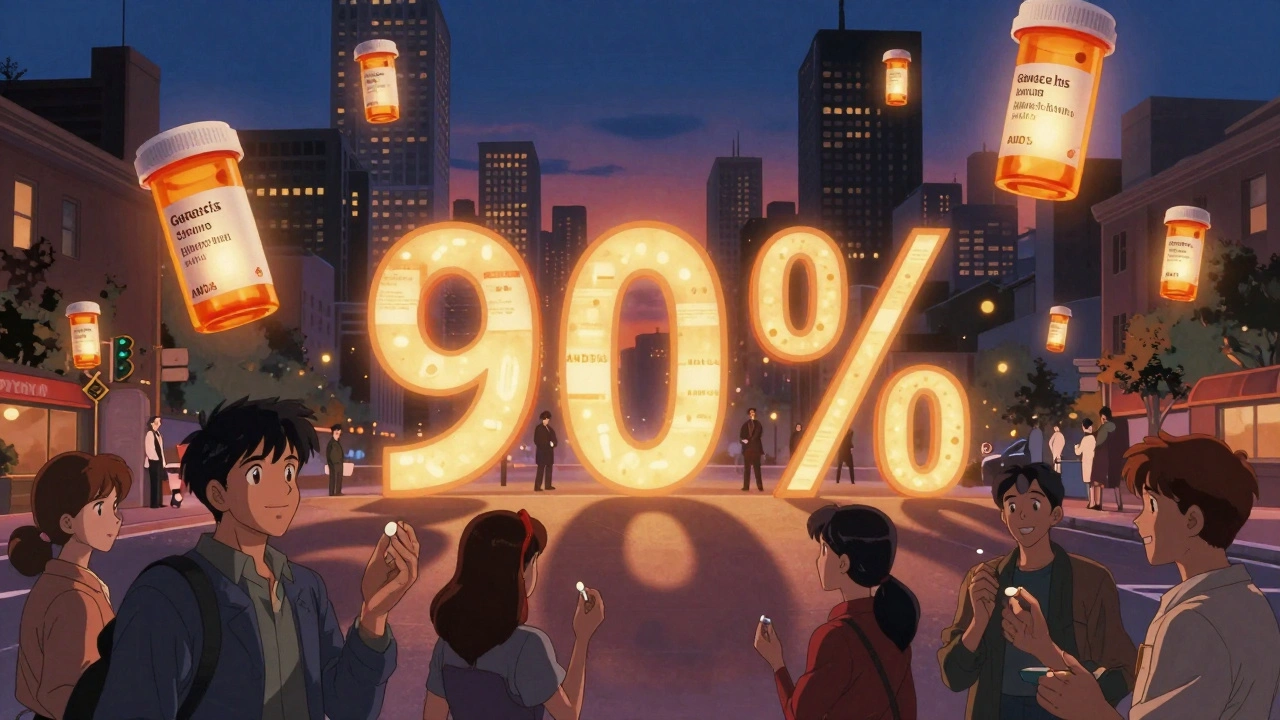
Over 90% of all prescriptions filled in the U.S. are for generic drugs. That’s not because people are settling. It’s because generics are safe, reliable, and approved under the same strict standards.
Think about insulin, blood pressure meds, or antibiotics. These are drugs people take for years. If they cost hundreds of dollars a month, many skip doses-or don’t fill them at all. Generic versions, often under $10 a month, make treatment possible.
The ANDA pathway didn’t just lower prices. It created competition. Before 1984, a brand-name drug could hold a monopoly for decades. Now, as soon as a patent expires, multiple companies can apply to make the generic. That drives prices down even further.
Take Humira, the top-selling drug in history. When its patent expired in 2023, 12 generic versions were approved within months. The price dropped by over 80% in the first year.
Challenges and Limitations
It’s not perfect. The ANDA system works best for simple, small-molecule drugs-pills, injections, creams. But what about complex products like inhalers, nasal sprays, or topical gels? These are harder to copy because how the drug is delivered matters as much as what’s in it.
That’s why the FDA launched its Complex Generic Drug Product Development program in 2022. It gives special guidance for these tricky products. Still, many generic makers struggle. A 2022 survey found that 68% of companies had trouble proving bioequivalence for complex forms. That leads to delays-and more rejection letters.
The FDA’s own data shows the most common reasons ANDAs get rejected:
- 32%: Inadequate manufacturing controls
- 27%: Insufficient bioequivalence data
- 18%: Labeling errors
Smaller companies often don’t have the resources to fix these issues. That’s why big generic players like Teva, Viatris, and Sandoz dominate the market-they’ve built teams just to handle ANDA submissions.
What’s Next for ANDAs?
The FDA is pushing for change. Under the 2023 GDUFA IV agreement, the goal is to approve 90% of original ANDAs on the first try by 2027. Right now, it’s around 65%. That’s a big jump.
More complex generics are coming. By 2028, experts predict one in four generic drugs will be from complex formulations-like inhalers for asthma or creams for eczema. That’s good news for patients, but it means the ANDA process will need to evolve.
There’s also a supply chain risk. Nearly 80% of generic drug ingredients come from just two countries: India and China. A single factory shutdown can cause shortages. The FDA is watching this closely.
Who Benefits the Most?
Everyone does.
Patients get cheaper meds. Pharmacies get reliable inventory. Insurers pay less. Taxpayers save billions on Medicare and Medicaid. Even brand-name companies benefit-they get to recoup their R&D costs before generics hit the market.
And it’s working. Since 1984, generic drugs have saved the U.S. healthcare system over $2.2 trillion. That’s more than the GDP of most countries.
The ANDA system isn’t flashy. It doesn’t make headlines. But every day, it’s quietly making sure millions of people can afford the medicine they need to live.
Is an ANDA the same as a generic drug?
No. An ANDA is the application a company submits to the FDA to get approval to sell a generic drug. The generic drug is the actual product that results after the ANDA is approved. Think of the ANDA as the paperwork, and the generic drug as the final product.
Can a generic drug be different from the brand-name version?
Yes-but only in ways that don’t affect safety or effectiveness. The active ingredient, strength, dosage form, and how it works in the body must be identical. Differences are allowed in inactive ingredients (like fillers or dyes), packaging, or labeling. But if those changes change how the drug is absorbed or used, the FDA will not approve it.
How long does it take to get an ANDA approved?
Under current FDA rules, the review time for a standard ANDA is 10 months. This is part of the Generic Drug User Fee Amendments (GDUFA), which sets performance goals for the FDA. Some applications get approved faster if they’re prioritized, while others take longer if the FDA requests more data.
Why are generic drugs so much cheaper?
Generic drug makers don’t have to repeat expensive clinical trials. They rely on the original brand-name company’s safety and effectiveness data, which the FDA already approved. Their main costs are manufacturing, testing for bioequivalence, and regulatory paperwork. That’s why a generic can cost 80-85% less than the brand version.
Do all drugs have generic versions?
No. Some drugs can’t have generics because they’re biologics-made from living cells, like insulin or cancer drugs. These require a different approval path called a biosimilar application. Also, if a drug is still under patent or has exclusivity protection, no ANDA can be submitted until those protections expire.
Can I trust a generic drug as much as a brand-name one?
Yes. The FDA requires generic drugs to meet the same quality, strength, purity, and stability standards as brand-name drugs. They’re made in the same type of facilities and inspected just as often. In fact, many brand-name companies also make their own generic versions. The only difference is the price-and sometimes the color of the pill.
Final Thoughts
The ANDA system is one of the most successful public health policies in modern history. It didn’t just lower drug prices. It made healthcare more fair. It gave patients choice. It forced innovation-not in marketing, but in access.
It’s not perfect. Complex drugs still pose challenges. Supply chains are fragile. But the core idea-that safe, effective medicine shouldn’t be a luxury-remains strong.
If you’ve ever saved money on a prescription, you’ve benefited from the ANDA pathway. And that’s something worth understanding.

James Kerr - 3 December 2025
I used to be scared of generics until my dad started taking them for his blood pressure. Same pill, same results, but now he saves $200 a month. 🙌
Francine Phillips - 5 December 2025
So generics are just as good huh
Rashmin Patel - 5 December 2025
As someone who works in pharma logistics in India, I can tell you the ANDA system is a game-changer. We manufacture 40% of the world’s generics and the quality control is insane. FDA inspections? We get visited more than most US plants. The bioequivalence studies? Done with real human volunteers here, not just lab models. And yeah, sometimes the fillers are different - like using tapioca starch instead of corn - but if it affects absorption, the batch gets tossed. No shortcuts. The real issue? Supply chain bottlenecks. One factory in Telangana shuts down and suddenly half the US runs out of metformin. We’re not the problem - the global logistics are.
sagar bhute - 5 December 2025
This is all corporate propaganda. The FDA is bought and paid for. I know a guy who took a generic for his antidepressant and ended up in the hospital. They don't test for long term effects. The brand name works because it's pure. The rest is just chemical garbage dressed up as medicine.
Cindy Lopez - 7 December 2025
The article correctly states that inactive ingredients can differ, but fails to mention that these differences can cause allergic reactions in sensitive individuals. Also, 'same effect on the body' is misleading - pharmacokinetic equivalence does not guarantee pharmacodynamic equivalence in all patients.
shalini vaishnav - 7 December 2025
India makes 70% of the world’s generics but you Americans act like we’re some kind of back-alley pharmacy. We have more GMP-certified plants than the entire EU. You think your $200 brand-name pill is better? It’s the same molecule. The only difference is the logo on the bottle and your blind patriotism. We follow FDA standards better than you follow your own traffic laws.
vinoth kumar - 9 December 2025
Love this breakdown. I’m a pharmacist in Mumbai and we ship out thousands of ANDA-approved tablets daily. The thing people don’t get is that the bioequivalence testing isn’t just a formality - it’s brutal. We test on 36 people, fasted and fed, multiple doses, blood draws every 30 minutes for 72 hours. If the curve doesn’t match within 80-125%, it’s rejected. No exceptions. The FDA doesn’t play around. And honestly? Most of the time, the generic works better because it’s fresher - we make it and ship it in weeks, not months.
bobby chandra - 9 December 2025
Let me blow your mind - the FDA doesn’t just approve generics, they *audit* the factories. I’ve seen the reports. Same inspectors. Same standards. Same swabs. Same documentation. The only thing different? The price tag. That’s it. You’re not getting a discount on quality - you’re getting a discount on marketing, patents, and corporate jets. The brand-name company spent $2 billion to invent it. We spent $3 million to copy it. And guess what? It still saves your life. That’s not capitalism - that’s common sense.
Archie singh - 10 December 2025
The 97% effectiveness stat is cherry-picked. What about the 3%? The ones who have seizures because their generic had 2% less absorption? You think that’s acceptable? You think your life is a statistical average? The FDA approves these based on averages. But people aren’t averages. They’re individuals. And when your drug fails, you don’t get a refund. You get a coffin.
Gene Linetsky - 10 December 2025
You know who really controls the ANDA system? Big Pharma. They own the reference drugs. They own the patents. They own the testing labs. And they quietly buy up the generic companies too. That’s why Humira generics took a year to hit the market - because the parent company owns 3 of the top 5 generic makers. This isn’t competition. It’s a controlled demolition. They let you think you’re winning. You’re not. You’re just being fed the crumbs.
Ignacio Pacheco - 10 December 2025
So if a generic is chemically identical, why do some people swear their brand-name version works better? Is it placebo? Or is the FDA just really good at lying to us?