
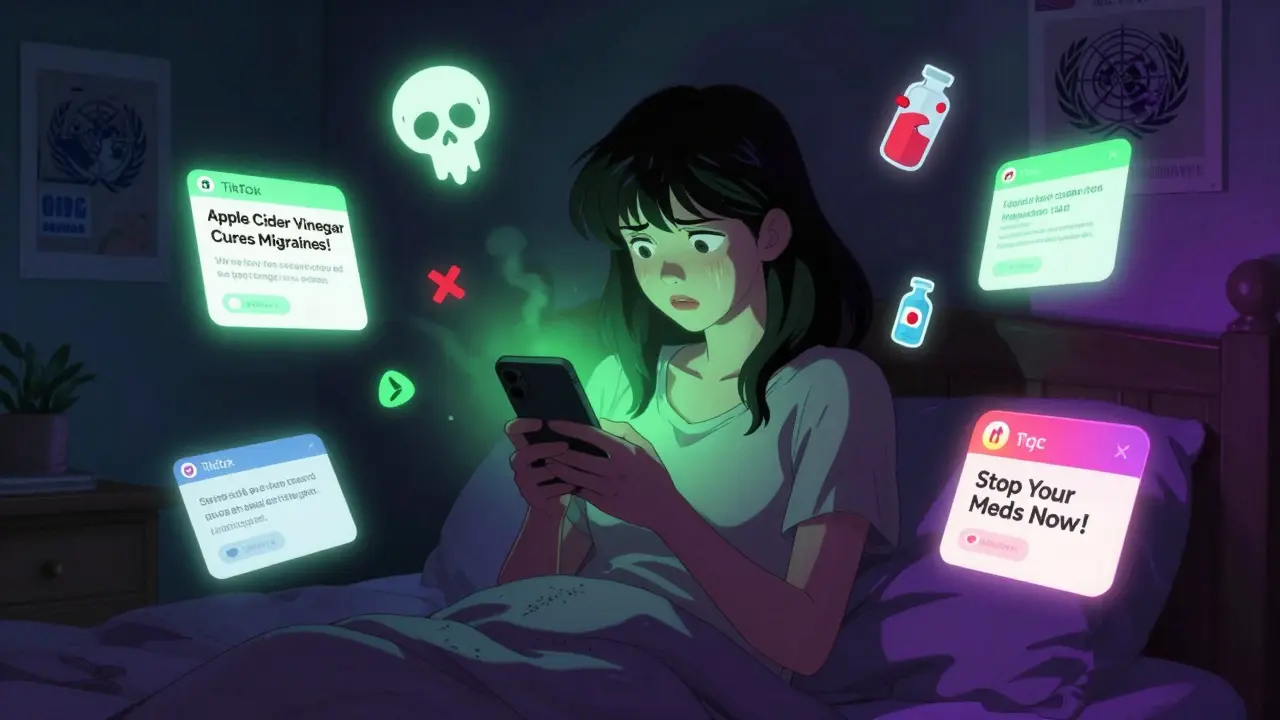
It’s easy to scroll past a TikTok video claiming that apple cider vinegar cures migraines or an Instagram post saying you can replace your blood pressure pill with garlic supplements. These posts look convincing. They’re often posted by people with friendly smiles, clean backgrounds, and hashtags like #NaturalHealing or #HealthHack. But what if that advice could hurt you-or worse, kill you?
Every day, millions of people turn to social media for health advice. According to the CDC, nearly 60% of Americans look up medical info online. And during the pandemic, that number spiked. But not all of it is safe. The World Health Organization called it an "infodemic"-a flood of false, misleading, or dangerous health claims that spread faster than facts. And the consequences are real. People have ended up in the hospital after following advice from strangers online. Some have stopped taking life-saving medications because someone on YouTube told them it was "toxic."
Who’s Really Giving This Advice?
First, ask yourself: Who is this person? Most of the time, they’re not doctors, pharmacists, or nurses. They’re influencers, bloggers, or everyday users with no medical training. The Baton Rouge Clinic warns: avoid advice from anyone who isn’t a licensed health professional. That’s not a suggestion-it’s a rule. It’s illegal in many places for healthcare workers to give medical advice to people they haven’t examined. So if someone on Instagram is telling you how to dose your insulin or switch from your prescribed antidepressant, they’re breaking the law.
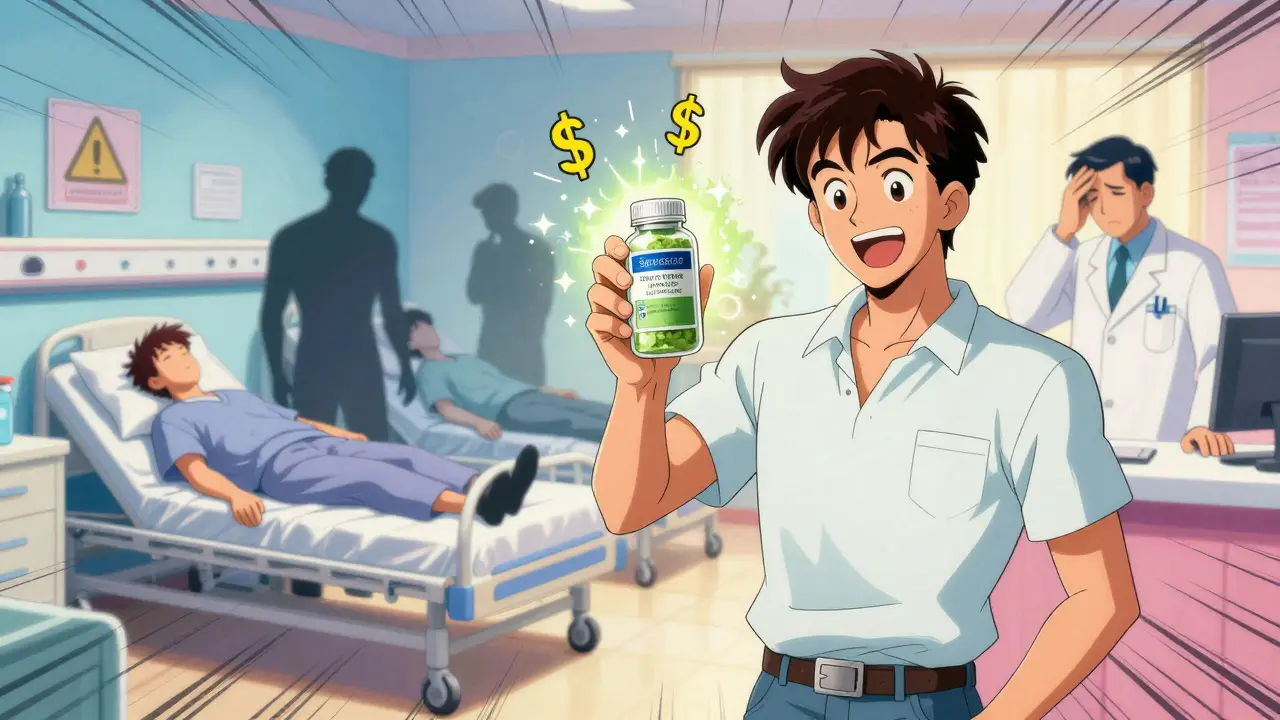
And here’s the twist: many of these people are being paid. Healthline found that influencers often partner with supplement companies, supplement brands, or even clinics. They’re not sharing advice-they’re selling something. That green powder they’re drinking? It’s probably not a miracle cure. It’s a product they get a commission on. Look for phrases like "Sponsored," "Partnered with," or "Use my code for 20% off." If you don’t see it, check the comments. Often, the disclosure is hidden there.
Red Flags You Can’t Ignore
Here are five clear signs the advice you’re seeing is unsafe:
- "Miracle cure" claims-If someone says something "cures" diabetes, cancer, or high cholesterol overnight, walk away. No single supplement, diet, or hack does that. Real medicine doesn’t work that way.
- Secret information-If they say "Doctors don’t want you to know this," or "This is banned in Europe," they’re trying to scare you. Reputable medical facts are published in journals, government websites, and hospitals-not buried in a 30-second video.
- One-size-fits-all advice-"Take 3 teaspoons of this every morning" ignores your weight, allergies, other medications, and medical history. What works for one person might cause a dangerous reaction in another.
- Only positive reviews-If every comment says "This changed my life!" and none mention side effects, that’s a red flag. Real treatments have risks. If no one’s talking about them, the post is likely biased or paid.
- Urgency and fear-"Do this now or you’ll die!" or "This will be gone in 24 hours!" is classic manipulation. Legitimate medical advice doesn’t rely on panic.
How to Check If It’s True
Before you try anything you see online, use this three-step check:
- Look up the person-Search their name + "credentials" or "license." Are they a registered nurse? A board-certified pharmacist? Or just someone with 100K followers and no medical background?
- Check the source-Is the advice backed by the CDC, FDA, Mayo Clinic, or a peer-reviewed journal? If the only source is a YouTube video or a Facebook group, it’s not reliable. Cross-reference the claim with at least three trusted sources.
- Ask your doctor-No matter how convincing it looks, always talk to your provider before changing your meds, starting a new supplement, or stopping a prescription. They know your history. Social media doesn’t.
The University of Colorado’s medical team recommends a simple habit: when you see a health trend, pause. Don’t share it. Don’t try it. Just search: "[claim] + FDA" or "[claim] + Mayo Clinic." You’ll often find a clear rebuttal. For example, search "apple cider vinegar for blood pressure" and you’ll see the FDA has issued warnings about unproven claims like this.
Why Algorithms Make It Worse
It’s not just the content-it’s how it’s delivered. Social media algorithms are designed to keep you scrolling. They show you more of what you click on. So if you’ve liked a few posts about natural cures, the algorithm will keep feeding you more. Soon, your feed is full of anti-vaccine rants, miracle weight-loss pills, and dangerous detox teas. This creates an "echo chamber"-a bubble where misinformation feels normal.
Research from the University of Denmark showed that people with different views on vaccines end up seeing completely different information online. One person sees science. Another sees conspiracy theories. And both think they’re right. That’s not a coincidence. It’s coded into the system.
Platforms like Facebook and Instagram have tools to fight this. They now flag posts with misinformation and link them to trusted sources. But these tools aren’t perfect. And they don’t catch everything. That means you still need to be your own fact-checker.
What Works Better Than Warning Signs
Experts say the best defense isn’t just spotting bad advice-it’s learning good info first. This is called "pre-bunking." Instead of waiting to see a false claim and then debunking it, you learn the truth ahead of time. For example, if you know that vitamin D doesn’t cure COVID-19 before you see that post, you’ll be less likely to believe it.
Studies in JAMA Pediatrics show that teaching teens how to spot misinformation reduces their risk of falling for it. The same applies to adults. Follow accounts from trusted organizations: CDC, WHO, FDA, American Heart Association, or your local hospital. When you see a suspicious post, compare it to what these real experts say.
Real Risks, Real Stories
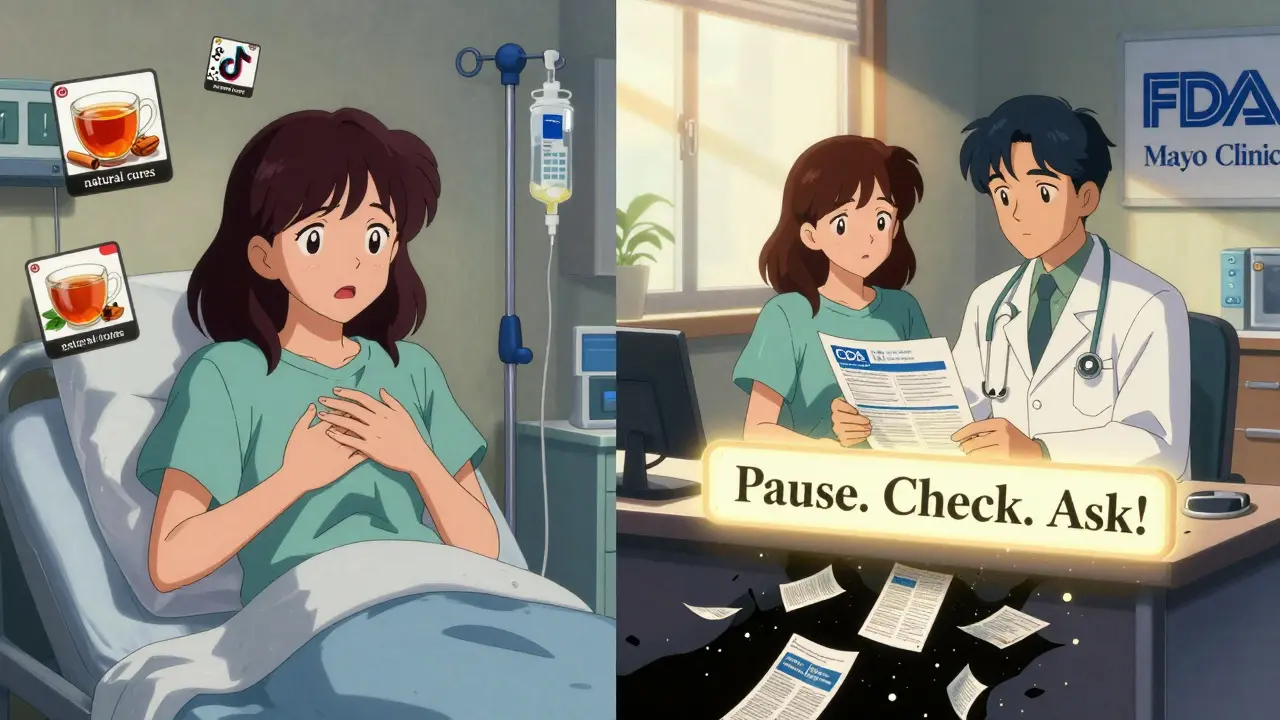
It’s not theoretical. A PubMed study found that social media misinformation affects pregnant women who take unsafe supplements based on online advice. Others have stopped taking statins because of viral videos, leading to heart attacks. One woman in Ohio replaced her insulin with cinnamon tea after watching a TikTok. She ended up in the ER with diabetic ketoacidosis.
These aren’t rare cases. They’re becoming common. And they’re preventable.
What You Can Do Today
You don’t need to quit social media. But you do need to change how you use it.
- Pause before sharing health content. Ask: "Would I say this to my mom?" If not, don’t share it.
- Turn off autoplay on health videos. Let yourself choose what to watch instead of being fed it.
- Follow at least three trusted health organizations. Let their content balance out the noise.
- Teach someone else. If you see a friend falling for a fake cure, send them a link to the FDA’s page on health scams-not a lecture.
Medication safety isn’t about being paranoid. It’s about being smart. Social media is a tool. Like any tool, it can help or hurt depending on how you use it. You have the power to protect yourself-and others-from dangerous advice. Start by asking one question before you believe anything: "Who says so, and why should I trust them?"
Can social media influencers legally give medical advice?
No. In most countries, it’s illegal for healthcare professionals to give medical advice to people they haven’t examined in person. Most influencers on social media aren’t licensed providers at all. Even if they have a medical background, sharing advice publicly without a patient-provider relationship violates ethical and legal standards. Always assume social media health advice is not legal or safe unless verified by your own doctor.
What should I do if I’ve already taken unsafe advice from social media?
Stop immediately. Don’t wait for symptoms. Contact your doctor or pharmacist and tell them exactly what you took, how much, and where you got the advice from. They can check for interactions, side effects, or risks based on your medical history. If you’re having a medical emergency, call emergency services. It’s not embarrassing to admit you followed bad advice-what matters is fixing it before it’s too late.
Are natural supplements always safer than prescription drugs?
No. "Natural" doesn’t mean safe. Many supplements interact dangerously with prescription medications. For example, St. John’s Wort can make birth control, antidepressants, and blood thinners ineffective. The FDA doesn’t test supplements for safety or effectiveness before they’re sold. That means you have no guarantee what’s in the bottle-or if it even works. Always treat supplements like medicine: talk to your doctor before using them.
How do I know if a website is a trustworthy source for medication info?
Look for .gov (like CDC.gov or FDA.gov), .edu (university sites), or major nonprofit health organizations like Mayo Clinic or Johns Hopkins. Avoid sites that sell products, have lots of ads, or use sensational headlines. Check the date-medical info changes. A page from 2018 may be outdated. Trustworthy sites update regularly and cite scientific studies.
Why do so many people believe fake health advice on social media?
It’s not just about being gullible. Social media is designed to make you feel understood. If you’re struggling with a health issue, seeing someone say "I felt the same way-then I tried this!" feels comforting. Algorithms reinforce that by showing you more of the same. Add in distrust of doctors, confusing medical jargon, and the appeal of quick fixes, and it’s easy to believe false claims-even if they contradict science.
Final Thought: Your Health Isn’t a Trend
Medication isn’t a viral challenge. It’s not a diet. It’s not a product to be promoted. It’s a tool that saves lives-when used correctly. Social media can be a great place to connect, learn, and find support. But when it comes to your pills, your dosage, or your treatment plan, your doctor and science are the only sources that matter.
Next time you see a post promising a miracle cure, don’t react. Pause. Check. Ask. Your body will thank you.

Geri Rogers - 3 February 2026
I saw a TikTok last week telling people to swap their statins for turmeric. I nearly vomited. 🤢 People, STOP. Just... stop. This isn't a detox challenge. It's your life.
Prajwal Manjunath Shanthappa - 5 February 2026
Honestly, it's appalling that the general public is so intellectually bankrupt that they believe a 19-year-old influencer with a yoga mat and a smoothie bowl knows more about pharmacology than a board-certified cardiologist... and yet, here we are.
Alex LaVey - 7 February 2026
I used to scroll through these posts thinking, 'Wow, this is so cool!' Then my aunt almost went into renal failure because she stopped her meds for 'herbal kidney cleanse.' Now I DM anyone I see sharing this stuff. Not to shame-just to say: 'Hey, I care. Let's check this with a doc first.' 💙
caroline hernandez - 7 February 2026
The cognitive dissonance here is pathological. We live in a post-evidence society where anecdotal testimony supersedes RCTs, and algorithmic reinforcement creates epistemic bubbles that are functionally identical to cult indoctrination. The lack of health literacy isn't ignorance-it's structural failure.
Jhoantan Moreira - 7 February 2026
I get it. When you're tired of feeling sick, and the system feels cold and impersonal, a friendly face saying 'just try this' feels like hope. But real hope comes with science, not sales pitches. 🙏 Let's lift each other up with facts, not fads.
Joseph Cooksey - 9 February 2026
Let’s be real: the medical industrial complex doesn’t want you to know that a $3 bottle of apple cider vinegar can do what a $500 prescription can’t-because they’re making bank off your dependency. The FDA? They’re in bed with Big Pharma. The ‘experts’ you’re told to trust? They’re paid shills. The system is rigged. And the only people who benefit? The ones selling the ‘miracle’ supplements.
Justin Fauth - 10 February 2026
America’s falling apart because we let influencers decide what’s healthy. We used to respect doctors. Now we trust a girl in leggings who says ‘I cured my anxiety with lavender oil.’ This isn’t freedom. This is national stupidity.
Sherman Lee - 11 February 2026
They’re not just selling supplements. They’re part of a global mind-control program. The WHO, CDC, FDA-they’re all in on it. They want you dependent on toxic pharmaceuticals so they can track you, tax you, and control your behavior. That ‘FDA warning’ you see? It’s a cover. The real truth is buried in 47 encrypted PDFs on a dark web forum only the enlightened can find. 🕵️♂️
Coy Huffman - 11 February 2026
i used to think all this was just dumb... until my cousin took that 'natural insomnia cure' and ended up in the psych ward. now i just send people the mayo clinic link and say 'read this before you do anything.' no drama. just facts. and a little love. 🤗
Amit Jain - 13 February 2026
Simple rule: if it sounds too good to be true, it is. No magic pills. No instant cures. Medicine takes time. Patience. And a real doctor.
Keith Harris - 14 February 2026
Oh wow, another ‘wake up sheeple’ lecture. Let me guess-you’re the kind of person who also thinks vaccines cause autism and that the moon landing was faked? You’re not educating people. You’re just feeding your own ego with performative outrage. Grow up.
Kunal Kaushik - 16 February 2026
My grandma used to say, 'If it ain't broke, don't fix it.' She took her meds every day, never listened to influencers, and lived to 94. Sometimes the old ways are the right ways. 🙏
Mandy Vodak-Marotta - 16 February 2026
Okay but can we talk about how the algorithm is literally weaponized? I followed one post about magnesium for anxiety, and now my feed is 90% detox teas, 'cancer cures,' and people claiming they reversed type 2 diabetes with lemon water. I didn’t even *want* this. It just... kept coming. I had to unfollow 37 accounts. I’m not even mad. I’m just... exhausted.
Nathan King - 17 February 2026
The erosion of epistemic authority in public discourse is a profound sociological phenomenon. The conflation of personal testimony with clinical evidence represents a fundamental breakdown in the epistemological foundations of health communication.
Harriot Rockey - 19 February 2026
I teach high school health. Last week, a kid told me his mom stopped her blood thinner because a TikTok said it 'thins the blood too much.' I showed him the CDC page. He cried. He said, 'I didn’t know she could die.' We need more of this. Not just posts. Real conversations. With real people. 💬❤️