

If you're taking levothyroxine for hypothyroidism and you love tofu, soy milk, or edamame, you're not alone-but you might be affecting how well your medication works. This isn't about cutting soy out of your diet. It’s about timing. The science is clear: soy can block your thyroid medication from being absorbed properly. But with the right routine, you can enjoy your favorite plant-based foods without risking your thyroid health.
Why Soy Interferes with Thyroid Medication
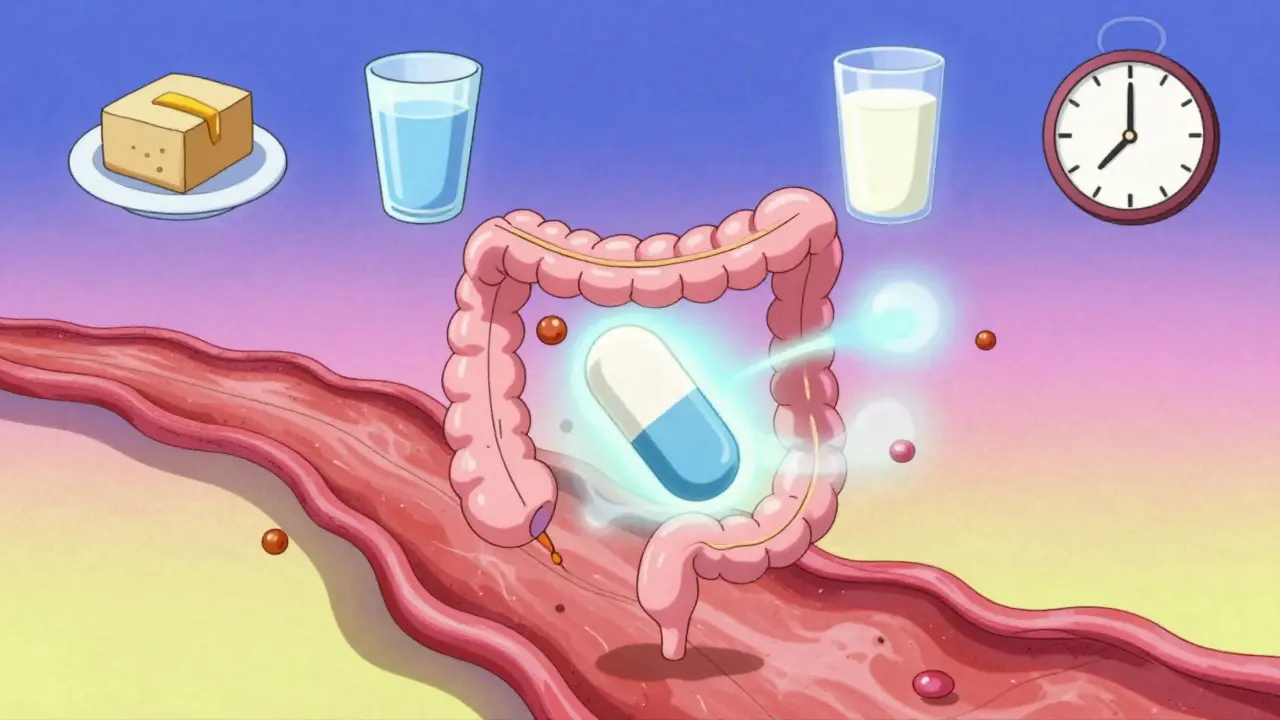
Levothyroxine, the most common treatment for hypothyroidism, needs to be absorbed in your small intestine to work. Soy contains compounds called isoflavones-mainly genistein and daidzein-that bind to the medication in your gut. This binding prevents your body from absorbing enough of the hormone. Studies show this can reduce absorption by 9% to 30%, depending on how much soy you eat and when you eat it. The effect isn’t just theoretical. In the 1960s, doctors noticed babies with congenital hypothyroidism on soy formula needed much higher doses of levothyroxine than those on regular formula. Fast forward to today, and we see the same pattern in adults. A 2006 case report in the Journal of Clinical Endocrinology & Metabolism described a woman who needed to increase her levothyroxine dose by 50% after starting daily soy protein shakes. Her TSH levels jumped from normal to high-until she stopped consuming soy within an hour of taking her pill. It’s not soy itself that causes hypothyroidism. People who eat soy regularly don’t develop thyroid problems if their thyroid is healthy. But if you’re already on medication to replace thyroid hormone, soy can make your dose less effective.How Much Soy Is Too Much?
Not all soy is created equal. The amount and form of soy matter a lot. - Whole soy foods like tofu, tempeh, edamame, and soy milk have the strongest effect. They contain high levels of protein and isoflavones that bind tightly to levothyroxine. - Soy protein isolates-used in shakes, bars, and meat substitutes-are even more concentrated. One study found they reduced absorption by up to 30% when taken at the same time as medication. - Soy isoflavone supplements (pills or powders) have less impact than whole foods. But they still interfere, especially if taken within an hour of your pill. A 2019 meta-analysis of 18 studies involving over 3,600 people found that soy only raised TSH (the hormone that signals your thyroid is underactive) by a tiny amount-0.35 mIU/L-on average. But that small rise matters if you’re already struggling to keep your levels stable.Timing Is Everything
The good news? You don’t have to give up soy. You just need to separate it from your medication. Research shows that the interference drops sharply when you wait: - Within 1 hour of taking levothyroxine: Absorption drops by up to 30%. This is the riskiest window. - 2 hours after: Interference falls to around 9-12%. Many people can manage fine with this gap. - 3-4 hours after: Almost no effect. This is the safest approach, especially for children or those with unstable thyroid levels. In March 2023, the Mayo Clinic updated its guidelines based on new research. For most adults, waiting just 2 hours between taking levothyroxine and eating soy is enough. But for children, pregnant women, or anyone with recent dose changes, they still recommend 3-4 hours.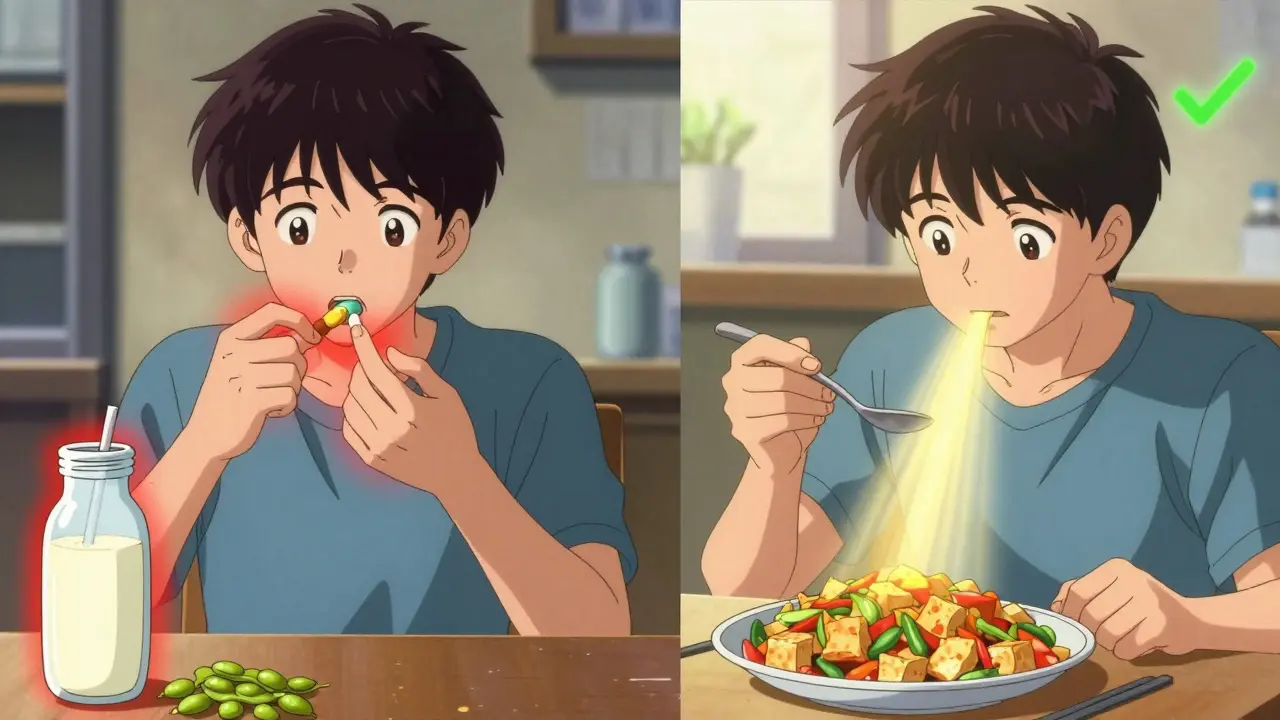
How Other Foods Compare
Soy isn’t the only thing that messes with levothyroxine absorption. Here’s how it stacks up:| Substance | Absorption Reduction | Recommended Separation Time |
|---|---|---|
| Calcium supplements | 25-36% | 4 hours |
| Iron supplements | 30-40% | 4 hours |
| Soy products | 9-30% | 2-4 hours |
| High-fiber foods (bran, psyllium) | 15-20% | 3-4 hours |
| Coffee | ~20% | 60 minutes |
Real-Life Stories
People’s experiences vary wildly. On Reddit’s r/Thyroid community, one user reported her TSH jumped from 1.8 to 5.2 after switching to soy milk with breakfast. Her doctor raised her dose from 75 mcg to 100 mcg. Another user has taken Synthroid with soy milk every morning for five years-no change in TSH. Her endocrinologist says timing matters more than avoidance. A 2023 Healthline survey of 1,200 hypothyroid patients found: - 42% had no issues with soy if they waited 2+ hours - 31% needed a dose increase after eating soy within 1 hour - 27% didn’t even realize soy could interfere until their doctor mentioned it The key takeaway? Your body might handle soy just fine. But if your TSH starts creeping up, soy timing is one of the first things to check.Best Practices for Daily Life
Here’s what works for most people:- Take levothyroxine on an empty stomach with a full glass of water. Wait at least 60 minutes before eating anything else.
- Avoid soy for 2-4 hours after your dose. If you take it in the morning, don’t have tofu at breakfast. Save it for lunch or dinner.
- Consider bedtime dosing. If you take your pill at night, 2 hours after your last meal, soy in the evening won’t interfere. Many endocrinologists now recommend this for patients who struggle with morning routines.
- Be consistent. If you take your pill at 7 a.m. one day and 10 p.m. the next, your body gets confused. Stick to the same time.
- Don’t rely on labels. Most drug inserts just say “take on empty stomach.” They rarely mention soy. Ask your doctor for specifics.
Special Cases
- Infants and children: Soy formula can require 15-30% higher levothyroxine doses. Pediatric endocrinologists almost always recommend avoiding soy unless absolutely necessary. - Vegetarians and vegans: A 2022 survey found 74% of plant-based eaters with hypothyroidism received counseling on soy interactions-up from 42% in 2015. Many switch to almond, oat, or rice milk as a simple workaround. - Pregnant women: Thyroid needs increase during pregnancy. Even small drops in absorption can affect fetal development. Stick to 4-hour separation unless your doctor says otherwise. - People with subclinical hypothyroidism (TSH >4.5 mIU/L): Soy’s effect is stronger here. A 2019 study showed TSH rose significantly only in this group.What to Do Next
If you’re on levothyroxine and eat soy:- Check your last TSH level. Was it above 3.0? If yes, soy timing could be a factor.
- Track your soy intake. When do you eat it? How soon after your pill?
- Try moving soy to later in the day. Wait 2-3 hours after your medication.
- Re-test your TSH in 6-8 weeks. A drop of 1-2 points is a good sign.
- If levels stay high, ask your doctor about switching to bedtime dosing.
Can I eat soy if I take levothyroxine at bedtime?
Yes. If you take levothyroxine at night, 2 hours after your last meal, you can eat soy earlier in the day without interference. Many people find this easier than waiting 3 hours after a morning dose. Just make sure you don’t eat soy within 2 hours of taking your pill.
Does cooked soy interfere less than raw soy?
No. Cooking doesn’t break down the isoflavones enough to prevent interference. Tofu, tempeh, and soy milk-even when heated-still bind to levothyroxine. The form matters more than how it’s prepared.
What if I accidentally eat soy right after my pill?
One mistake won’t ruin your treatment. But if it happens often, your TSH may rise over time. If you forget and eat soy within an hour, don’t take another pill. Wait until your next scheduled dose. Monitor your TSH in 6-8 weeks. If it’s higher than usual, talk to your doctor about adjusting your routine.
Are all soy products equally problematic?
No. Whole soy foods like tofu and soy milk have the strongest effect. Soy sauce, miso, and soy oil contain very little isoflavone and are unlikely to interfere. Stick to avoiding concentrated sources: soy milk, tofu, edamame, soy protein powder, and soy-based meat alternatives.
Should I stop soy completely?
No. Soy doesn’t cause thyroid disease, and it’s a healthy protein source. Complete avoidance isn’t necessary or recommended unless your doctor sees a clear, repeated pattern of rising TSH linked to soy intake. Timing is the solution-not elimination.

Philip Blankenship - 17 February 2026
Just took my levothyroxine at 7 a.m. and had my soy latte at 8:15. Felt fine. My TSH’s been stable for two years. Maybe this whole soy thing is overhyped? I mean, if it were that big a deal, why don’t drug labels scream about it? I’ve seen more warnings on protein powder than on tofu.
Also, I take mine with water, wait an hour, then eat oatmeal with almond butter. No soy. But I’m not mad at people who do. Just don’t panic. Your body’s not a chemistry set.
Carrie Schluckbier - 17 February 2026
Oh wow. So soy is secretly controlled by Big Pharma to keep people dependent on synthroid? I knew it. They’ve been poisoning our food chain with isoflavones since the 80s. Did you know the FDA approved soy formula in 1967? That’s the same year they started pushing thyroid meds. Coincidence? I think not.
Also, I read somewhere that glyphosate in soy binds to the thyroid. That’s why everyone’s hypothyroid now. It’s not the meds-it’s the system. Wake up, sheeple.
Prateek Nalwaya - 17 February 2026
Man, I love how this post breaks it down without fearmongering. It’s rare to see a medical topic that doesn’t end with ‘STOP EATING SOY NOW’ or ‘THIS IS A CONSPIRACY.’
As someone who’s been vegan for 12 years and on levothyroxine since 2018, I switched from soy milk to oat milk just because I got lazy and forgot the timing. Turns out my TSH didn’t budge. Maybe I’m lucky. Or maybe timing really is everything.
Also, I never knew soy sauce was safe. That’s a game-changer. Now I can finally enjoy my ramen without guilt.
Adam Short - 18 February 2026
So let me get this straight. In Britain, we’ve been eating soy for decades and no one’s dropping like flies. But here in the US, we’re acting like tofu is the new aspartame? I’ve got a cousin in London who eats edamame with her Synthroid and she’s got the thyroid of a 20-year-old.
Maybe the real issue isn’t soy-it’s the American obsession with perfecting every damn thing. Chill out. Eat your tofu. Take your pill. Wait two hours. Done.
guy greenfeld - 20 February 2026
There’s a deeper truth here, you know. The body doesn’t care about levothyroxine or soy isoflavones. It cares about alignment. The modern world fractures us-our meals, our rhythms, our connection to nature. We’re told to take a pill at 7 a.m. and avoid soy until 11 a.m. like we’re in a prison schedule.
But what if the real problem is that we’ve lost the sacredness of routine? What if the answer isn’t timing, but presence? When you eat with awareness, when you take your medicine with reverence, does the body not respond differently?
Perhaps the soy is just a mirror. Reflecting our disconnection.
Digital Raju Yadav - 21 February 2026
India produces 80% of the world’s soybeans. And now Americans are panicking over tofu? Typical. You people can’t even handle a plant-based protein without turning it into a medical emergency.
My uncle in Pune takes his thyroid meds with soy milk every morning. He’s 72. Active. No issues. You’re all overreacting because you don’t know how to cook. Grow a spine. Eat the food. Time it right. Don’t turn your diet into a spreadsheet.
Kancharla Pavan - 21 February 2026
Let me tell you something. I’ve been on levothyroxine for 8 years. I used to eat soy at breakfast. My TSH went from 2.1 to 6.8. I thought I was fine. Then I read this. I changed my routine. Waited 4 hours. Cut out all soy protein shakes. My TSH is now 1.9. I’m not some miracle worker. I just followed the science.
People who say ‘it doesn’t matter’ are either lying or they’re lucky. You don’t get to gamble with your thyroid. This isn’t a suggestion. It’s a biological law. You want to live? Listen. Don’t be a hero. Don’t be a rebel. Just wait. Two hours. Minimum. Three if you’re serious.
Linda Franchock - 22 February 2026
So I took my pill at 7 a.m., had tofu scramble at 8 a.m., and my TSH jumped. Then I switched to bedtime dosing. Took it at 10 p.m., had soy at lunch. TSH dropped. Boom. Problem solved.
Also, I used to think I was ‘doing everything right’ until I realized I was taking my pill with coffee and calcium. So yeah. Maybe I’m not the brightest bulb. But now I’m the guy who figured it out. Thanks for the post. And thanks, Reddit, for making me feel less alone.
Geoff Forbes - 24 February 2026
As a board-certified endocrinologist with 22 years of experience, I must say this article is… adequate. But it lacks nuance. The 2019 meta-analysis you cite? It pooled studies with wildly inconsistent dosing protocols. The real issue is bioavailability, not soy. And you didn’t even mention the role of gastric pH or proton pump inhibitors.
Also, your table is misleading. Calcium and iron are more problematic, yes-but soy’s effect is nonlinear and dose-dependent. If you’re eating 300g of tofu daily? You’re asking for trouble. But one glass of soy milk? Irrelevant for most. Still, I’d recommend 4 hours. Just to be safe. And please, stop using Reddit as medical authority.
Jonathan Ruth - 24 February 2026
My TSH went from 3.4 to 5.9 after I started drinking soy milk with my pill. I didn’t know. Now I know. I switched to almond milk. TSH is 2.1. Done.
People who say it doesn’t matter are the same ones who say vaccines are fake and gluten is a scam. You don’t get to ignore science because it’s inconvenient. This isn’t opinion. It’s chemistry. Wait 2 hours. Or don’t. But don’t come crying to your doctor when your levels are trash.
Agnes Miller - 25 February 2026
i took my pill at 7am and had soy yogurt at 8:15. my tsh went from 2.5 to 5.1. i didnt even know soy could do that. i switched to oat milk and waited 3 hours. now its 2.3. thanks for the info. i feel dumb but also relieved.
ps. i had no idea soy sauce was fine. now i can eat sushi again. yay.
Oliver Calvert - 25 February 2026
Bedtime dosing changed my life. Took levothyroxine at 10 p.m., had soy stir-fry at 6 p.m. No interference. No stress. No counting hours.
My endo said it’s actually preferred for people with busy mornings. Makes sense. You’re not rushing. You’re not eating breakfast while half-asleep. You’re just… sleeping. And your body absorbs it better.
Try it. It’s easier than you think.
Philip Blankenship - 27 February 2026
Just read your bedtime dosing comment. I tried it. Took my pill at 11 p.m. Had soy noodles at 6 p.m. No issues. My TSH dropped another 0.2. Honestly? This might be the best advice in the whole thread.
Thanks for sharing. I’m stealing this.