
Why do you sometimes walk out of the pharmacy with a different pill than your doctor wrote on the prescription pad? It’s not a mistake. It’s often a state law at work. Across the United States, governments are actively trying to steer patients toward generic drugs instead of expensive brand-name versions. They don’t just hope it happens; they build financial and legal structures to make it the default choice. These mechanisms are known as generic prescribing incentives.
The core idea is simple: generics save money. But getting everyone-doctors, pharmacists, insurers, and patients-to agree on which pills to use is complicated. States have developed a toolkit of strategies over the last few decades to manage this. From lists that prioritize certain drugs to laws that let pharmacists swap medications without asking, these policies shape what ends up in your medicine cabinet. Understanding how they work helps explain why your healthcare costs look the way they do today.
The Foundation: Why States Push for Generics
To understand current incentives, we have to look back at the Hatch-Waxman Act of 1984. This federal law created the pathway for generic drugs to enter the market safely and quickly. Before this, brand-name companies held monopolies for too long. The act allowed generics to launch after patents expired, sparking competition that drove prices down. However, simply having cheap options available didn't mean people would use them. Brand-name marketing was powerful, and doctors were accustomed to writing specific brand names.
States stepped in to bridge the gap between availability and usage. The primary goal has always been cost containment without sacrificing health outcomes. Generic drugs are required by the FDA to be bioequivalent to their brand-name counterparts, meaning they work the same way in the body. So, from a medical standpoint, switching is safe. The challenge is behavioral and financial. States realized they needed levers to pull to ensure that safety and savings translated into actual prescriptions filled.
| Framework | Year Established | Primary Impact on Generic Incentives |
|---|---|---|
| Hatch-Waxman Act | 1984 | Created the approval pathway for generic drugs, enabling market competition. |
| Omnibus Budget Reconciliation Act (OBRA) | 1990 | Established the Medicaid Drug Rebate Program, requiring manufacturers to pay rebates to states. |
| 340B Drug Pricing Program | 1992 | Provides discounted drug prices to safety-net providers, influencing institutional purchasing. |
Preferred Drug Lists: The Gatekeepers
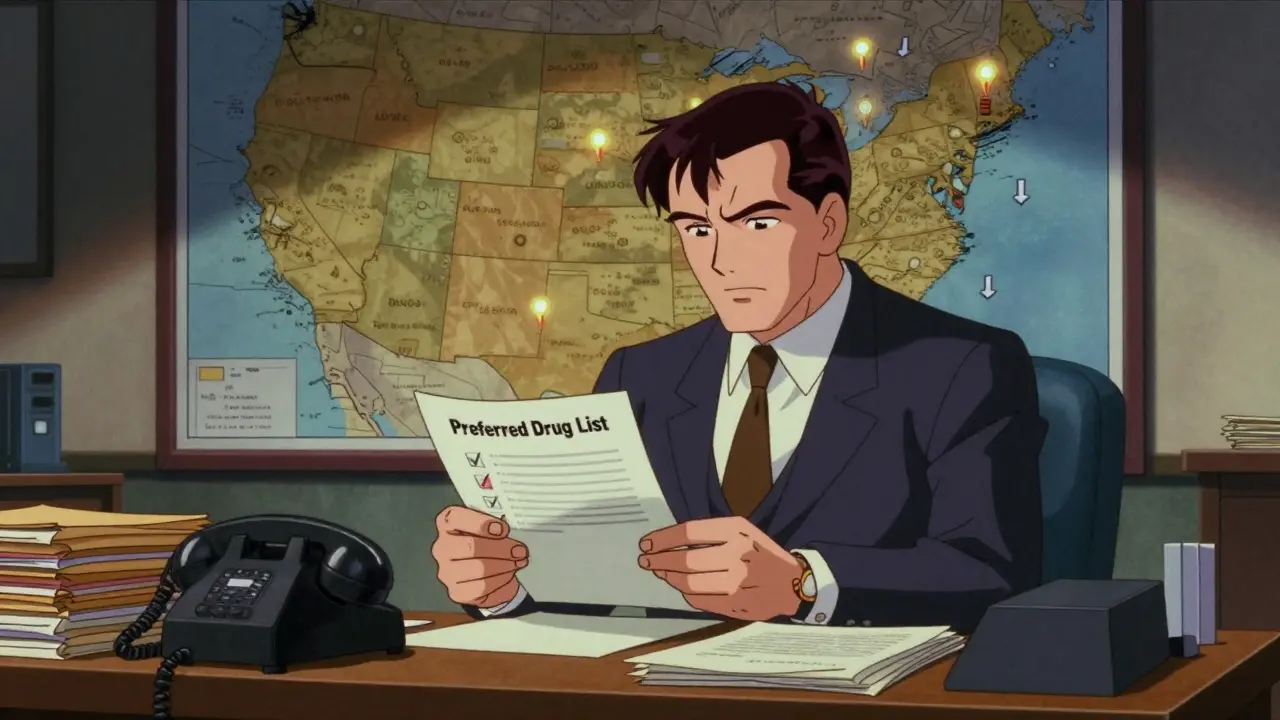
One of the most common tools states use is the Preferred Drug List (PDL). Think of a PDL as a curated menu. If a medication is on the list, it’s easy to get. If it’s not, there are hurdles. As of July 2019, 46 out of 50 states used PDLs for their Medicaid fee-for-service programs. This widespread adoption shows that states view this as a standard practice for managing drug spending.
How does a PDL actually change behavior? It usually works through two mechanisms: prior authorization and copayment differentials. If a doctor prescribes a non-preferred brand-name drug when a preferred generic exists, the patient might have to pay a higher copay. Sometimes, the insurance plan requires the doctor to fill out extra paperwork proving why the generic won’t work-a process called prior authorization. This adds friction. Doctors are busy; patients hate paying more. The path of least resistance becomes the generic option.
Who decides what goes on these lists? It varies by state. According to data from the Kaiser Family Foundation (KFF), 29 states rely on Pharmacy and Therapeutics (P&T) committees-groups of experts who review clinical evidence. Seven states leave it to the Medicaid agency itself, and six use Drug Utilization Review (DUR) boards. This structure ensures that decisions are based on medical merit and cost-effectiveness, not just arbitrary choices. Most states review these lists annually, though some do it quarterly or every six months to keep pace with new drug approvals.
Substitution Laws: The Pharmacist's Role
While PDLs influence doctors and insurers, substitution laws directly empower pharmacists. These laws dictate whether a pharmacist can replace a prescribed brand-name drug with a generic equivalent without calling the doctor or asking the patient. There are generally two types of frameworks here: explicit consent and presumed consent.
In an explicit consent system, the pharmacist must ask the patient if they want the generic. If the patient says no, the pharmacist must dispense the brand. In a presumed consent system, the pharmacist assumes the patient wants the cheaper option unless the patient explicitly opts out. The difference seems small, but the impact is massive. A study published in the National Institutes of Health (NIH) database found that presumed consent laws increase generic dispensing rates by 3.2 percentage points compared to explicit consent states.
Why does this matter? Because human nature favors the default. Asking a question creates a moment where patients might choose the brand due to habit or misinformation about quality. Presumed consent removes that friction. The NIH researchers estimated that if all 39 states with explicit consent had switched to presumed consent, total prescription drug spending in those states could drop from $297 billion to $246 billion annually. That’s $51 billion in potential savings. This suggests that policy changes aimed at the point of sale-the pharmacy counter-can be just as effective as those targeting doctors.
Financial Levers: Rebates and Copays
Beyond lists and substitution rules, money talks. The Medicaid Drug Rebate Program (MDRP), established in 1990, is the backbone of state-level financial incentives. It requires drug manufacturers to pay rebates to state Medicaid programs. For generic drugs, the base rebate is set at a minimum of 13% of the Average Manufacturer Price (AMP). This gives states a baseline return on their purchases.
But states don't stop there. They negotiate supplemental rebates. KFF’s 2020 survey showed that 46 states negotiated these additional discounts for preferred agents on their PDLs. Essentially, states tell manufacturers: "If you want your drug to be the preferred option on our list, give us a better deal." This creates a competitive bidding environment among manufacturers, even for generics, driving prices further down.
Patient-facing financial incentives also play a role. Copayment differentials mean patients pay less for generics than for brands. While the direct savings to the patient might seem modest, it signals value. When patients see a lower price tag, they are more likely to accept the generic. Interestingly, research from the Department of Health and Human Services (HHS) noted that efforts targeting pharmacists alone are less successful than those imposing incentives on consumers. This highlights the importance of combining provider-side rules (like substitution laws) with patient-side nudges (like lower copays).
Challenges and Unintended Consequences
No policy is perfect, and generic prescribing incentives face significant headwinds. One major issue is the complexity of rebate calculations. Avalere Health identified scenarios where generic manufacturers face inflation rebates even when they haven't raised prices. Factors like seasonal fluctuations or input cost increases can trigger these rebates, making some generic products unprofitable for manufacturers to sell in Medicaid. When a drug becomes unprofitable, manufacturers may withdraw it from the market, leading to shortages. This paradoxically hurts the very cost-containment goals states are trying to achieve.
Another challenge lies in the 340B Drug Pricing Program. This program provides discounted drugs to safety-net providers like community health centers. While it saves these entities money, it complicates state reimbursement models. The Centers for Medicare & Medicaid Services (CMS) had to clarify regulations in 2016 to ensure states reimbursed pharmacies correctly without exceeding the 340B ceiling price. Navigating Actual Acquisition Cost (AAC) methodologies remains a headache for state agencies, requiring sophisticated infrastructure to track and calculate payments accurately.
Furthermore, the rise of high-cost specialty drugs threatens to offset gains made in generic utilization. Even as generic prescription rates grew from 33% in 1993 to 45% in 1998, the overall share of spending on generics decreased because new, expensive brand-name drugs entered the market. States must constantly adjust their PDLs and incentive structures to keep up with pharmaceutical innovation, ensuring that cost containment doesn't stall as treatments become more complex.
The Future: Standardization and Sustainability
Looking ahead, states are exploring ways to simplify and sustain these incentives. The federal government is developing the Medicare $2 Drug List Model, which aims to standardize cost-sharing for low-cost generics in Medicare Part D. While currently voluntary and specific to Medicare, this model could serve as a template for states. Simplifying cost-sharing makes it easier for patients to understand and trust the system, potentially increasing adherence to generic therapies.
Copay adjustment programs are also evolving. As of spring 2022, only 15 states and Puerto Rico had specific laws addressing these programs, according to the National Conference of State Legislatures. These programs allow patients to pay no more than the generic copay amount even if they receive a brand-name drug that is clinically necessary. Expanding such protections could reduce patient burden while maintaining cost controls.
Sustainability will depend on balancing immediate savings with long-term market health. If rebate structures drive generic manufacturers out of business, states lose the competition that keeps prices low. Policymakers must monitor metrics like product withdrawals and shortage frequencies closely. The trajectory points toward more sophisticated approaches that integrate data analytics to predict market shifts and adjust incentives dynamically. By learning from past successes and pitfalls, states can continue to leverage generic prescribing incentives to keep healthcare affordable for millions of Americans.
What is a Preferred Drug List (PDL)?
A Preferred Drug List is a catalog of medications that a state’s Medicaid program or private insurer encourages its members to use. Drugs on the list typically have lower copayments and fewer administrative hurdles, such as prior authorization requirements, compared to non-preferred alternatives.
How do substitution laws affect my prescription?
Substitution laws determine whether a pharmacist can replace a brand-name drug with a generic one without explicit permission. In states with 'presumed consent' laws, the pharmacist will automatically dispense the generic unless you specifically request the brand name. This leads to higher generic usage and lower costs for patients and insurers.
Why do states negotiate supplemental rebates?
States negotiate supplemental rebates to secure deeper discounts from drug manufacturers beyond the federal minimum. By offering preferred status on their PDLs, states create leverage to demand lower prices, which helps contain overall Medicaid spending.
Are generic drugs as effective as brand-name drugs?
Yes. The FDA requires generic drugs to be bioequivalent to their brand-name counterparts, meaning they contain the same active ingredients, work the same way in the body, and meet the same quality standards. The main differences are usually in inactive ingredients and price.
What is the Hatch-Waxman Act?
The Hatch-Waxman Act of 1984 is a federal law that streamlined the approval process for generic drugs while protecting patent rights for innovator companies. It established the framework for modern generic competition, allowing generics to enter the market once patents expire, which significantly reduced drug prices.
How does the 340B program relate to generic incentives?
The 340B program provides discounted drug prices to eligible safety-net providers. While primarily focused on institutional savings, it influences state reimbursement policies and generic utilization patterns within these clinics. States must navigate complex reimbursement rules to ensure they pay pharmacies fairly without exceeding the 340B ceiling price.
Can generic manufacturers withdraw drugs from the market?
Yes. Complex rebate structures can sometimes make generic drugs unprofitable for manufacturers, especially if inflation rebates are triggered without corresponding price increases. This can lead to product withdrawals and shortages, undermining the goal of consistent access to affordable medications.
What is the Medicare $2 Drug List Model?
This is a proposed federal initiative to standardize cost-sharing for low-cost generic drugs in Medicare Part D plans. It aims to simplify expenses for beneficiaries by capping copays at $2 for select generics, potentially serving as a model for state-level simplification efforts.