

Vancomycin Infusion Rate Calculator
Safe Vancomycin Infusion Calculator
Calculate the minimum infusion time based on FDA guidelines to prevent vancomycin flushing syndrome. Never infuse faster than 10 mg per minute.
Recommended Infusion Rate
Minimum Infusion Time
Important: Vancomycin infusion reaction is NOT an allergy. It's caused by infusing too quickly (over 10 mg/min). The reaction can occur on the first dose and is completely preventable by slowing the infusion.
When you hear the word vancomycin, you might think of it as a powerful last-resort antibiotic for serious infections like MRSA. But there’s another side to this drug-one that many patients and even some clinicians still don’t fully understand. It’s not an allergy. It’s not life-threatening in most cases. And it’s completely preventable. This is the story of what really happens when vancomycin hits the vein too fast.
What’s Really Going On? It’s Not an Allergy
For decades, doctors called it "red man syndrome." The name stuck because of the bright red rash that often appeared on the face, neck, and upper chest during or right after an infusion. But that term is outdated, offensive, and misleading. Today, medical guidelines from UCSF, the Infectious Diseases Society of America, and StatPearls all use "vancomycin infusion reaction" or "vancomycin flushing syndrome." Why? Because this isn’t an allergic reaction at all.
True allergies involve your immune system. They need prior exposure. They’re driven by IgE antibodies. Vancomycin doesn’t work that way. Instead, it directly triggers mast cells and basophils to dump histamine into your bloodstream. Think of it like accidentally poking a beehive-you don’t need to have been stung before to get swarmed. That’s why this reaction can happen the very first time someone gets vancomycin. And that’s why it’s not listed as a "drug allergy" in modern electronic health records.
A 2021 study from Hospital Pediatrics reviewed over 21,000 patient records and found that more than 60% of vancomycin "allergy" entries still used the old term. After a formal change in terminology across one hospital system, that number dropped by 17% in just three months. The shift matters. Mislabeling this as an allergy can lead to unnecessary avoidance of vancomycin, forcing doctors to use less effective or more toxic alternatives.
What Does It Feel Like?
The symptoms are unmistakable if you’ve experienced them. Within 15 to 45 minutes of starting the infusion, you might feel:
- A warm, burning sensation across your face and chest
- Intense flushing-your skin turns bright red, almost like a bad sunburn
- Itching or tingling, especially on the neck and upper back
- A rapid heartbeat or mild dizziness
In more severe cases, people report chest tightness, muscle spasms, or even low blood pressure. But here’s the key difference from true anaphylaxis: you won’t get wheezing, throat swelling, or trouble breathing. Those signs point to something else entirely-like a real IgE-mediated reaction, which is extremely rare with vancomycin.
A 2022 UCSF guideline studied 198 patients labeled as allergic to vancomycin. Only 3% had true anaphylaxis. Another 4% had other serious skin reactions like DRESS or SJS. The rest? Over 90% had the flushing reaction. That’s not an allergy. That’s a pharmacological side effect.
Why Does It Happen? Speed Is the Culprit
The trigger isn’t the dose. It’s the speed.
Back in 1988, a landmark study in The Journal of Infectious Diseases gave 11 healthy volunteers 1,000 mg of vancomycin over one hour. Eighty-two percent of them had a noticeable reaction. When they gave the same dose over two hours? Zero reactions. The researchers measured histamine levels in the blood-when the infusion rate exceeded 10 mg per minute, histamine spiked. The faster the drip, the worse the flush.
Today, the rule is simple: never infuse vancomycin faster than 10 mg per minute. That means a 1-gram dose should take at least 100 minutes. Most hospitals now use IV pumps to control this automatically. But in urgent settings-emergency rooms, ICUs, or rural clinics-some still rush it. And that’s when reactions happen.
Here’s a real-world example: a 68-year-old man admitted with sepsis gets 1 gram of vancomycin over 30 minutes because the nurse is busy. Ten minutes in, his face turns crimson. His heart races. He feels like he’s going to pass out. The infusion is stopped. Within 20 minutes, he’s fine. No steroids. No epinephrine. Just slower infusion next time.
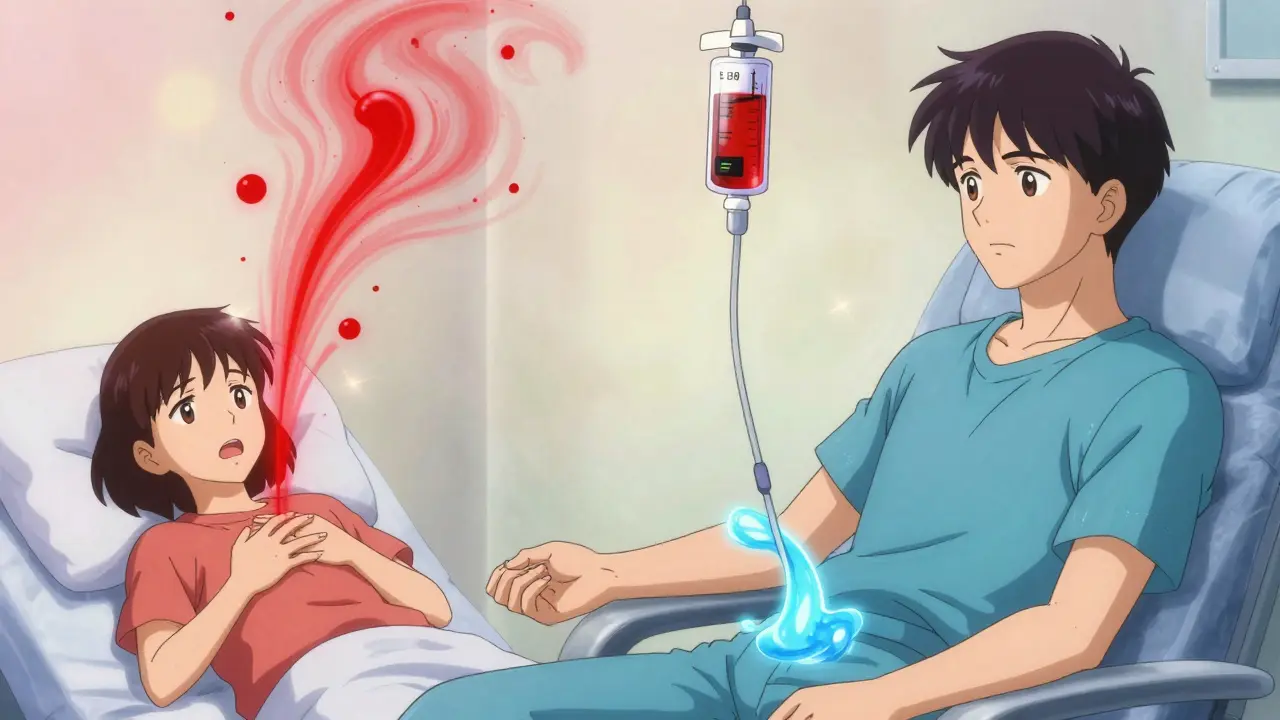
Can You Prevent It?
Yes. And you don’t need to pre-medicate.
For years, many hospitals automatically gave patients diphenhydramine (Benadryl) or ranitidine before vancomycin. The idea was to block histamine. But a 2018 study in the Journal of Hospital Medicine found no benefit for first-time users. If you’ve never had a reaction before, pre-medication adds no protection. It just adds side effects-drowsiness, dry mouth, confusion in older adults.
The real prevention? Slowing the infusion. That’s it. If a patient has had a reaction before, then yes-consider pre-treatment with an H1 blocker (like diphenhydramine) and an H2 blocker (like famotidine). But even then, the infusion must still be given slowly. Medication alone won’t fix a fast drip.
Also avoid mixing vancomycin with other histamine-releasing drugs. Opioids like morphine, muscle relaxants like succinylcholine, and even some contrast dyes can make things worse. Give them separately, with time between doses.
What If It Happens Anyway?
If a patient starts flushing during an infusion:
- Stop the infusion immediately.
- Notify the medical team. Don’t assume it’s "just a reaction." Assess for signs of true anaphylaxis or other serious reactions.
- Keep the IV line open with saline. Don’t remove the catheter-you may need to give fluids or medications.
- Monitor vital signs. Blood pressure and heart rate usually dip slightly, then recover.
- Wait 30 minutes. Symptoms almost always fade on their own.
- Resume vancomycin later, but at half the rate-no more than 5 mg per minute.
There’s another interesting twist: people often have milder reactions on the second or third dose. That’s called tachyphylaxis. Your body seems to adapt. The histamine release drops. This isn’t immunity. It’s just physiology. So if someone had a bad reaction once, don’t assume they’ll always have one.

Other Drugs That Do the Same Thing
Vancomycin isn’t alone. Other antibiotics and drugs can cause similar flushing reactions:
- Amphotericin B - used for fungal infections. Triggers histamine release via complement activation.
- Rifampin - an anti-TB drug. Causes reactions through toxic metabolites that bind to skin cells.
- Ciprofloxacin - a fluoroquinolone. Rare, but documented cases of flushing and itching.
If a patient gets flushed after one of these drugs, the same rules apply: slow the infusion. Don’t panic. Don’t label it an allergy. Just adjust the rate.
Why Terminology Matters
Calling it "red man syndrome" isn’t just outdated-it’s harmful. The term originated in the 1970s when vancomycin was first widely used. It was a descriptive phrase, yes, but it also carried racial connotations that have no place in modern medicine. A 2021 study in Hospital Pediatrics called it "racist" and led a formal campaign to remove it from all clinical documentation.
Dr. Christina M. Lepore and her team at UCSF replaced every instance of "red man syndrome" in their electronic records with "vancomycin flushing syndrome." Within three months, the number of new records using the old term dropped from 61.6% to 44.6%. That’s progress. But it’s not enough. The American Academy of Allergy, Asthma & Immunology and Harvard’s FXB Center for Health and Human Rights have both endorsed this change. Terms like this don’t just mislead-they deepen health disparities.
When a patient is labeled "allergic to vancomycin" because of a flushing reaction, they may be denied the best treatment for a life-threatening infection. That’s not just a medical error. It’s a safety risk.
Bottom Line
Vancomycin is a lifesaver. But it’s not harmless. The flushing reaction isn’t rare. It’s predictable. And it’s entirely preventable.
If you’re a clinician: slow the drip. Don’t pre-medicate unless there’s a history. Don’t call it "red man syndrome." Document it accurately.
If you’re a patient: if your skin turns red during an infusion, speak up. Tell the nurse. It’s not an allergy. It’s a warning sign that the medicine is going in too fast. You can still get the treatment-you just need it slower.
The science is clear. The fix is simple. And the language? It’s time to leave "red man syndrome" in the past.
Is vancomycin infusion reaction the same as an allergy?
No. Vancomycin infusion reaction is not an allergy. It’s an anaphylactoid reaction caused by direct histamine release from mast cells. Allergies involve the immune system and require prior exposure. This reaction can happen the first time you get vancomycin and doesn’t involve IgE antibodies.
Can you prevent vancomycin flushing syndrome?
Yes. The most effective prevention is slowing the infusion rate to 10 mg per minute or slower. For a 1-gram dose, that means giving it over at least 100 minutes. Pre-medication with antihistamines isn’t needed for first-time users and should only be considered if you’ve had a prior reaction.
Why is "red man syndrome" no longer used?
The term "red man syndrome" is considered outdated and racially insensitive. Medical institutions, including UCSF and the Infectious Diseases Society of America, now use "vancomycin infusion reaction" or "vancomycin flushing syndrome." A 2021 study showed that replacing the old term reduced its use in medical records by 17% in just three months.
Does this reaction get worse with repeated doses?
No-usually it gets better. Many patients experience milder reactions on subsequent doses, a phenomenon called tachyphylaxis. The body appears to adapt, releasing less histamine. This is why slowing the infusion rate remains the best strategy, even for patients who had a reaction before.
What should you do if you start flushing during a vancomycin infusion?
Stop the infusion immediately. Notify the medical team. Keep the IV line open with saline. Monitor vital signs. Symptoms usually resolve within 30 minutes. Once symptoms clear, the infusion can be restarted at half the original rate-no faster than 5 mg per minute.




Cory L - 23 February 2026
I've seen this a dozen times in the ER. Patient comes in screaming like they're getting burned alive, nurse panics, stops the drip, calls for a code. Then you check the chart and boom - 500mg in 15 minutes. No wonder people think it's an allergy. Just slow it down. It's not rocket science. Seriously, if you can't count to 100 while giving vancomycin, maybe don't work in med-surg.
Bhaskar Anand - 24 February 2026
This is why Indian hospitals still use rapid infusions because nurses are overworked and doctors dont care. We dont have time to wait 100 minutes for one antibiotic. If the patient cant handle it then give them something else. Why make everything so complicated. We dont need fancy terms like vancomycin flushing syndrome. Just say it hurts and move on.
William James - 26 February 2026
I love how this piece reframes the whole thing. It’s not about fear or labeling. It’s about respect. For the drug. For the patient. For the science. I’ve worked in rural clinics where they’d rush vancomycin because the IV pump was broken and the next shift was coming in. We didn’t have a choice. But now? We fix the pump. We wait. We listen. And honestly? That’s what healing looks like. Not just curing. Listening. Slowing down. It’s a quiet revolution.
David McKie - 27 February 2026
Oh great. Another ‘woke’ medical article. They removed ‘red man syndrome’ because it was ‘racist’? What’s next? ‘Chest pain’ becomes ‘cardiac discomfort experience’? This is why medicine is dying. We used to treat patients. Now we treat their feelings. If the patient turns red and itches? Stop the drip. Done. No need to rename it. No need to lecture. Just fix the problem. Stop the drama.
Southern Indiana Paleontology Institute - 27 February 2026
I work in a small hospital. We dont have pumps. We use gravity. So we tie a knot in the line to slow it down. My nurses call it the "knot trick". Works every time. One guy got flushed so bad he yelled "I'm turning into a lobster!" We laughed. Then we slowed it down. No Benadryl. No drama. Just a knot. Simple. Real. Effective.
Anil bhardwaj - 28 February 2026
I read this after my uncle had this reaction. He was scared he was having an allergic attack. But the nurse just said "hold on, it's just the speed" and slowed it. He was fine in 20 minutes. Now he's like "why didn't anyone tell me this before?" I think this info should be on every hospital pamphlet. Not just for docs. For patients too.
lela izzani - 28 February 2026
As a nurse, I can’t tell you how many times I’ve had to explain this to families. They think "allergy" means the drug is dangerous. But it’s not. It’s just a fast drip. I always say: "Imagine pouring hot coffee too quickly into a paper cup. It spills. That’s what’s happening here. Slow it down. No need to panic." And guess what? They get it. Every time.
Joanna Reyes - 28 February 2026
I’ve been on both sides of this - as a patient and as a clinician. Once, I got vancomycin too fast. Felt like my skin was on fire. I didn’t say anything because I thought I was dying. Then I became a nurse and realized how common it was. Now, when I give vancomycin, I sit with the patient. I say, "You might feel warm, maybe a little flushed. That’s normal. It’s not an allergy. Just let me know." And I watch their face. The moment they realize it’s not life-threatening? The relief is palpable. It’s not just medicine. It’s trust.
John Smith - 2 March 2026
Wow. Another 2000-word essay on how to give an IV. Groundbreaking. I’m sure the world was waiting for this. Next up: "The Surprising Truth About Aspirin: Don’t Crush It Unless You Want to Taste the Powder."
Shalini Gautam - 3 March 2026
In India, we call it "vancomycin flush" and everyone knows what it means. No drama. No renaming. Just slow it. My brother got it once, we laughed, we slowed it, he was fine. Why make it complicated? We dont need American medical jargon to fix a simple problem.
Natanya Green - 4 March 2026
I had this happen to me during chemo! I thought I was having an allergic reaction and cried so hard! The nurse came in and said "oh honey, that's just the vancomycin being a drama queen" and slowed it down. I was like...wait, what? It felt like a horror movie. Then I felt like a total drama queen. So now I say "vancomycin flushing syndrome" with a smirk. It's funny. It's real. And it saved my life.
Steven Pam - 5 March 2026
I’ve been giving vancomycin for 18 years. I’ve seen it all. The panic. The mislabeling. The unnecessary avoidance. I started a mini-education program in my unit. Handouts. A 90-second video. Now our reaction rate dropped by 80%. People think it’s about drugs. It’s not. It’s about communication. Slowing the drip. Slowing the fear. Slowing the stigma. That’s the real medicine.
Timothy Haroutunian - 5 March 2026
I read the whole thing. Twice. And honestly? I’m tired of being told what to think. The term "red man syndrome" was descriptive. It was visual. It was accurate. Now we’re replacing it with this over-polished, clinical jargon that sounds like it was written by a marketing intern. Who decided we needed to sanitize every word? What’s next? "Fever" becomes "temperature elevation event"? This isn’t progress. This is performance.
Brandice Valentino - 5 March 2026
i was in the er last week and the nurse said "oh this is red man syndrome" and i was like wait is that racist?? and then i looked it up and now i feel weird. like i’m mad at a word i didn’t even know existed. but also… i kinda get it? like… maybe we should just say "flushing"? idk. im confused. but the slow drip thing makes sense. i think.
Larry Zerpa - 6 March 2026
Let’s be real. The entire premise of this post is a distraction. Vancomycin is toxic. It’s nephrotoxic. It’s ototoxic. It causes C. diff. And now we’re having a semantic debate about a flushing reaction? That’s like arguing whether to call a car crash a "collision" or a "vehicle impact event" while ignoring the fact that no one’s wearing seatbelts. Fix the system. Don’t rename the symptom.