
Drug Contraindication Checker
Check Your Medication Safety
Enter your health conditions and the medication you're taking to see if there are any contraindications or warnings.
Results
Understanding Your Results
A Contraindication means you should not take this medication under any circumstances. A Warning means the medication carries risks that require careful monitoring.
When you pick up a prescription or even an over-the-counter medicine, the label isn’t just instructions-it’s a safety manual. But most people skim it like a receipt. That’s dangerous. The drug labels you ignore could be the difference between staying safe and ending up in the hospital. The FDA requires every drug to include clear contraindications and warnings, yet studies show only 30% of patients truly understand them. Here’s how to read them right-no medical degree needed.
What’s the Difference Between Contraindications and Warnings?
Contraindications and warnings aren’t the same thing, and mixing them up can cost you.Contraindications mean: Do not use this drug under any circumstances if this applies to you. These are absolute red flags. For example, if a drug has a contraindication for "severe liver disease," and you have that condition, taking it could cause organ failure or death. The FDA requires these to be based on strong clinical evidence. If it’s listed in Section 4 of the prescription label, it’s not a suggestion-it’s a rule.
Warnings are different. They say: This could be risky for you, so proceed with caution. Warnings cover serious side effects that might happen, like increased risk of heart attack, suicidal thoughts, or severe infections. They don’t say "never use," but they do say "watch out." These are in Section 5 of the label and often include numbers: "3.5 serious infections per 100 patient-years" or "1.8-fold higher risk of heart attack after age 65."
Boxed Warnings: The FDA’s Red Alert
If you see a thick black box at the very top of a prescription label, stop and read it. That’s a Boxed Warning-the FDA’s highest level of safety alert. These are reserved for risks that can cause death or serious injury.Examples? Warfarin has one for major bleeding. Bupropion has one for suicidal thoughts in young adults. These aren’t hypothetical. A 2015 JAMA study found that 40% of new drugs approved between 2008 and 2012 got a Boxed Warning within five years. And once it’s there, it stays until the FDA says otherwise.
Don’t assume a Boxed Warning means you can’t take the drug. Sometimes, the benefits still outweigh the risks-if you’re monitored closely. But you need to know what you’re signing up for. Ask your doctor: "What’s the exact risk? How do we watch for it? What happens if it shows up?""
How to Find These Sections on the Label
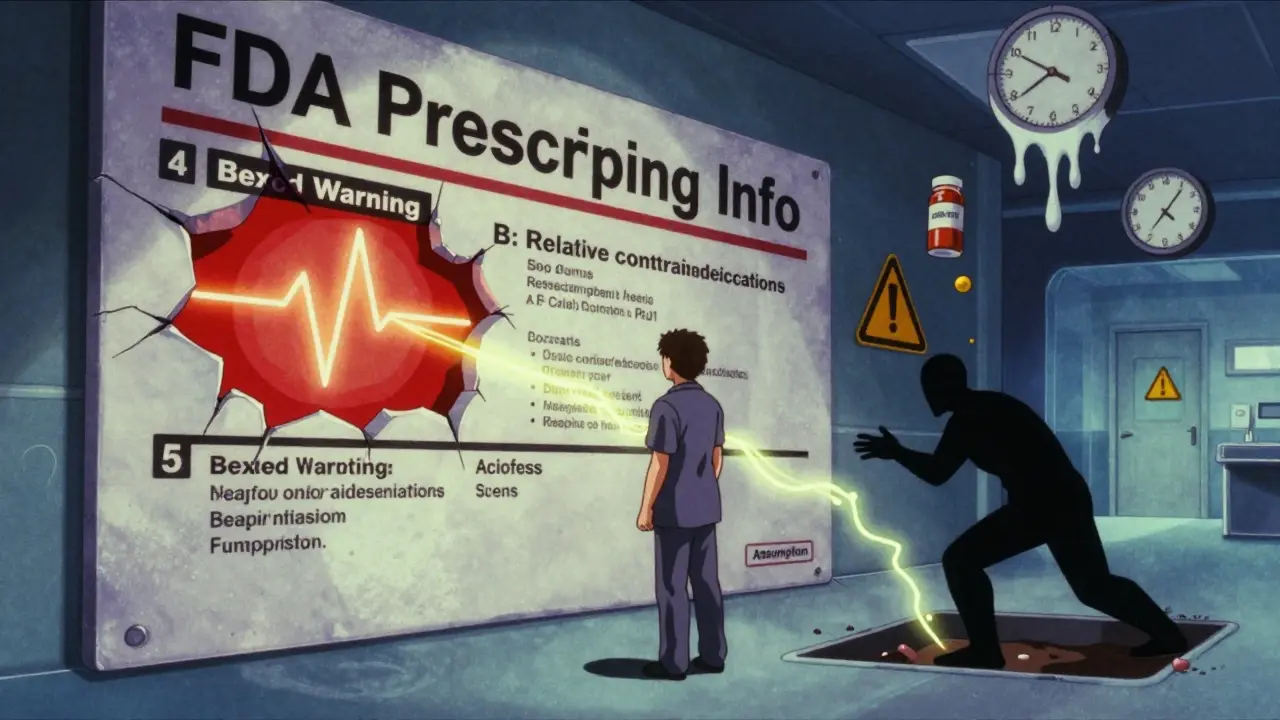
Prescription drug labels follow a strict 16-section format set by the FDA since 2006. You don’t need to read all of it-but you must read these three:- Boxed Warning (if present)-top of the document, black border, impossible to miss.
- Section 4: Contraindications-lists absolute no-go conditions. Look for words like "must not," "should not," or "contraindicated in."
- Section 5: Warnings and Precautions-this is the longest part. It lists risks in order of severity. The most dangerous ones come first.
For OTC drugs (like ibuprofen or allergy pills), the format is different. Look at the "Drug Facts" label. Under "Warnings," you’ll see two key phrases:
- "Do not use" = contraindication. Example: "Do not use if you have ever had a stomach ulcer."
- "Ask a doctor before use if" = precaution. Example: "Ask a doctor before use if you have high blood pressure."
Many people miss this. They see "Ask a doctor" and think it’s optional. It’s not. It’s a signal that your condition could make the drug dangerous.
What "Relative Contraindication" Really Means
You’ll often hear doctors say, "It’s a relative contraindication." That sounds vague-but it’s not. It means: "This isn’t an absolute no, but you need extra care."For example, a drug might say: "Contraindicated in severe kidney disease. Use with caution in mild to moderate kidney disease." That’s a relative contraindication. Your doctor might still prescribe it-but they’ll lower your dose, check your kidney function more often, or avoid combining it with other drugs that stress the kidneys.
Here’s the problem: a 2021 study found only 42% of physicians correctly identified relative contraindications. If your doctor doesn’t know, how will you? Always ask: "Is this a hard no, or can we manage it?" If they can’t explain the difference, get a second opinion.
Real-World Mistakes People Make
People don’t read labels because they think they’re too complicated. But the real danger isn’t complexity-it’s assumptions.- Mistake: "I took this before and was fine, so it’s safe now." → Your health changes. New condition? New risk.
- Mistake: "The pharmacist didn’t say anything, so it must be okay." → Pharmacists are busy. They don’t always catch every interaction.
- Mistake: "I have a little bit of that condition, so it’s not a big deal." → The label says "severe." You have "mild." But mild can still be dangerous with certain drugs.
One Reddit user shared how their cardiologist prescribed amiodarone despite mild lung disease. The pharmacist almost refused to fill it because they misread the label. The label said "severe pulmonary disease"-not "any." The patient was fine because the doctor knew the difference. But if the patient had read the label themselves, they’d have understood why it was okay.
What to Ask Your Doctor or Pharmacist
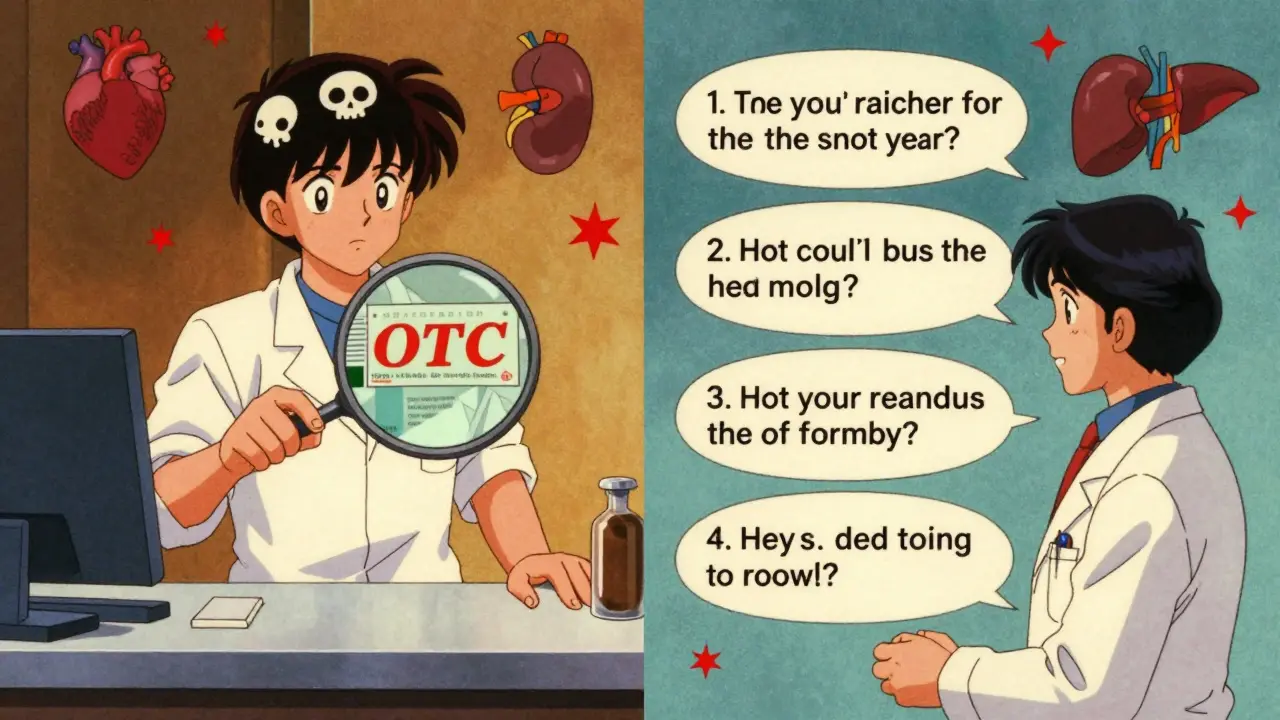
Don’t wait for them to explain. Ask these three questions every time you get a new prescription:- "What’s the biggest risk I need to watch for?"-This forces them to pick the top warning, not just list everything.
- "How likely is it that I’ll experience it?"-If they say "it’s rare," ask for numbers. "1 in 100? 1 in 1,000?"
- "What should I do if I notice symptoms?"-Don’t just know the risk-know the action plan.
These questions aren’t rude. They’re necessary. The FDA says 1.3 million injuries each year in the U.S. happen because of poor communication on drug labels. You’re not being difficult-you’re protecting yourself.
How to Use Online Resources Wisely
You can look up any drug on the FDA’s website or DailyMed (a free public database). Search by brand or generic name. You’ll get the full prescribing information-exactly what doctors use.But don’t trust random blogs or forums. A 2022 FDA report found 47% of consumer questions about drug labels came from confusion over drug interactions that weren’t clearly explained. Always cross-check with official sources.
Some apps and digital tools now offer interactive warnings based on your health profile. Mayo Clinic and Kaiser Permanente are testing AI tools that flag risks specific to your age, kidney function, or other medications. These aren’t mainstream yet-but they’re coming.
What’s Changing in Drug Labeling
The FDA is finally fixing the system. In 2024, they required all new drugs to include a "Highlights" section that summarizes the most critical contraindications and warnings in plain language.They’re also testing color-coded risk levels (red for high, yellow for moderate) and standardized risk numbers. Why? A 2022 Rand Corporation study found that drugs with clear numbers like "1.8-fold increased risk" had 23% fewer adverse events than those with vague warnings like "may increase risk."
But until these changes are everywhere, you still need to read the fine print. The FDA admits that only 30% of critical safety info is effectively understood by patients. You don’t have to be part of that 70%.
Final Checklist: Before You Take Any New Drug
Use this simple list before swallowing anything:- Is there a Boxed Warning? If yes, read it fully.
- Is there a contraindication that matches your condition? Even if it’s "mild," check if it’s listed.
- Does the warnings section mention your other medications? Drug interactions are the #1 cause of preventable harm.
- Is there a "Do not use" statement on an OTC label? If yes, don’t take it.
- Did you ask your doctor: "What’s the biggest risk? How likely? What do I do if it happens?"
Reading drug labels isn’t about being a pharmacist. It’s about being your own best advocate. The system isn’t perfect-but you can still protect yourself. Start with one label. Read it like your life depends on it. Because it does.
What’s the difference between a contraindication and a warning on a drug label?
A contraindication means you should never take the drug if you have a specific condition-like severe liver disease or an allergy to the ingredients. It’s an absolute rule. A warning means the drug carries a serious risk, but you might still take it with caution-like monitoring your blood pressure or avoiding alcohol. Warnings tell you what could go wrong; contraindications tell you when you absolutely must not use it.
What is a Boxed Warning, and why does it matter?
A Boxed Warning is the FDA’s strongest safety alert. It’s a thick black border around the most dangerous risks-like death, organ failure, or suicidal behavior. If a drug has one, it means clinical evidence shows a high chance of serious harm. These warnings are required at the top of every prescription label. Never ignore them. They don’t mean the drug is banned-they mean you need close medical supervision if you take it.
Can I take a drug if I have a "relative contraindication"?
Yes-but only under careful supervision. A relative contraindication means the risk is lower than in an absolute case. For example, if a drug is contraindicated in severe kidney disease but you have mild kidney disease, your doctor may still prescribe it but lower the dose or monitor your kidney function more often. Never assume it’s safe without asking your doctor to explain the risk and plan.
How do I find the official drug label for my medication?
Go to DailyMed (dailymed.nlm.nih.gov), a free government database. Search by the drug’s brand or generic name. You’ll see the full FDA-approved prescribing information, including Sections 4 (Contraindications) and 5 (Warnings). This is exactly what your doctor and pharmacist use. Avoid random websites-only trust official sources.
Why do OTC drug labels say "Ask a doctor before use if"?
That phrase means you have a condition that could make the drug dangerous-even if it’s not a hard contraindication. For example, if you have high blood pressure, taking decongestants could spike your pressure dangerously. The label is telling you: "This isn’t a no, but you need a doctor’s input first." Don’t skip this step. It’s there to prevent preventable harm.
What should I do if I don’t understand a warning on my drug label?
Don’t guess. Call your pharmacist or doctor and ask for clarification. Say: "I read this warning, but I’m not sure what it means for me." Be specific-mention the exact phrase. Most healthcare providers are happy to explain. If they brush you off, get a second opinion. Your safety is worth the time.
What to Do Next
Start today. Grab your next prescription bottle or OTC medicine. Open the label. Find Section 4 or the "Do not use" line. Read it out loud. Ask yourself: "Does this apply to me?" Then ask your doctor one question: "Is there anything here I should be worried about?"You don’t need to memorize every drug label. But you need to know how to read them when it matters. One label, one question, one conversation-that’s how you stop being a passive patient and become your own safety expert.

Dorine Anthony - 18 December 2025
So many people just swallow pills like candy and never look at the label. I used to do it too until my mom had a bad reaction to ibuprofen because she had a silent ulcer and the "Do not use" was right there. Never again. Read the damn thing.
Also, the "Ask a doctor" line? That’s not a suggestion. That’s a lifeline.
William Storrs - 19 December 2025
This is the kind of post that should be mandatory reading in high school. Seriously. We teach kids how to balance a checkbook but not how to read a drug label? That’s like teaching someone to drive but not how to use brakes.
Grab your next pill bottle. Right now. Open it. Read the "Warnings" like your life depends on it-because it does. You’re not being paranoid, you’re being smart.
James Stearns - 21 December 2025
One must observe, with clinical precision, the egregious failure of public health literacy. The FDA’s labeling protocol, codified since 2006, is a masterpiece of regulatory clarity-yet the populace, in their collective ignorance, reduces it to a decorative artifact on the pharmaceutical vial.
It is not merely negligence; it is an epistemological crisis. One cannot rely upon pharmacists, who are overworked and undertrained in pharmacovigilance, to serve as human interpreters of regulatory orthodoxy. The onus is squarely upon the patient to engage in disciplined textual analysis. Failure to do so constitutes a moral dereliction of self-preservation.
Nina Stacey - 22 December 2025
I just read the label on my blood pressure med and realized I’ve been taking it wrong for two years because I didn’t know "use with caution" meant "watch your kidneys" and not "maybe take it with food"
my doctor never explained it and i felt dumb asking but now i know and i’m gonna ask about all my meds from now on
also i think the FDA should make the warnings bigger like actually like 2x font size and maybe bold and red and not just tiny print that looks like a receipt from 1998
also i love how they say "ask your doctor" but then don’t give you time to ask so you just nod and leave and then you forget what you were gonna say
so i wrote it down on my phone now
thank you for this post i feel less alone
Dominic Suyo - 23 December 2025
Let’s be real-the drug label is a legal minefield disguised as medical advice. The FDA doesn’t care if you live or die, they just care if the pharma giant gets sued. That Boxed Warning? That’s not a warning-it’s a liability shield wrapped in black ink.
And don’t get me started on "relative contraindications." That’s corporate-speak for "we know this could kill you, but we’ve got a patent to protect."
Meanwhile, your pharmacist is rushing you out the door because they’ve got 12 more scripts to fill and zero emotional bandwidth. You’re not a patient-you’re a revenue stream with a pulse.
Kevin Motta Top - 25 December 2025
My grandma in Texas used to say: "If it’s not written in blood, don’t trust it." She never went to college but she read every drug label like a Bible.
She died at 92. No hospital trips in her last decade. She knew the difference between "do not use" and "ask your doctor."
That’s wisdom. Not luck.
William Liu - 25 December 2025
Finally, someone says this out loud. I work in a clinic and I see it every day. People take meds they’ve been on for 10 years and never check if their new diagnosis changes the risk. One guy started taking meloxicam after being diagnosed with early-stage kidney disease. The label said "avoid in renal impairment." He didn’t read it. Now he’s on dialysis.
It’s not about being scared. It’s about being informed.
Aadil Munshi - 25 December 2025
Ah yes, the sacred ritual of reading the tiny print while ignoring the fact that 80% of adverse drug reactions occur because of polypharmacy, not individual label ignorance.
But sure, let’s blame the patient for not memorizing Section 5 while their doctor prescribed 7 different meds in 10 minutes with no interaction check.
Also, the FDA’s "Highlights" section? That’s just marketing. They still bury the real risks in 14-point font under 3000 words of legalese.
Self-advocacy is great-but systemic reform is overdue. You can’t educate your way out of a profit-driven healthcare machine.
Frank Drewery - 25 December 2025
I used to ignore labels too. Then my sister had a seizure after taking an OTC cold med because she had undiagnosed epilepsy. The label said "avoid in seizure disorders." We didn’t know she had it. But if we’d read it? Maybe we’d have asked sooner.
It’s not about being paranoid. It’s about being present.
Thank you for writing this. I’m going to print it out and leave it on the kitchen counter.
Danielle Stewart - 27 December 2025
My mom is 78 and takes 12 meds. She reads every label like it’s a contract. She underlines things. She writes notes in the margin. She asks questions. She doesn’t trust the pharmacist’s "it’s fine" if it doesn’t match what the doctor said.
I used to think she was overbearing. Now I’m her copy.
This post? Perfect. I’m sending it to my whole family.
mary lizardo - 28 December 2025
It is both regrettable and alarming that the public has been conditioned to treat pharmaceutical labeling as an exercise in aesthetic minimalism rather than a legally binding document of clinical consequence. The FDA’s prescribing information is a meticulously structured, evidence-based artifact, yet the populace, in its profound intellectual laziness, reduces it to a decorative appendage on the pill bottle.
Furthermore, the notion that one may "ask a doctor" as a substitute for personal comprehension is not merely irresponsible-it is a surrender of autonomy. The onus of comprehension lies not with the physician, but with the individual who ingests the substance. One does not rely on a mechanic to interpret the owner’s manual for one’s automobile; one should not rely on a clinician to interpret the safety profile of one’s own pharmacotherapy.
This is not advocacy. This is basic civic responsibility.