
When you’re on Medicare and taking daily medications, your biggest worry isn’t just whether the drug works-it’s whether you can afford it. For millions of seniors, the answer used to be a painful yes: paying hundreds or even thousands out of pocket each year just to keep taking generic blood pressure pills, cholesterol meds, or diabetes drugs. But in 2025, that’s changing. Thanks to major reforms under the Inflation Reduction Act, Medicare Part D now offers the strongest savings on generic drugs in its history.
What Changed in 2025?
Before 2025, Medicare Part D beneficiaries had to spend nearly $8,000 out of pocket before reaching catastrophic coverage and getting free drugs for the rest of the year. That meant someone on a few generic medications could be paying $1,200 or more just to hit the cap. Now, thanks to a new $2,000 out-of-pocket spending limit, that number dropped by 75%. Once you hit $2,000 in qualified expenses-deductibles, copays, coinsurance-you pay nothing for the rest of the year. And that includes all your generics.That $2,000 cap isn’t just a number. It’s a lifeline. The Centers for Medicare & Medicaid Services (CMS) estimates that in 2025, Part D beneficiaries will collectively save $7.4 billion on prescription drugs-mostly because of this cap. For the average person taking generics, that translates to about $400 in annual savings. For those on multiple medications, the savings can be much higher.
How Much Do Generics Cost Now?
The cost of a 30-day supply of a preferred generic drug under Part D is now typically around $10. That’s the median copay across both stand-alone Prescription Drug Plans (PDPs) and Medicare Advantage Prescription Drug plans (MA-PDs). Some plans offer even lower copays-$5 or even $0-for certain generics, especially if you’re enrolled in a plan with a preferred pharmacy network.And here’s the kicker: you don’t pay premiums toward that $2,000 cap. Only what you spend on the drugs themselves counts. That means your monthly premium-whether it’s $7 or $39-isn’t part of the equation. But every copay, every deductible payment, every coinsurance amount you pay for your meds? All of it adds up toward the cap.
For people who qualify for the Low-Income Subsidy (Extra Help), the savings are even bigger. They pay $0 for deductibles and $0 to $4.50 for each generic prescription, with no coverage gap at all. That’s the most affordable way to get generics under Medicare.
Part D Plans: PDPs vs. MA-PDs
Not all Part D plans are the same. There are two main types: stand-alone Prescription Drug Plans (PDPs) and Medicare Advantage Prescription Drug plans (MA-PDs). Both cover generics, but the cost structure is very different.MA-PDs bundle your drug coverage with your medical benefits. The average monthly premium for the drug portion of these plans is just $7. That’s because the plan gets paid by Medicare to cover your care, including prescriptions. PDPs, on the other hand, are separate from your Medicare coverage. The average monthly premium for a PDP is $39-more than five times higher.
But here’s the catch: even though MA-PDs have lower premiums, they often have more restrictions. About 27% of Part D plans now require step therapy for at least 15 generic drug classes. That means your doctor might need to try a cheaper generic version first before approving the one you’re used to. Some plans also limit which pharmacies you can use or require prior authorization for certain generics-even if they’re on the formulary.
Why Some People Still Struggle
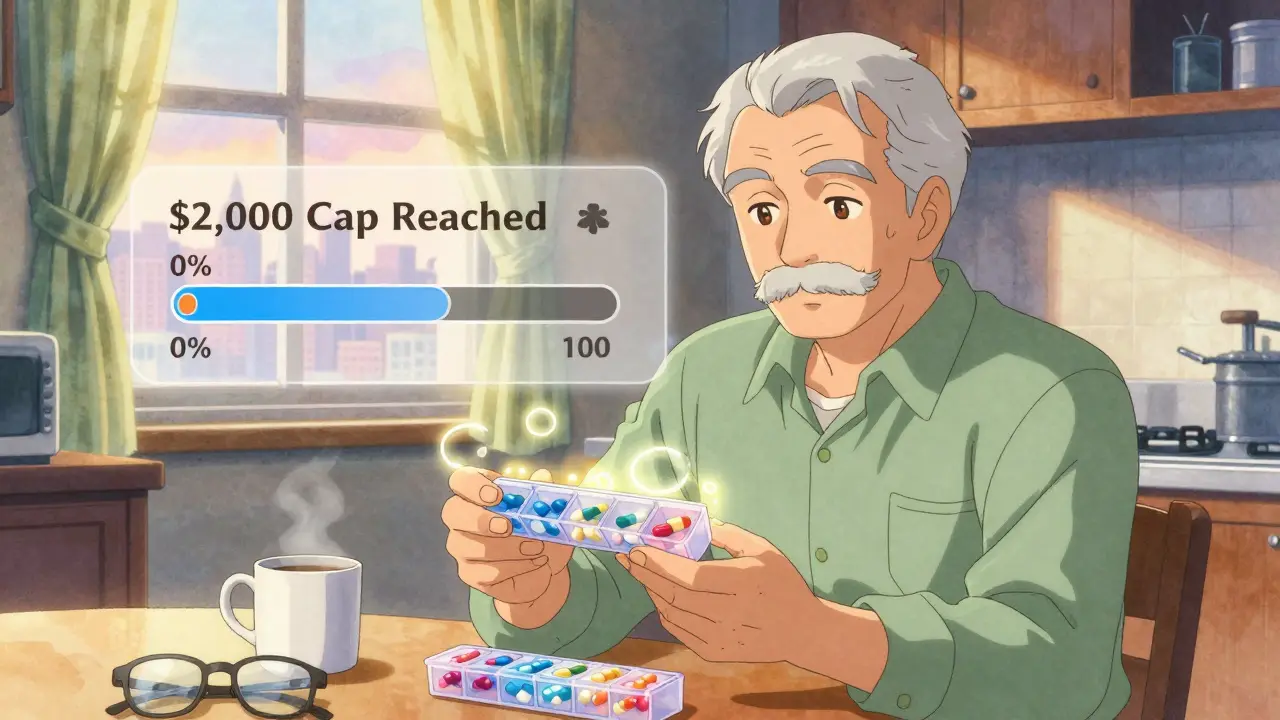
Despite the big improvements, not everyone is seeing the savings they expected. A 2024 survey by the Medicare Rights Center found a 23% jump in calls from beneficiaries confused about formulary changes. Many were switched to a different generic version of their medication-same active ingredient, different brand name, higher copay. That’s called therapeutic substitution, and it’s legal under Part D rules.Another issue? Understanding what counts toward the $2,000 cap. Many people don’t realize that manufacturer discounts-like the ones drugmakers now have to offer under the Inflation Reduction Act-also count toward your out-of-pocket total. That means you might hit the cap faster than you think. But if you don’t know that, you might keep paying coinsurance even after you’re eligible for free drugs.
A KFF study found that 41% of beneficiaries didn’t understand how manufacturer discounts worked. That’s a huge gap. And with over 51 million people enrolled in Part D, even small misunderstandings add up to big financial stress.
How to Make Sure You’re Getting the Best Deal
The Medicare Plan Finder tool, updated every October, is your best friend. You can type in your exact medications-generic or brand-and see which plans charge the least for each one. You can filter by pharmacy, monthly premium, and whether the plan covers your preferred pharmacy.But don’t just pick the plan with the lowest premium. Look at the total cost: premiums + copays + deductible. A plan with a $10 monthly premium and $20 copays might cost you more than a $25 premium with $5 copays if you take five prescriptions a month.
Also, check if your plan uses a preferred pharmacy network. If you fill your prescriptions at a non-preferred pharmacy, your copay could double. Some plans even offer mail-order discounts for 90-day supplies of generics-often cutting your monthly cost in half.
What’s Coming Next?
The reforms aren’t done. In 2026, a new program called the Selected Drug Subsidy Program will kick in. It will give PDPs a 10% subsidy to help cover the cost of certain high-priced generics. That could lead to even lower copays for complex medications like those used for rheumatoid arthritis or multiple sclerosis.And biosimilars-generic versions of complex biologic drugs-are starting to appear in Part D formularies. While they’re not traditional generics, they work the same way: lower cost, same effect. By 2028, they could capture 35% of the biologic market, saving even more money.
For now, the biggest win is the $2,000 cap. It’s simple, it’s powerful, and it’s working. People who used to skip doses to save money are now taking their meds as prescribed. Pharmacies report fewer abandoned prescriptions. And seniors are sleeping better at night knowing their meds won’t bankrupt them.
Real Stories, Real Savings
One Reddit user, ‘RetiredPharmacist2023,’ shared that their blood pressure generic, which cost $1,200 more in 2024, now costs $0 after hitting the cap. Another beneficiary told the Medicare Rights helpline they were paying $75 a month for a diabetes generic until the plan switched them to a lower-cost version-saving them $900 a year.These aren’t exceptions. They’re the new normal. The old system was broken. It forced people to choose between their health and their budget. The 2025 changes didn’t just tweak the rules-they rebuilt them to put people first.
Do generic drugs work the same as brand-name drugs under Medicare Part D?
Yes. Generic drugs contain the same active ingredients, dosage, and strength as their brand-name equivalents. They’re required by the FDA to be equally safe and effective. Under Part D, generics are often preferred because they cost less, and plans are required to cover at least two generic options for each drug class. The only difference is usually the price-and sometimes the pill shape or color.
Does my monthly premium count toward the $2,000 out-of-pocket cap?
No. Only what you pay directly for your prescriptions counts toward the $2,000 cap. That includes your deductible, copays, and coinsurance. Monthly premiums, even if you pay them to your Part D plan, do not count. This is a common misunderstanding-many people think their premiums are helping them reach the cap, but they’re not.
Can my Part D plan switch me to a different generic version of my medication?
Yes. Plans can use therapeutic substitution, meaning they can switch you to a different generic version of the same drug if it’s cheaper or preferred on their formulary. This is legal and common. But if the new version has a higher copay, you can request a formulary exception from your plan. Your doctor can help you submit a letter explaining why the original version is medically necessary.
What if I can’t afford my generic meds even with the $2,000 cap?
You may qualify for Extra Help (Low-Income Subsidy), which reduces or eliminates your deductible, copays, and coinsurance for generics. You can apply through Social Security or your state Medicaid office. Even if you didn’t qualify last year, your situation may have changed. Check your eligibility every year-it’s free to apply.
How do I know if my plan’s generic coverage is good?
Use the Medicare Plan Finder tool and enter your exact medications. Look at the total annual cost: premiums + deductible + estimated copays for the year. Compare plans side by side. Also check if your pharmacy is preferred and if mail-order is an option. If your plan requires prior authorization or step therapy for your generics, that’s a red flag-it could delay or block your access.
Do manufacturer discounts count toward the $2,000 cap?
Yes. Under the Inflation Reduction Act, drugmakers must pay rebates if their prices rise faster than inflation. Those rebates are now counted as part of your out-of-pocket spending, even if you don’t pay them directly. That means you reach the $2,000 cap faster. But if you’re not aware of this, you might keep paying coinsurance after you’ve already qualified for free drugs. Always check your plan’s Explanation of Benefits to see how much of your spending is from your payments versus manufacturer discounts.

Blow Job - 23 December 2025
This $2,000 cap is a game-changer. I used to skip my blood pressure meds every other month just to make ends meet. Now I take them like clockwork. No more anxiety at the pharmacy counter. My doctor even noticed my numbers improved. Simple policy change, massive human impact.
Christine Détraz - 23 December 2025
I’m 72 and on three generics. Last year I paid $1,100 out of pocket. This year? $180. I’m not exaggerating when I say this saved my life. I started eating better, walking more. It’s not just about money-it’s about dignity.
John Pearce CP - 23 December 2025
These reforms are a classic example of government overreach disguised as compassion. The market was working fine before. Now drugmakers are being forced to subsidize their own products, which will inevitably lead to higher prices down the line. This is not sustainability-it’s fiscal theater.
EMMANUEL EMEKAOGBOR - 24 December 2025
As someone from Nigeria watching this unfold, I’m amazed. In my country, even basic generics cost a month’s salary. The fact that a senior citizen in America can now get life-saving medication for $10 is revolutionary. This should be a global model.
CHETAN MANDLECHA - 26 December 2025
Just curious-how many of these savings are real vs. accounting tricks? I’ve seen how formularies shift generics around to make it look like costs dropped. Same pill, different name, same price. It’s sleight of hand.
Jillian Angus - 26 December 2025
my plan switched me to a different generic and now my copay doubled and no one told me
why is this even legal
Ajay Sangani - 27 December 2025
it’s funny how we think of medicine as a commodity when really it’s a basic human need
the fact that we needed a law to make generics affordable says more about us than the system
we built a world where people have to choose between food and pills
and now we’re patting ourselves on the back for fixing the bare minimum
Pankaj Chaudhary IPS - 27 December 2025
India has long understood the power of generic pharmaceuticals. We export billions in lifesaving generics worldwide. The U.S. catching up to this reality is long overdue. This policy shift is not just economic-it’s ethical. It reflects a fundamental shift in values: health over profit.
Steven Mayer - 29 December 2025
While the $2,000 out-of-pocket cap appears beneficial, the underlying structural dynamics of the Part D program remain opaque. Manufacturer rebates, which now count toward the cap, are not transparently communicated to beneficiaries, resulting in suboptimal decision-making. Furthermore, the absence of premium integration into the cap introduces a regressive cost allocation mechanism that disproportionately burdens high-utilization populations.
Sidra Khan - 30 December 2025
yeah but what if your plan doesn’t cover your specific generic even though it’s the same thing?
also why is mail order only available at 3 pharmacies in my state?? 🤡
Andrea Di Candia - 30 December 2025
I used to cry at the pharmacy. Not because I was weak, but because I felt like my body was being priced out of existence. Now I just nod, hand over my card, and walk out with my meds. No drama. No guilt. Just peace. This is what progress looks like.
Joseph Manuel - 1 January 2026
The 7.4 billion in projected savings is statistically misleading. It aggregates disparate cost structures across 51 million beneficiaries, ignoring regional disparities, plan-specific formulary restrictions, and the fact that many beneficiaries still face non-formulary exclusions. The narrative of universal relief is a policy myth.
Abby Polhill - 2 January 2026
Just got my EOB. Saw that my manufacturer discount counted toward the cap. Didn’t know that. Figured out I hit $2,000 two months ago. Been getting my meds free since December. Should’ve checked this sooner. Everyone needs to read their Explanation of Benefits. It’s not just paperwork-it’s your wallet.