

When a product leaves a manufacturing facility, it shouldn’t carry hidden dangers. In pharmaceuticals, food processing, and cosmetics, a single microbe or chemical residue can trigger recalls, lawsuits, or worse-hospitalizations. That’s why environmental monitoring isn’t just a checklist item. It’s the first line of defense against contamination that no one sees until it’s too late.
What Environmental Monitoring Actually Does
Environmental monitoring tracks what’s in the air, on surfaces, and in the water inside your facility. It’s not about testing the final product after it’s made. It’s about catching contamination before it touches the product at all. Think of it like a smoke alarm for microbes and chemicals. You don’t wait for the fire to spread-you check for smoke before it starts. Regulators like the FDA and EMA don’t treat this as optional. The FDA’s 2023 guidelines state clearly: environmental monitoring and product testing are verification steps to prove you’re controlling microbial hazards. The CDC backs this up, saying proper monitoring can prevent outbreaks that cost the U.S. economy over $77 billion a year. In a food plant, it’s Listeria on a conveyor belt. In a drug lab, it’s mold spores in a cleanroom. In a cosmetic factory, it’s bacteria in a water line. The goal is the same: stop the problem at the source.The Zone System: Where to Look and How Often
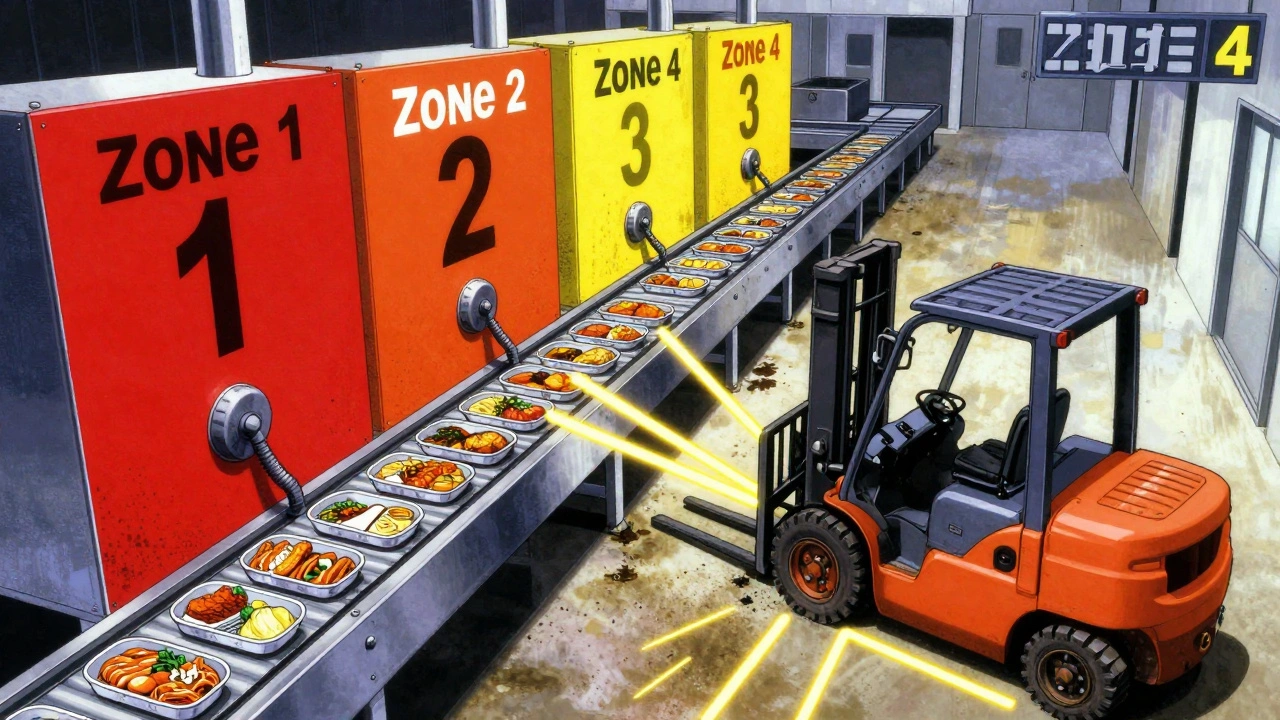
Not all surfaces are equal. That’s why every serious facility uses the Zone Classification System. It divides your space into four risk levels:- Zone 1: Direct food or product contact surfaces-slicers, mixers, filling nozzles, packaging tools. This is ground zero. Sampling here happens daily or every shift.
- Zone 2: Surfaces near contact points-equipment housings, refrigeration units, nearby walls. Tested weekly to biweekly.
- Zone 3: Remote but still inside production areas-forklifts, carts, overhead pipes. Often ignored, but a 2013 PPD study found floors (a Zone 3 surface) caused 62% of all contamination alerts.
- Zone 4: Outside production-restrooms, hallways, storage rooms. Monitored monthly or quarterly.
How Testing Works: Tools and Methods
Different contaminants need different tools:- Microbiological swabs and air samplers: Sterile sponges or swabs collect samples from surfaces. Air samplers-like liquid impingers or solid impactors-pull in cubic meters of air to catch microbes and particles. Results are measured in CFU/m³ (colony-forming units per cubic meter).
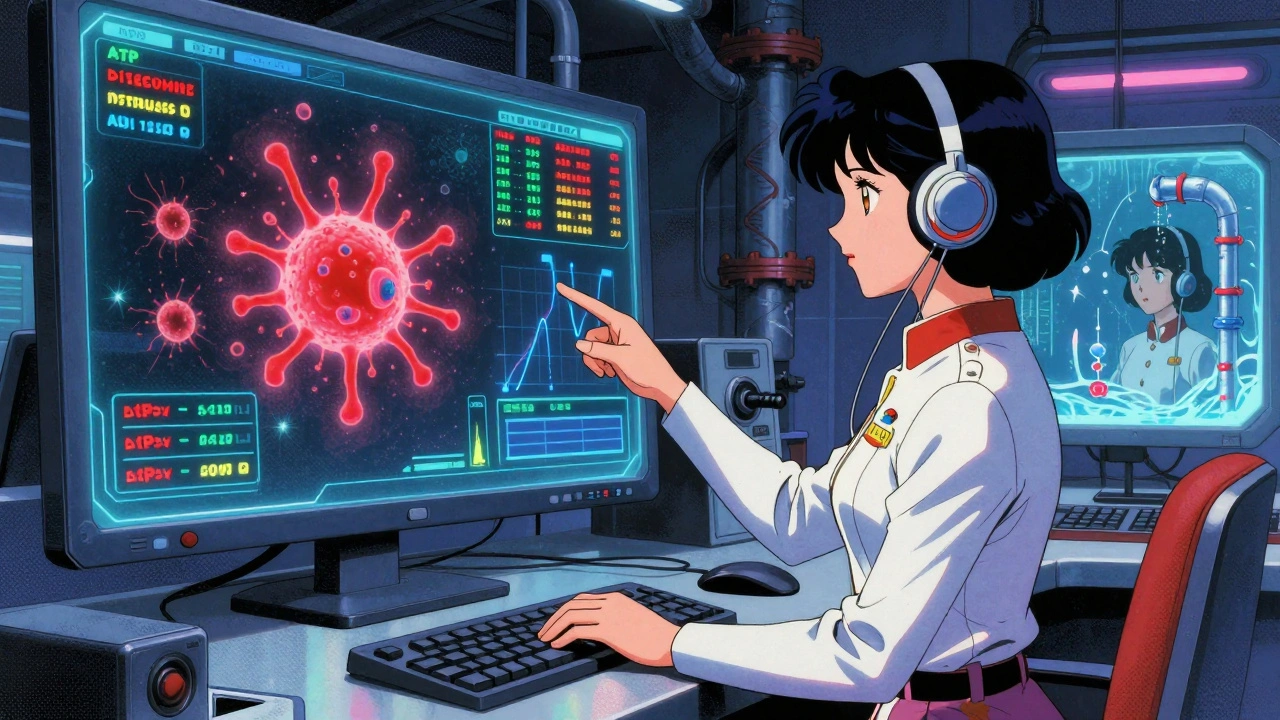
- ATP testing: This isn’t a microbe test. It’s a cleanliness test. ATP (adenosine triphosphate) is found in all living cells. A handheld device gives you a reading in seconds. Facilities using ATP see 32% faster production turnarounds because they don’t wait 48 hours for lab results.
- TOC and conductivity tests: Used in pharmaceutical water systems. Measures organic carbon and ion levels to ensure purified water meets USP <645> standards.
- ICP and chromatography: For heavy metals or chemical residues. Inductively Coupled Plasma detects lead or mercury. HPLC or GC finds traces of solvents or cleaning agents.
Industry Differences: Pharma vs. Food vs. Cosmetics
Not all facilities are built the same. Here’s how they differ:| Factor | Pharmaceutical | Food Processing (RTE) | Cosmetics |
|---|---|---|---|
| Primary Target | Particulates, fungi, endotoxins | Listeria monocytogenes, Salmonella | Staphylococcus aureus, Pseudomonas |
| Air Quality Standard | ISO Class 5 (EU Grade B) continuous monitoring | No continuous air monitoring required | ISO Class 7-8 in filling areas |
| Water Testing | TOC, conductivity, endotoxin (USP <645>) | Compliance with EPA municipal standards | Microbial limits per USP <61> |
| Regulatory Driver | EU GMP Annex 1 (2023 revision) | USDA Listeria Rule (9 CFR 430) | FD&C Act, GMP guidelines |
| Sampling Frequency (Zone 1) | Daily or per batch | Weekly (minimum) | Weekly to biweekly |
What Goes Wrong: Common Pitfalls
Even with good intentions, things fail. Here’s what breaks most often:- Inconsistent zone classification: One manager sees a pipe above a mixer as Zone 1 because it drips. Another sees it as Zone 3. No standard = no control.
- Bad sampling technique: Swabs aren’t sterile. Air samplers aren’t cleaned between uses. The CDC warns: the inside of the sampler must be sterile too. If it’s not, you’re contaminating your own test.
- Fragmented data: ATP results, microbial results, allergen tests-all stored in different systems. No one connects the dots. A spike in ATP might mean a cleaning failure, but if it’s not linked to a microbial result, you miss the pattern.
- Understaffing: A medium-sized food plant needs 2-3 full-time staff just for monitoring. Many small facilities (under 50 employees) skip this. Only 48% of small processors have fully compliant programs, according to USDA data.
Where the Industry Is Headed
The future of environmental monitoring is faster, smarter, and connected:- Real-time data: EU GMP Annex 1 now requires continuous monitoring and trending of temperature, humidity, and particulates. No more manual logs.
- AI and analytics: Systems are starting to predict contamination risks based on past data. If humidity spikes and ATP readings climb after lunch shift, the system flags it before a sample is even taken.
- Next-gen sequencing (NGS): Instead of waiting 72 hours to ID a microbe, labs can now sequence its DNA in under 24 hours. That means faster recalls and fewer false positives.
- Antibiotic resistance tracking: The CDC found 19% of Listeria isolates from food plants now resist multiple antibiotics. Monitoring now includes resistance profiles-not just presence.
What You Need to Do Now
If you run a manufacturing facility, here’s your action list:- Map your zones. Be specific. Document why each surface is classified as Zone 1, 2, 3, or 4.
- Match your testing method to your risk. Don’t use ATP for pathogen detection. Don’t skip air sampling in cleanrooms.
- Train your team. The FDA recommends 40 hours of hands-on training before anyone collects a sample.
- Integrate your data. Use one system to track ATP, microbiological, and chemical results together.
- Review your program quarterly. Are you catching more alerts? Are they linked to real events? If not, your program isn’t working.
What’s the difference between environmental monitoring and product testing?
Environmental monitoring tests the environment-air, surfaces, water-around your product to catch contamination before it happens. Product testing checks the final item after production. Monitoring is preventative; product testing is reactive. Relying only on product testing is like checking your car’s brakes after it crashes.
How often should I test Zone 1 surfaces?
Zone 1 surfaces should be tested daily or after every production shift in high-risk industries like pharmaceuticals and ready-to-eat food. For lower-risk facilities, at least weekly is required by FDA guidelines. The frequency must be risk-based-more often if you’ve had past contamination events or if the product is consumed raw.
Is ATP testing enough for contamination control?
No. ATP testing only tells you if organic material is present-it doesn’t identify microbes. A surface can have high ATP from cleaning residue and still be sterile. Or it can have low ATP but harbor dangerous pathogens like Listeria. ATP is a fast screening tool, but it must be paired with microbiological testing to confirm safety.
Why are Zone 3 and 4 surfaces important if they don’t touch the product?
Contaminants move. A dirty floor can transfer bacteria to a forklift tire. That tire rolls past a Zone 1 conveyor. A person walks through Zone 3 and touches a Zone 1 surface with contaminated gloves. The PPD study showed 62% of contamination events originated in Zone 3 or 4. Ignoring these areas is like ignoring the doors and windows in a secure room.
What happens if my facility fails an environmental monitoring inspection?
The consequences depend on severity. Minor issues may trigger a warning letter. Repeated failures or detection of pathogens like Listeria or Salmonella can lead to product recalls, import alerts, or facility shutdowns. The FDA can issue a Form 483 (inspectional observations) and later a Warning Letter. In extreme cases, criminal charges have been filed against facility managers.
Can small facilities afford a full environmental monitoring program?
Yes, but they need to be smart. A small food processor doesn’t need a full-time lab team. They can outsource lab testing, use ATP meters for daily checks, and focus only on Zone 1 and 2. The USDA found 48% of small facilities (<50 employees) are non-compliant-not because they can’t afford it, but because they underestimate the risk. Start with the highest-risk areas. A $15,000 annual program focused on critical zones is better than a $50,000 program that’s half-empty.


Allan maniero - 2 December 2025
Man, I’ve seen so many facilities treat Zone 3 like it’s a suggestion rather than a risk zone. That Wisconsin forklift story? Classic. I worked at a plant where a janitor’s mop bucket was sitting right next to a filling line-no one thought twice about it. Turns out, the bucket had been sitting in a sink that hadn’t been sanitized in weeks. Listeria showed up in three batches. All because someone thought, ‘It’s just a floor.’
Environmental monitoring isn’t sexy, but it’s the unsung hero keeping your brand from becoming a cautionary tale. You don’t need a PhD to get it right-just consistency, documentation, and a little humility.
Zoe Bray - 2 December 2025
The integration of real-time particulate monitoring under EU GMP Annex 1 represents a paradigm shift in aseptic processing compliance. The transition from discrete sampling to continuous, trended data streams enables predictive rather than reactive risk mitigation. Furthermore, the incorporation of next-generation sequencing for microbial identification reduces turnaround time from 72 to 24 hours, significantly enhancing root cause analysis fidelity. It is imperative that facilities adopt ISO 14644-1 compliant monitoring protocols to maintain alignment with global regulatory expectations.
Shubham Pandey - 3 December 2025
Zone 3 is just a scam to sell more swabs.
Anthony Breakspear - 5 December 2025
ATP testing is like using a flashlight to check if your car’s engine is running-you get a quick glow, but you still gotta pop the hood to see if there’s a raccoon in there with a wrench. I’ve seen plants go all-in on ATP because it’s fast and flashy, then ignore the microbial swabs like they’re optional homework. Spoiler: they’re not. One guy told me, ‘We’ve never had a recall!’ Yeah, buddy. Until you did. And it cost you $2M and three months of shutdown. Don’t be that guy.
Do the work. Train your crew. Link your data. And for the love of all that’s clean-don’t let your forklift be the villain in your next FDA letter.
Elizabeth Farrell - 5 December 2025
I really appreciate how this post breaks down the zones and the real-world consequences of cutting corners. It’s easy to think of contamination as something that happens to ‘other’ companies, but the truth is-it can happen anywhere, even to the most well-intentioned teams.
What I’ve seen in small operations is that the biggest barrier isn’t cost-it’s culture. People feel overwhelmed, or they think ‘it’s not my job.’ But when leadership frames environmental monitoring as a shared mission-not just a compliance chore-it changes everything. One facility I worked with started having ‘cleanroom huddles’ before shifts. Just five minutes, talking about what they saw, what worried them. Within six months, their alert rate dropped by 70%. It’s not about more tests. It’s about more care.
Eddy Kimani - 5 December 2025
Interesting breakdown on the industry differences-especially the air quality standards. Pharma’s ISO Class 5 continuous monitoring is a whole different ballgame than food’s ‘weekly swabs.’ But I’m curious: how do you reconcile the cost of real-time particulate sensors with the reality that most small cosmetic manufacturers operate on razor-thin margins? Is there a tiered compliance model emerging, or are we just waiting for the first big recall to force change?
Also, the antibiotic resistance angle is terrifying. If we’re now tracking resistance profiles, are we also tracking biofilm formation kinetics? That feels like the next frontier.
Chelsea Moore - 6 December 2025
THIS IS WHY WE CAN’T HAVE NICE THINGS!!!
Someone’s going to die because some manager thought ‘Zone 3 is fine’ and now we’re all paying for it with higher prices, lawsuits, and panic-buying baby formula because Listeria got into the ‘safe’ production line!!!
WHO’S RESPONSIBLE?!?!?!?!
IT’S THE PEOPLE WHO THINK ‘IT’S JUST A FLOOR’!!!
AND THE GOVERNMENT ISN’T DOING ENOUGH!!!
WE NEED MORE INSPECTIONS!!! MORE PENALTIES!!! MORE FINESSSSSS!!!
WHY ISN’T THIS ON THE NEWS?!?!?!
John Biesecker - 8 December 2025
Man, this whole post gave me chills. 🥹 I used to think contamination was something that happened in movies… you know, the ‘contaminated vaccine’ plot twist. But now I realize it’s happening in plain sight, in warehouses and factories no one ever thinks about.
That forklift story? I can’t unsee it. It’s like a domino made of dirt.
Also, ATP testing is kinda like a mood ring for cleanliness-glows green, but doesn’t tell you if someone’s crying in the corner.
Big thanks for writing this. I’m gonna share it with my cousin who runs a small cosmetic shop. She thinks ‘clean’ means ‘doesn’t smell weird.’ 😅
Let’s hope more people wake up before it’s too late. 🙏