
Kombucha Alcohol Content Calculator
How This Tool Works
Estimate alcohol content in your kombucha based on brewing parameters. This tool helps determine if your kombucha might be unsafe with alcohol-sensitive medications.
Most people drink kombucha for the tangy flavor and gut-health buzz. But if you’re on medication that reacts to alcohol, even a small sip could be risky. Kombucha isn’t just tea with bubbles-it’s a living ferment. And that means it contains alcohol, even when you don’t see it.
Why Kombucha Has Alcohol at All
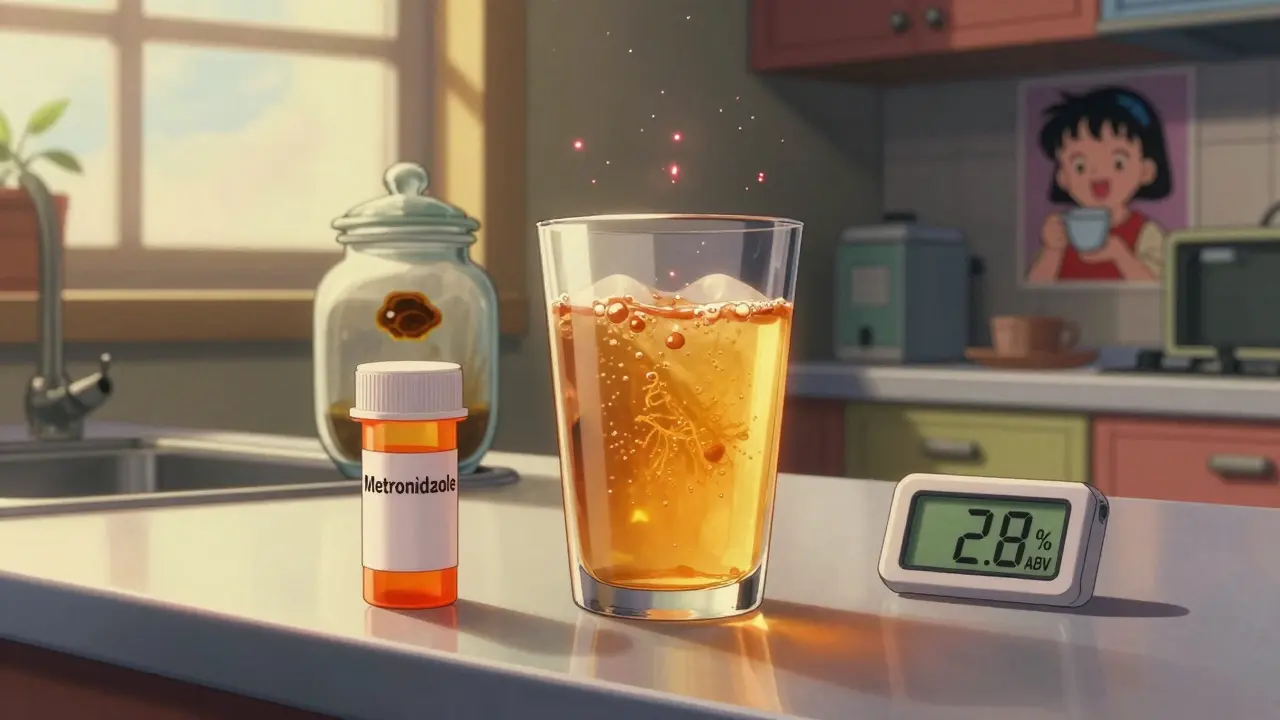
Kombucha is made by fermenting sweetened tea with a SCOBY-a symbiotic culture of bacteria and yeast. The yeast eats the sugar and turns it into alcohol and carbon dioxide. That’s how beer and wine are made too. In kombucha, the alcohol is usually low, but it’s still there. Commercial brands must keep alcohol under 0.5% ABV (alcohol by volume) to be sold as non-alcoholic in the U.S. That’s the same limit as non-alcoholic beer. But homemade versions? They can hit 2.5% ABV or more. That’s like a light beer.Temperature, time, and how much sugar you use all change how much alcohol forms. If you leave it fermenting too long, or keep it in a warm spot, the yeast goes wild. A 2024 Harvard study found 43% of homebrewed kombucha exceeded 0.5% ABV. Twelve percent of those batches were at 3.2% ABV-enough to show up on a breathalyzer.
Medications That Can’t Handle Even a Little Alcohol
You might not think 0.5% is a big deal. But for some medications, that tiny amount can cause serious side effects. The American Pharmacists Association lists 17 medication classes that interact with kombucha’s alcohol. Here are the big ones:- Antibiotics like metronidazole and tinidazole: These can cause violent nausea, vomiting, flushing, and rapid heartbeat if mixed with alcohol-even trace amounts. A 2023 case report in the Journal of Clinical Pharmacy and Therapeutics described a patient who ended up in the ER after drinking homemade kombucha while on metronidazole.
- Diabetes drugs like chlorpropamide and metformin: Alcohol can lower blood sugar too much. One Reddit user reported a 15-point drop in blood sugar after kombucha and metformin, leading to an emergency visit.
- CNS depressants like benzodiazepines (Xanax, Valium) and sleep aids: Alcohol makes them stronger. Stanford’s Dr. Andrew Huberman warned that even 0.5% ABV can boost sedation by affecting GABA receptors in the brain.
- Nitrates for heart conditions: Alcohol can cause dangerous drops in blood pressure when taken with these.
- Some antidepressants like SSRIs: Users on Reddit and medical forums report dizziness, nausea, and brain fog when combining kombucha with sertraline or fluoxetine.
ConsumerLab’s 2023 survey of 1,243 kombucha drinkers found 18% had experienced medication interactions. Over half of those involved antidepressants. Another 29% involved antibiotics. These aren’t rare accidents-they’re predictable.
Commercial vs. Homemade: The Big Difference
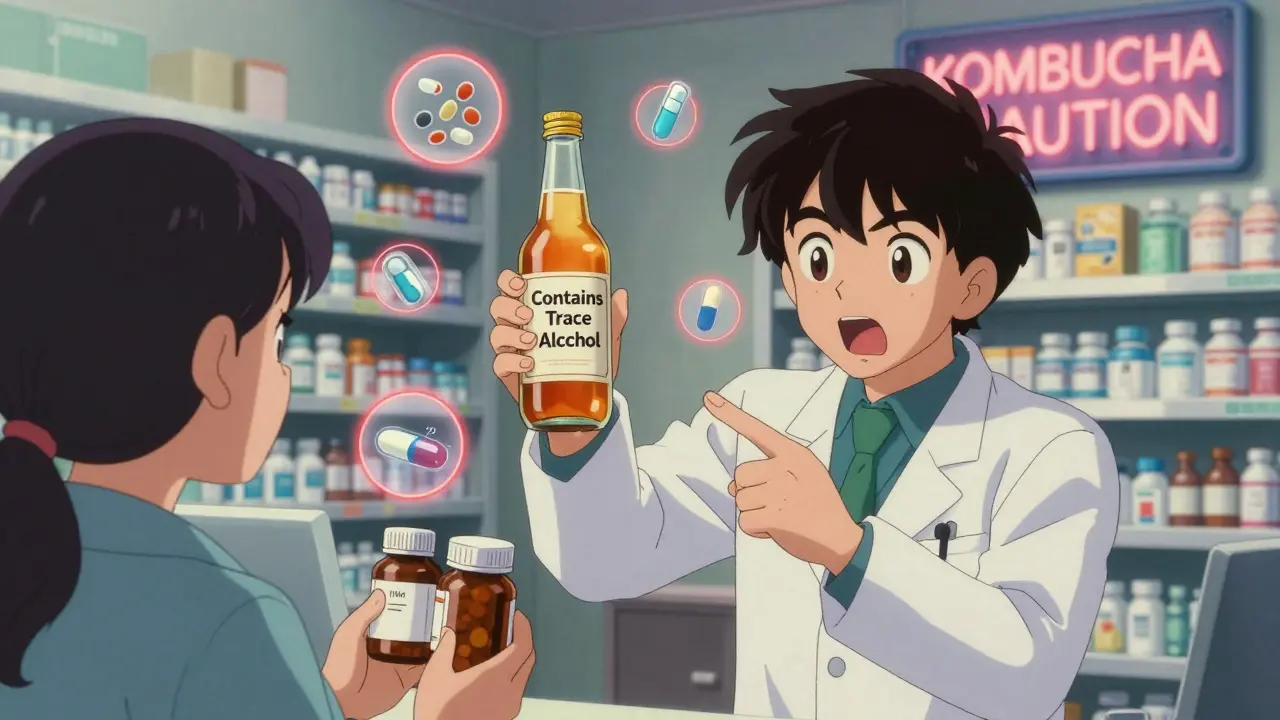
Not all kombucha is the same. Big brands like GT’s, Health-Ade, and Brew Dr. use strict controls. They pasteurize their product or filter it to kill off yeast and stop fermentation. They test every batch with HPLC machines to make sure alcohol stays below 0.5%. Since January 2024, U.S. law requires all commercial kombucha to say “Contains Trace Alcohol” on the label.But homemade kombucha? No rules. No testing. No warning labels. One study tested 150 homebrew batches and found alcohol levels varied by up to 300%. Two people brewing the same recipe in the same kitchen could end up with wildly different alcohol content. That’s why so many adverse reactions happen at home.
Even among commercial brands, there’s inconsistency. A 2023 FDA report found only 63% of products clearly state they contain alcohol. If you don’t read the label, you might not know you’re drinking something that could interfere with your meds.
What You Should Do If You’re on Medication
If you take any of the medications listed above, here’s what to do:- Check your prescription label. Look for warnings about alcohol. If it says “avoid alcohol,” assume kombucha counts.
- Ask your pharmacist. Many pharmacists still don’t know kombucha contains alcohol. A 2023 survey found only 32% of pharmacists correctly identified it as a potential interaction risk. Don’t assume they know-ask directly.
- For homebrewers: Test it. Use a simple alcoholmeter like the HM Digital HA-520. It costs under $50 and gives readings accurate to ±0.1% ABV. It takes 3-5 batches to get good at it, but it’s worth it.
- Wait 48 hours. The Cleveland Clinic recommends waiting at least two full days after taking alcohol-sensitive meds before drinking kombucha.
- Choose brands with QR codes. Health-Ade launched a Transparency Project in February 2024. Scan the QR code on the bottle to see the exact alcohol content for that batch. Other brands are following.
The Bigger Picture: Why This Matters Now
The kombucha market hit $3.2 billion in 2023. More than 14 million Americans drink it regularly. And 38% of adults over 50-people who typically take four or more medications daily-are drinking it without knowing the risks. That’s a ticking time bomb.The FDA launched its “Hidden Alcohol Sources” initiative in 2022. The National Institutes of Health just started a $2.3 million study in March 2024 to look at kombucha-medication interactions. Preliminary results are expected in mid-2025.
Meanwhile, sales of alcohol-testing equipment for homebrewers jumped 212% in 2023. That’s not because people are making better kombucha. It’s because they’re starting to realize how dangerous it can be when mixed with meds.
Final Thoughts: It’s Not About Fear-It’s About Awareness
Kombucha isn’t evil. It’s not poison. But it’s not harmless either. If you’re healthy and not on medication, you can enjoy it without worry. But if you’re managing a chronic condition and taking pills daily, that little bottle of fizzy tea could be doing more harm than good.Don’t assume “natural” means safe. Don’t assume “low alcohol” means no risk. And don’t assume your doctor or pharmacist knows about this unless you tell them.
Read the label. Test your brew. Ask questions. Your body-and your meds-will thank you.
Can I drink kombucha if I’m on antibiotics?
It depends on the antibiotic. Metronidazole and tinidazole can cause severe reactions-even with 0.5% ABV kombucha. Other antibiotics like amoxicillin don’t interact, but it’s still risky. Always check with your pharmacist before combining kombucha with any antibiotic.
Is store-bought kombucha safer than homemade?
Yes, generally. Commercial brands are required to test and label alcohol content, and most keep it below 0.5% ABV. Homemade kombucha can easily exceed that, especially if fermented longer than 14 days or in warm conditions. If you’re on medication, stick to trusted brands with clear labeling.
Does kombucha show up on a breathalyzer?
Yes, if it’s over 0.5% ABV. Homemade kombucha at 2-3% ABV can trigger a breathalyzer reading. Even some commercial brands may briefly spike above 0.5% if not properly stabilized. If you’re subject to alcohol testing, avoid kombucha entirely.
How do I know if my kombucha has alcohol?
Check the label: If it says “Contains Trace Alcohol,” it does. If it’s homemade, use a digital alcoholmeter like the HM Digital HA-520. Taste or smell won’t tell you-it’s not like beer. Only testing gives you reliable numbers.
Are there kombucha brands that are completely alcohol-free?
No. All true kombucha contains trace alcohol because of fermentation. Some brands use pasteurization or filtration to freeze the alcohol level below 0.5%, but they can’t remove it entirely. If you need zero alcohol, choose a non-fermented probiotic drink instead.

Ashlyn Ellison - 7 February 2026
I just drank kombucha this morning and I’m on metformin. Guess I’m lucky it didn’t knock me out. 😅
Monica Warnick - 9 February 2026
I’ve been brewing my own kombucha for three years and I’ve never tested it. I just assumed ‘natural’ meant ‘safe.’ Turns out I’m basically a walking chemical experiment. Thanks for the wake-up call. I’m buying an alcoholmeter this weekend.
Also, I’m now convinced my roommate’s ‘mild headache’ after drinking my batch last month was actually a low-blood-sugar episode. She’s on Zoloft. I’m so dumb.
Ken Cooper - 10 February 2026
so like... i just found out my favorite brand says 'trace alcohol' but never says how much? like come on. i thought they were just being cute with the label. turns out i might be drinking something that could make my blood pressure drop into the abyss. i'm switching to water. or maybe just tea. without the bubbles.
also, why is no one talking about how this is basically a regulatory loophole? kombucha's not beer, but it's alcohol? i'm confused.
Brett Pouser - 10 February 2026
As someone who’s been on antibiotics for a chronic infection, I never thought kombucha was a problem. But after reading this, I’m glad I asked my pharmacist. She actually paused, looked me in the eye, and said, 'I didn’t know either until last month.'
Turns out, the FDA’s new labeling rules are a start, but we’re still in the Wild West with homebrew. If you’re on meds, don’t guess. Test. Ask. Don’t be like me-wait until you’re dizzy in the grocery aisle.
John Watts - 11 February 2026
This is why I love communities like this. We’re not here to scare people-we’re here to help. I’ve been teaching kombucha brewing workshops for five years, and I now start every class with a 10-minute safety talk about meds.
One of my students, a 68-year-old grandma on blood pressure meds, started testing her batches after this. She’s now got a QR code on every bottle. She calls it her 'Health Passport.' I’m so proud of her.
You don’t have to quit kombucha. You just have to be smart about it.
Kathryn Lenn - 11 February 2026
Oh great. So now I have to test my kombucha like it’s a moonshine still? And the FDA’s got a whole 'Hidden Alcohol Sources' initiative? What’s next? Are they gonna start regulating pickles?
‘Contains trace alcohol’-so now I’m supposed to read the label like it’s a nuclear reactor manual?
Meanwhile, my neighbor’s 80-year-old aunt drinks kombucha every day and still beats me at chess. I think we’re being manipulated into overthinking a tea that tastes like vinegar with a party.
Marie Fontaine - 12 February 2026
I’m on sertraline and I’ve been drinking GT’s for years. I had no idea. I just thought the brain fog was from work.
Went to my pharmacist yesterday and she said ‘oh yeah, that’s a thing.’ She didn’t even know kombucha had alcohol. I’m getting a new bottle today and scanning the QR code.
PS: if you’re on meds and you’re not reading labels, you’re playing Russian roulette with your brain. 🤦♀️
Angie Datuin - 13 February 2026
I’ve been on metronidazole before. Let me tell you, it’s not just nausea. It’s like your body’s trying to escape your skin. I drank kombucha once, didn’t think anything of it, and ended up in the ER at 3 a.m. with my heart racing.
My doctor said if I’d waited 24 hours, I’d have been fine. But I didn’t know.
Now I read every label. Even if it’s '0.5%' I still think twice. It’s not worth it.
glenn mendoza - 15 February 2026
It is with the utmost seriousness and profound regard for public health that I address this matter. The presence of ethyl alcohol, even in trace quantities, within a beverage marketed as health-promoting presents a non-trivial pharmacological risk profile, particularly for the elderly and polypharmacy populations.
While the fermentation process is natural, natural does not equate to benign. The absence of standardized testing protocols for homebrewed kombucha constitutes a significant regulatory gap.
I commend the FDA’s initiative and urge all healthcare professionals to incorporate kombucha into their alcohol interaction counseling protocols. Patient safety is not optional.
Joshua Smith - 15 February 2026
I’ve been reading all these comments and I just want to say-thank you. I’m on a beta-blocker and I had no idea. I thought kombucha was just ‘healthy soda.’
I just checked my bottle. It says ‘Contains Trace Alcohol.’ I’ve been drinking it every day for two years.
I’m going to call my doctor tomorrow. Maybe I’ll even get a cheap alcoholmeter. I didn’t know I needed to. Now I do.