
Have you ever stared at a prescription label for an inhaler or patch and felt completely lost? You are not alone. While swallowing a pill is straightforward, specialized delivery systems like inhalers, patches, and injectables come with unique instructions that can be confusing if you do not know what to look for. Misreading these labels is not just an inconvenience; it is a serious safety risk. A 2022 study found that nearly 39% of medication errors involving these devices were directly caused by patients misunderstanding the label information.
The good news is that once you know where to look, reading these labels becomes much easier. This guide breaks down exactly what each part of the label means for these three specific types of medication, helping you avoid common pitfalls and use your medicine safely and effectively.
Key Takeaways
- Inhalers: Always check the dose counter and priming instructions. The canister feeling full does not mean it still has medication left.
- Patches: Watch for heat warnings and exact change intervals (e.g., every 72 hours). Never cut a patch unless explicitly instructed.
- Injectables: Pay close attention to concentration (units/mL) and storage requirements. Confusing U-100 with U-500 insulin can be dangerous.
- General Rule: Look for auxiliary labels (stickers added by the pharmacy) for critical handling instructions like "shake well" or "do not expose to heat."
Understanding Inhaler Labels: More Than Just Sprays
Inhalers are often misunderstood because they feel different from other medications. When you pick up your prescription, the first thing to locate on the label is the dosage per actuation. For example, a label might read "albuterol sulfate 90 mcg per actuation." This tells you exactly how much medicine you get with one puff. It is crucial to distinguish this from the total amount in the device.
One of the most common mistakes people make is assuming the inhaler is empty only when it stops spraying. In reality, many metered-dose inhalers (MDIs) contain propellant that makes the canister feel heavy and cold even after the medication is gone. According to the Cleveland Clinic, over 27% of inhaler errors happen because users don't realize the device is depleted. To prevent this, modern labels increasingly include a dose counter. If your inhaler has a counter, check it regularly. If it does not, track your usage manually or ask your pharmacist for a counting device.
You will also see instructions about "priming." Priming means releasing test sprays into the air before using the inhaler for the first time or if it hasn't been used for a while. The label will specify how many sprays are needed (often four). Skipping this step can result in receiving little to no medication during your actual dose.
| Label Element | What It Means | Why It Matters |
|---|---|---|
| Dosage per Actuation | Amount of drug per puff (e.g., 90 mcg) | Ensures correct therapeutic dose |
| Total Actuations | Total number of puffs available | Helps track when to refill |
| Priming Instructions | Steps to prepare new/unused device | Prevents under-dosing |
| Shake Well | Mix suspension particles | Required for some MDIs, not solutions |
Decoding Transdermal Patch Labels: Timing and Temperature
Transdermal patches deliver medication through your skin over a long period. The label for a patch is very different from an inhaler. The most critical piece of information is the delivery rate, such as "fentanyl 25 mcg/hour." This tells you how much medicine enters your body each hour, not the total amount in the patch.
Timing is everything with patches. Labels will specify a wear duration, often "change every 72 hours." A Consumer Reports survey found that 63% of users thought this meant "about three days," which can lead to gaps in treatment or overlapping doses. Set a reminder on your phone for the exact day and time you apply the patch. Consistency maintains steady medication levels in your blood.
Heat exposure is a major hidden risk. Many patch labels now include explicit warnings about heat, mandated by Health Canada since 2021. Heat from hot baths, heating pads, or even intense exercise can increase drug absorption by up to 50%, leading to overdose. Always check for these heat warnings on the label.
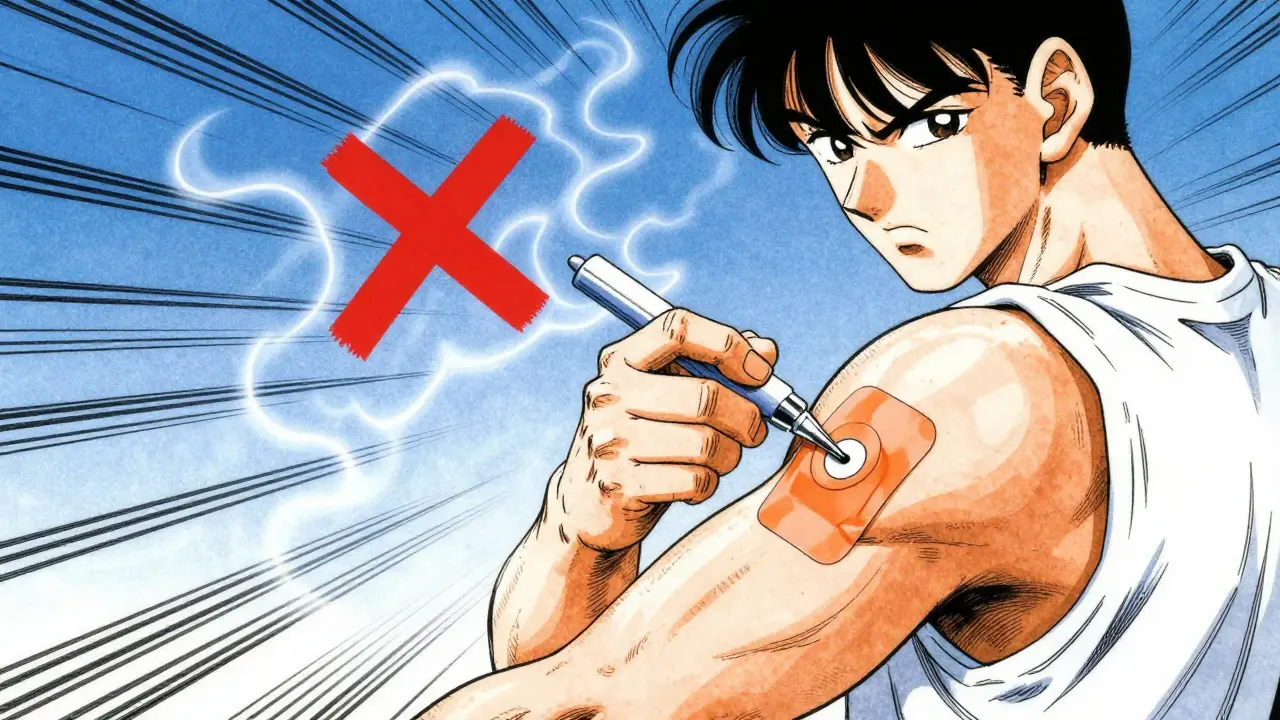
Another vital instruction is "Do Not Cut." Cutting a patch destroys its controlled-release mechanism, potentially dumping the entire dose into your system at once. The FDA notes that cutting fentanyl patches increases overdose risk significantly. Only cut a patch if your doctor and pharmacist have explicitly instructed you to do so, which is rare.
Navigating Injectable Medication Labels: Concentration and Preparation
Injectables, including insulin and other biologics, require the highest level of precision. The most dangerous error here involves misreading concentration. Insulin labels will state "U-100" (100 units/mL) or "U-500" (500 units/mL). Confusing these two can lead to a five-fold overdose or severe under-dosing. Always verify the concentration matches your prescription before drawing up any dose.
Storage conditions are prominently displayed on injectable labels. Most insulins must be refrigerated until opened, then stored at room temperature for a specific number of days. Using insulin that has been frozen or exposed to extreme heat renders it ineffective. Check the expiration date and the "discard after" date printed on the vial or pen.
If your injectable comes as a powder that needs mixing (reconstitution), the label will provide detailed steps. The Institute for Safe Medication Practices reports that 68% of injectable errors occur during preparation. Follow the reconstitution instructions precisely, including the type of diluent to use and the mixing technique. If the instructions are unclear, ask your pharmacist to demonstrate.
The Role of Auxiliary Labels: Don't Ignore the Stickers
Beyond the manufacturer's printed label, pharmacies add auxiliary labels-small stickers with specific instructions. These are critical. For inhalers, you might see "Shake Well" or "Prime Before Use." For patches, you might see "Apply to Clean, Dry Skin" or "Dispose Safely." For injectables, "Refrigerate" or "Do Not Freeze" are common.
A 2023 audit showed that 92% of specialized delivery prescriptions have these auxiliary labels. They are there to highlight risks that are easy to miss in the fine print. Treat these stickers as mandatory instructions, not suggestions.
Visual Aids and Digital Tools
Reading text alone isn't always enough. Modern labels increasingly include pictograms or QR codes. Scanning a QR code can link you to a video demonstrating proper administration technique. Studies show that using these digital resources improves patient comprehension by 29%. If your label has a QR code, scan it. If not, ask your pharmacist for a demonstration video.
For those with visual impairments, large-print labels or braille options may be available. The DEA requires visual identification descriptors on 87% of specialized labels to help distinguish between similar-looking devices. If you struggle to read the small print, request assistance immediately.
When to Seek Help
If any part of the label is unclear, do not guess. Contact your pharmacist. They are trained to explain complex labeling in simple terms. The American Society of Health-System Pharmacists recommends 15-20 minutes of counseling for new specialized medications. Take advantage of this time. Ask questions like:
- How do I know when this device is empty?
- What should I do if I miss a dose?
- Are there specific foods or activities I should avoid?
How do I know if my inhaler is empty?
Check for a dose counter on the device. If there is no counter, track your puffs manually. Remember, the canister may feel full due to propellant even when the medication is gone. Refer to the label for the total number of actuations.
Can I cut a transdermal patch in half?
Generally, no. Cutting a patch disrupts the controlled-release mechanism and can cause a dangerous overdose. Only cut a patch if your doctor and pharmacist have explicitly instructed you to do so.
What does 'U-100' mean on an insulin label?
'U-100' means there are 100 units of insulin per milliliter. It is critical to match this concentration with your syringe or pen settings. Using U-500 insulin with U-100 equipment can lead to severe dosing errors.
Why is heat warning important on patch labels?
Heat increases blood flow to the skin, which can accelerate drug absorption by up to 50%. This can lead to toxic levels of medication in your body. Avoid hot baths, heating pads, and excessive sun exposure while wearing a patch.
What are auxiliary labels?
Auxiliary labels are stickers added by the pharmacy with specific instructions like "Shake Well," "Refrigerate," or "Do Not Cut." They highlight critical safety information that may be missed in the standard label text.