

When a brand-name drug loses its patent, the first generic version usually hits the market at about 15% to 20% of the original price. That sounds like a win-until you realize the real savings haven’t even started yet. The biggest price drops come not from the first generic, but from the second and third generics that follow. These aren’t just copies-they’re market disruptors that force prices down by half, sometimes more.
Why the First Generic Isn’t Enough
The first generic drug to enter after a brand’s patent expires often doesn’t slash prices as much as you’d expect. Why? Because there’s no real competition yet. The manufacturer knows it’s the only game in town, so it sets a price just low enough to attract buyers but high enough to still make a healthy profit. Data from the FDA shows that after the first generic enters, prices typically fall to about 87% of the original brand price. That’s a drop, but not a crash. In many cases, that first generic company even has a head start thanks to exclusivity rules. The Hatch-Waxman Act lets the first generic manufacturer get 180 days of market exclusivity, meaning no other generics can enter during that time. That’s plenty of time to lock in customers and set pricing before anyone else shows up.The Real Price Crash: Second Generic Entry
When the second generic arrives, everything changes. Suddenly, there are two companies selling the exact same pill. Neither wants to lose market share, so they start undercutting each other. The FDA found that the second generic typically brings prices down to just 58% of the brand’s original price. That’s a 31-point drop in just a few months. This isn’t theoretical. Take the cholesterol drug atorvastatin (generic Lipitor). After the first generic entered, it sold for around $0.30 per pill. When the second generic hit, prices dropped to $0.15. By the time the third generic arrived, it was $0.08. That’s an 80% reduction from the first generic’s price-and over 90% below the brand’s original cost. The pressure isn’t just from price. Generic manufacturers also compete on delivery speed, packaging, and even customer service. Pharmacies and PBMs (pharmacy benefit managers) now have leverage. They can threaten to drop one supplier if prices don’t drop further. That’s why some of the biggest savings happen in the first year after the second generic enters.Third Generic: The Price Collapse Point
The third generic doesn’t just lower prices-it triggers a cascade. Once three or more manufacturers are selling the same drug, the market shifts from competition to a race to the bottom. The FDA’s analysis shows prices fall to just 42% of the brand’s original price at this stage. That’s a 58% drop from the first generic’s price alone. This is where the real savings for patients and insurers kick in. A 2021 analysis by the Assistant Secretary for Planning and Evaluation (ASPE) found that markets with three generic competitors see price reductions of about 20% compared to duopolies. But the savings don’t stop there. When five or more generics enter, prices can fall 70% to 80% below the brand price. In some cases, like the antibiotic amoxicillin, you can find the same pill for less than a penny per dose. The University of Florida tracked this pattern across hundreds of drugs and found that when competition drops from three to two manufacturers, prices often spike by 100% to 300%. That’s not a glitch-it’s how the market works. Remove one competitor, and the remaining ones stop competing. They start pricing like monopolies again.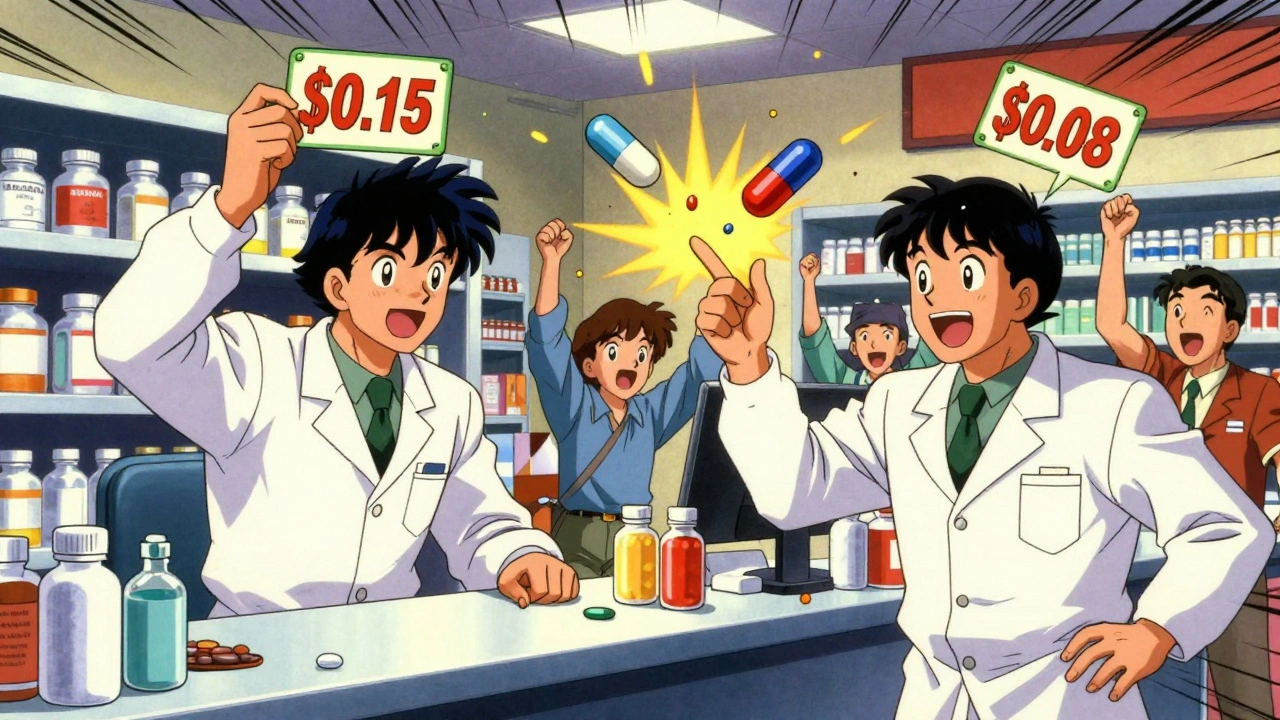
Why More Competitors = Lower Prices
It’s basic economics: more sellers = lower prices. But in the generic drug world, it’s more extreme because the product is identical. There’s no brand loyalty. No marketing. No patents. Just pills in a bottle. So the only way to win is to be the cheapest. Manufacturers know this. They enter the market expecting thin margins. Some even lose money on the first few batches just to get their name on the list. Once they’re in, they can sell volume at low prices and still profit. That’s why companies like Teva, Mylan, and Sandoz keep entering markets-even if they’re already crowded. The cost to produce a generic pill is often less than a nickel. The real expense is in getting approval from the FDA, which can take years and cost millions. But once that’s done, the marginal cost of making another pill is almost nothing. That’s why prices keep falling: there’s no limit to how low they can go, as long as someone’s willing to make them.Who’s Holding Prices Up?
Despite the clear benefit of multiple generics, competition isn’t always free. Big players sometimes block it. Brand-name companies use tactics like “pay for delay”-paying a generic manufacturer to stay out of the market. The Blue Cross Blue Shield Association estimates this costs patients $3 billion a year in higher out-of-pocket costs. Another tactic is “patent thicketing,” where a brand files dozens of minor patents to delay generics. One drug had 75 patents, stretching its monopoly from 2016 to 2034. Even after generics enter, consolidation in the supply chain works against consumers. Three companies-McKesson, AmerisourceBergen, and Cardinal Health-control 85% of drug distribution. Three PBMs handle 80% of prescriptions. They negotiate with manufacturers, but they’re not always pushing for the lowest price. Sometimes they favor suppliers they have exclusive deals with, even if others offer better rates.What Happens When Competition Fades
If a generic manufacturer exits the market-due to low margins, supply issues, or consolidation-the price can jump overnight. In 2017, a muscle relaxant called cyclobenzaprine had three manufacturers. One shut down. Prices doubled in six months. Another drug, doxycycline, saw a 300% price spike when one of four makers left the market. This volatility is why experts say the sweet spot for savings is between the second and fifth generic entrants. After that, too many competitors can lead to financial strain, and some companies quit. That’s why the FDA is now pushing to speed up approvals for complex generics-like injectables and inhalers-where fewer companies have the capacity to enter.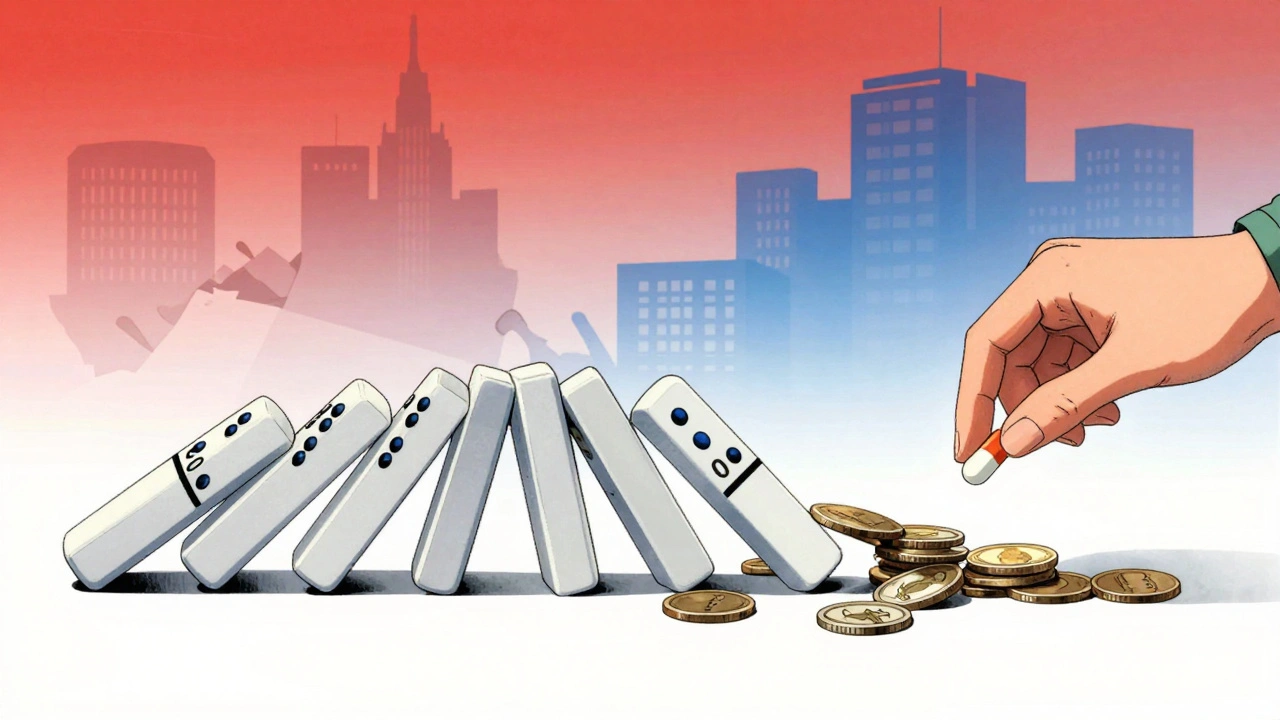
How Much Money Are We Talking About?
The numbers are staggering. Between 2018 and 2020, the FDA approved 2,400 new generic drugs. Those drugs saved consumers $265 billion. That’s not a guess-it’s an official estimate based on price comparisons before and after generic entry. The Actuarial Research Corporation projects that if we accelerate generic competition through policy changes, we could save $1 trillion in prescription drug spending over the next decade. Most of that comes from getting more second and third generics into the market faster. For patients paying out of pocket, this isn’t abstract. A 30-day supply of metformin (a diabetes drug) used to cost $120 with the brand. After the first generic, it dropped to $25. After the third generic, it’s now $4. That’s the difference between taking your medicine and skipping doses.What’s Being Done to Help?
Legislation is slowly catching up. The CREATES Act (2022) stops brand companies from blocking generic manufacturers from getting samples needed for testing. The Preserve Access to Affordable Generics Act targets “pay for delay” deals. The FDA’s GDUFA III program, running through 2027, includes faster review timelines for generics, especially for complex drugs where competition has been slow. But progress is uneven. While simple pills like lisinopril or hydrochlorothiazide have 20+ manufacturers, injectables, inhalers, and topical creams still have only one or two. That’s where the next wave of savings needs to happen.What Patients Should Know
If you’re on a generic drug and your price suddenly jumps, ask your pharmacist: “Are there other generics available?” If you’re paying more than $10 for a common generic, you’re probably not getting the best deal. Pharmacies often default to the supplier they have a contract with-not the cheapest one. Insurers and PBMs are supposed to steer you to the lowest-cost option. But they don’t always. If your plan won’t cover the cheapest generic, file an appeal. Mention the number of manufacturers available. That’s a legitimate argument. The bottom line? Generic drugs aren’t just cheaper-they get cheaper over time. The more companies making them, the better off you are. The second and third generics aren’t just nice to have. They’re the reason you can afford your medicine at all.Why do generic drug prices keep dropping after the first one enters?
The first generic often doesn’t drop prices much because it has little to no competition. Once a second or third manufacturer enters, they compete aggressively on price since the product is identical. This drives prices down rapidly-often by 50% or more within months. The more manufacturers there are, the lower the price goes.
How much can adding a third generic reduce a drug’s price?
Adding a third generic typically brings the price down to about 42% of the original brand-name drug’s cost. That’s a 27% further drop from the second generic’s price and over 90% below the brand’s original price. For example, a drug that cost $1 per pill as a brand might drop to $0.15 after the first generic, $0.08 after the second, and $0.04 after the third.
Do generic drug prices ever go up after they’ve dropped?
Yes. If one or more manufacturers leave the market-due to low profits, supply issues, or consolidation-prices can spike dramatically. Studies show that when competition drops from three to two manufacturers, prices can jump 100% to 300%. This is why maintaining multiple suppliers is critical for stable, low prices.
What’s the difference between brand-name and generic drug pricing?
Brand-name drugs are sold under patent protection, meaning only one company can make them. That allows the maker to set high prices with no competition. Generic drugs have no patents, so multiple companies can produce them. Once competition kicks in, prices fall rapidly. The brand’s price is often 10 to 100 times higher than the generic’s after multiple entrants.
Why don’t all generic drugs have many manufacturers?
Some drugs are harder to make-like injectables, inhalers, or complex formulations. They require specialized equipment and regulatory approval, which deters smaller companies. Also, brand manufacturers sometimes delay generics through legal tactics like patent thickets or pay-for-delay deals. Consolidation among generic makers has also reduced the number of independent competitors.
How can I make sure I’m getting the cheapest generic?
Ask your pharmacist if there are multiple generic versions available. Check your insurance formulary to see which one is listed as the lowest-cost option. If your plan won’t cover the cheapest version, request a formulary exception. Many pharmacies will switch to a lower-cost generic if you ask-especially for common drugs like metformin, lisinopril, or atorvastatin.



Yatendra S - 14 December 2025
💸 When the third generic hits, it’s like watching a monopoly turn into a flea market. One pill, 10 sellers, everyone screaming "BUY MEEE!" 🤑
kevin moranga - 14 December 2025
This is one of those rare cases where capitalism actually works the way it’s supposed to. More players = lower prices = people actually getting their meds. I wish more industries operated like this. The fact that a $120 diabetes pill can drop to $4 because of competition? That’s not just smart economics - that’s human decency.
Webster Bull - 15 December 2025
more generics = cheaper pills = less people dying b/c they skipped doses. simple. why is this even a debate?
Alvin Montanez - 16 December 2025
Let’s be honest - this whole system is a joke. The FDA approves generics like they’re handing out candy, but the real villains are the PBMs and pharmacy chains who lock in contracts to keep prices high. They don’t care about savings - they care about kickbacks. And don’t even get me started on how they bury the cheapest option under five layers of ‘preferred formulary’ nonsense. This isn’t free market. It’s rigged market.
Keasha Trawick - 17 December 2025
OMG. I just realized - this is the only industry where the product gets CHEAPER the more people make it. Imagine if Netflix got cheaper every time a new streaming service launched. Or if your iPhone dropped in price every time Samsung made a copy. We’d all be living in a utopia. But no - we’re stuck with pharmaceutical monopolies playing 3D chess while patients go bankrupt. 🤯
Himmat Singh - 18 December 2025
One must question the underlying assumption that competition inherently leads to societal benefit. The market, in its unfettered state, often produces instability - as evidenced by the 300% price spikes when a manufacturer exits. Is volatility a fair trade for marginal savings? One might argue that regulated, stable pricing - even at higher levels - ensures continuity of supply and avoids the dangerous boom-and-bust cycles that harm patient adherence.
Donna Hammond - 19 December 2025
I’ve worked in pharmacy for 18 years, and this is 100% accurate. I’ve seen patients cry because they couldn’t afford their blood pressure med - then watched the price drop from $45 to $3 when a third generic came in. The system isn’t broken - it’s just being manipulated by middlemen who don’t care about your health. If your pharmacy won’t switch to the cheapest generic, ask for the formulary exception form. They’re required to process it. Don’t take ‘no’ for an answer.
Richard Ayres - 20 December 2025
It’s fascinating how economics plays out in such a visceral, human way here. The moment competition enters, the abstract concept of ‘value’ collapses into the tangible reality of ‘affordability.’ What’s remarkable is how little the product changes - same chemical, same packaging, same pill - yet the price becomes a mirror of market dynamics rather than production cost. It reveals how much of what we pay is not for the medicine, but for the illusion of scarcity.
Emma Sbarge - 21 December 2025
America needs to stop pretending we’re a free market when we’re really a corporate oligarchy. The fact that three distributors control 85% of the supply chain? That’s not competition - that’s collusion with a side of bureaucracy. And don’t tell me ‘the market fixed it’ - the market only fixes things when it’s profitable. People are dying because a PBM’s contract says they can’t switch to the $0.04 version. This isn’t capitalism. This is feudalism with a pharmacy receipt.
Tommy Watson - 22 December 2025
bro why is this so hard? i just want my atorvastatin to be cheap. why do i have to write a thesis to get a $4 pill? 🤡
Tom Zerkoff - 22 December 2025
I appreciate the depth of this analysis. While the data clearly demonstrates the benefits of multi-generic competition, we must also consider the long-term sustainability of the generic manufacturing ecosystem. Thin margins incentivize consolidation, which eventually reduces competition - creating a paradox. Policy interventions should not only accelerate entry but also ensure that smaller manufacturers remain viable. A healthy market requires not just quantity of competitors, but diversity of capacity and resilience. We must design systems that reward participation, not just price-cutting.