
Statin Exercise Risk Calculator
Your Statin Type
Exercise Intensity
Your risk assessment will appear here
Millions of people take statins to lower cholesterol and protect their hearts. But for many, a nagging side effect keeps them from moving: muscle pain. And when they try to start exercising - something their doctor told them to do - the pain gets worse. So what’s really going on? Can you still work out on statins? Does exercise make muscle damage worse? Or could it actually help?
The answer isn’t simple. But the latest science, from studies in 2023 and 2024, gives us clear answers - if you know what to look for.
Statin Muscle Pain Is Real - But Not Always What You Think
Statin-associated muscle symptoms (SAMS) affect between 5% and 29% of users. That wide range isn’t random. Clinical trials report lower numbers because they control for placebo effects. Real-world data? People stop taking statins because their legs ache, their shoulders feel heavy, or they just can’t get up the stairs like they used to. It’s frustrating. And it’s often mislabeled.
Here’s the key: statin pain doesn’t feel like a workout soreness. It’s constant. It shows up within 30 days of starting the drug and doesn’t go away when you rest. If you were active before starting statins and then suddenly felt stiff all the time - that’s a red flag. Harvard Health found people who exercised regularly before taking statins were 37% less likely to develop muscle pain. Why? Their muscles were already conditioned. Their mitochondria - the energy factories inside muscle cells - were stronger.
Statin drugs block a pathway that makes cholesterol - but they also block coenzyme Q10 (CoQ10). CoQ10 helps your muscles produce energy. Without enough, even simple movements can feel like a chore. A 2015 study showed CoQ10 drops by 40% within a month of starting statins. That’s not a coincidence. It’s biology.
Not All Statins Are Created Equal
There are over a dozen statins on the market. But they’re not all the same. Some slip easily into muscle tissue. Others don’t.
Lipophilic statins - like atorvastatin (Lipitor), simvastatin (Zocor), and lovastatin - are fat-soluble. That means they pass through cell membranes easily… including muscle cells. That’s why high-dose atorvastatin (80 mg/day) increased creatine kinase (CK) levels by 11.3% in a 6-month trial compared to placebo. CK is a marker of muscle damage. Even in people who didn’t feel pain.
Hydrophilic statins - like rosuvastatin (Crestor) and pravastatin (Pravachol) - are water-soluble. They stay mostly in the liver, where they’re supposed to work. They don’t invade muscle tissue as much. The FDA’s adverse event data shows atorvastatin 80 mg has a 10.5-fold higher risk of severe muscle injury than pravastatin 40 mg. That’s not a small difference. It’s life-changing.
If you’re struggling with muscle pain and your doctor hasn’t switched your statin, ask: "Is this the right one for me?"
Exercise: Friend or Foe?
Here’s where most people get it wrong. They think: "If statins hurt my muscles, then exercise must make it worse." But the data says otherwise.
A major 2023 study in the Journal of the American College of Cardiology followed 105 people: 35 with statin muscle pain, 35 without, and 35 not taking statins. All did a 30-minute moderate bike ride. The result? CK levels rose the same amount in all three groups. No extra damage. No extra pain. Just normal, expected muscle stress.
That’s huge. It means moderate exercise doesn’t make statin muscle pain worse. In fact, it might help. Movement improves blood flow. It helps mitochondria recover. It keeps muscles strong.
But there’s a catch. Vigorous exercise? That’s different.
Back in 2007, researchers studied Boston Marathon runners. Among the statin users, CK levels were nearly 50% higher than non-statin runners. One athlete hit 1,082 U/L. Normal is under 200. That’s a sign of serious muscle breakdown. And it’s not rare. A 2016 study found eccentric exercise - think downhill running or heavy weightlifting - spiked CK levels by 300% in statin users versus 200% in others. That’s a 50% increase in damage.
So: moderate exercise? Safe. Intense exercise? Risky.
What Counts as "Moderate"?
"Moderate" doesn’t mean slow. It means you can talk but not sing. Your heart rate is around 40-70% of your maximum. For most people, that’s brisk walking, cycling on flat ground, or swimming laps without pushing hard.
The American College of Cardiology recommends starting with 10-15 minutes of walking daily. Add 5 minutes each week. That’s it. No need to run a 5K on day one. In fact, that’s how people end up in the hospital.
There’s real-world proof. The 4Days Marches in the Netherlands had 100 athletes walk 30-50 kilometers a day for four straight days. Both statin users and non-users had the same rise in CK - from 150 to 350 U/L. No extra damage. No extra pain. Just consistent, moderate movement.
But here’s what happens when people ignore this: Maria Rodriguez, a competitive cyclist, took simvastatin 40 mg and trained for a race. She didn’t change her routine. Then she collapsed. CK levels hit 12,450 U/L. She was hospitalized with rhabdomyolysis - a dangerous breakdown of muscle tissue. She’s lucky to be alive.

What Should You Do?
If you’re on statins and have muscle pain:
- Don’t quit exercise. Stop intense workouts, but keep moving. Walking is your best friend.
- Switch statins. Ask your doctor about rosuvastatin or pravastatin. Studies show 65% of people feel better after switching.
- Lower the dose. Some people do fine on 20 mg instead of 40 mg. Or take it every other day - success rate: 58%.
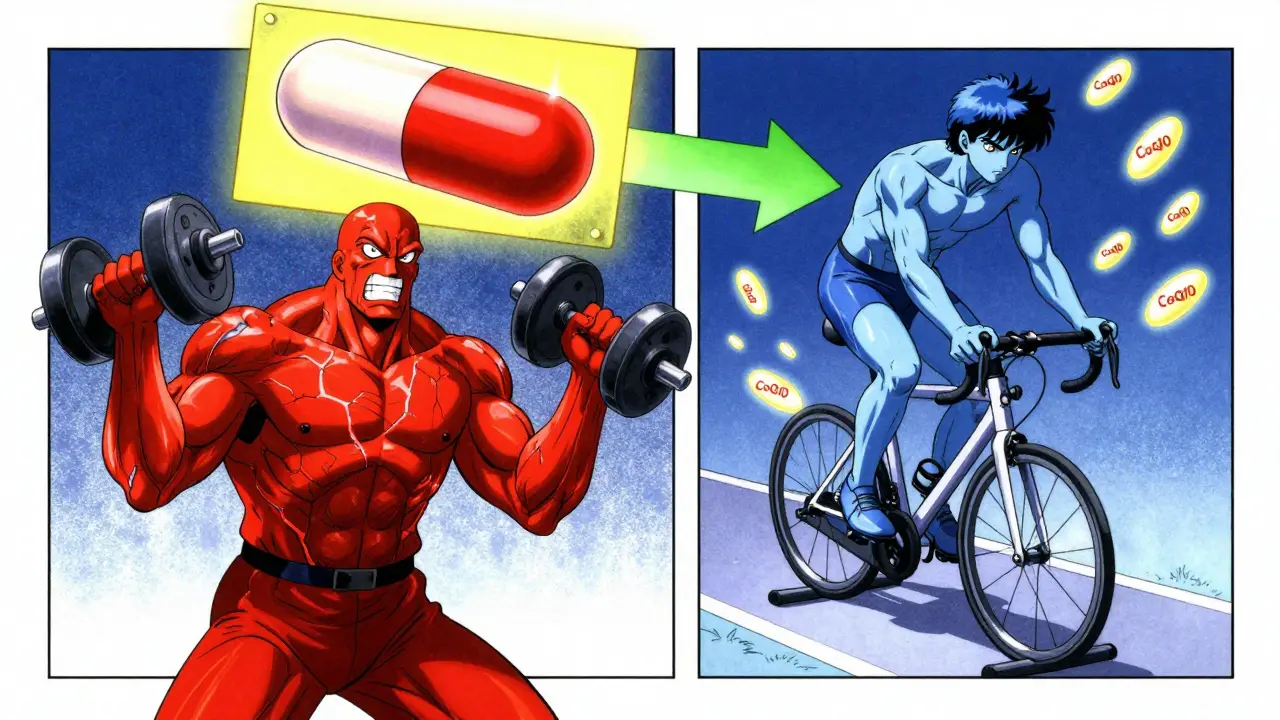
- Try CoQ10. A 2023 meta-analysis found 200 mg daily improved muscle pain in 68% of users. It’s cheap. It’s safe.
- Monitor your pain. Statin pain is constant. Exercise pain goes away in 2-3 days. If your pain flares after a workout but fades, you’re probably fine. If it lingers, stop and talk to your doctor.
John Davis, a marathon runner profiled in Runner’s World, switched from atorvastatin 40 mg to rosuvastatin 20 mg. He kept running 40 miles a week. His pain vanished. He’s still racing.
The Bigger Picture
Statins save lives. They cut heart attacks and strokes by up to 30%. But they’re not perfect. And they’re not one-size-fits-all.
The problem isn’t exercise. It’s the mismatch. People take high-dose, lipophilic statins and then do HIIT, CrossFit, or long-distance running. That’s a recipe for trouble.
The solution? Personalization. Genetic testing for the SLCO1B1 gene variant - which increases muscle pain risk by 2.3 times - is coming soon. In five years, your doctor might test your DNA before prescribing a statin. Until then, you can take control now.
Don’t stop moving. Don’t stop living. But do listen to your body. Adjust your statin. Adjust your workout. And don’t let fear stop you from doing what keeps your heart strong.
The science is clear: moderate exercise is safe. The real question isn’t whether you can move - it’s whether you’re moving in the right way.



phyllis bourassa - 7 March 2026
I swear, every time I see someone say 'just walk more' like it's some magical cure, I want to scream. I've been walking for years. My legs still feel like concrete after 10 minutes. Statins didn't just make me sore - they made me *afraid* to move. I used to dance. Now I waddle. And yes, I tried CoQ10. It did nothing. But thanks for the condescending advice, doctor.
Bridget Verwey - 7 March 2026
Wow. Someone actually wrote a post that didn’t start with 'you’re doing it wrong.' 🙌
Also, I switched from Lipitor to pravastatin last year and went from 'can’t lift grocery bags' to 'doing 5Ks on weekends.' No magic. Just the right statin. Don’t let fear keep you from moving - but do listen to your body. And if your doc says 'just push through,' find a new doc. 😎
Sean Callahan - 8 March 2026
i read this whole thing and my brain is like ‘wait so i can still jog??’ bc i’ve been too scared to even walk my dog since i started simvastatin. also, coq10? i thought that was just for bodybuilders. lol. also also, my doctor never mentioned any of this. he just said ‘take your pill and shut up.’ 🤡
Ferdinand Aton - 9 March 2026
Moderate exercise is safe? Lol. Have you ever met a 65-year-old man who 'moderately' walks and then suddenly starts doing 100 squats because he 'felt good'? That’s not moderate. That’s denial with sneakers. Also, CoQ10 is a placebo. I’ve taken it. My muscles still hate me.
William Minks - 9 March 2026
This was so helpful 😊
Just wanted to say - I’m from Kenya and we don’t have statins here like you do. But we DO have walking. Every morning, the whole neighborhood walks to the market. No one’s in a gym. No one’s doing HIIT. Just… walking. And we’re all still here. Maybe the answer isn’t the drug - it’s the rhythm. 🌿
Jeff Mirisola - 10 March 2026
I had rhabdo once. It’s not a joke. I was in ICU for 5 days. I was on simvastatin and ran a half-marathon. Don’t be that guy. I’m alive because I listened. Now I walk 30 mins a day, take rosuvastatin, and do yoga. I’m not a fitness influencer. I’m just not dead. That’s my win. 💪
Susan Purney Mark - 10 March 2026
I’m a nurse. I’ve seen so many patients quit statins because they thought exercise was the problem. The real problem? They didn’t know how to move safely. This post? Perfect.
For anyone reading this - if you’re scared, start with 5 minutes a day. Sit down. Stand up. Walk to the mailbox. That’s enough. Progress isn’t about miles. It’s about consistency. And you’re already doing better than you think. ❤️
Ian Kiplagat - 12 March 2026
Pravastatin. Changed my life. No more leg pain. Still run 5Ks. Simple.
Amina Aminkhuslen - 14 March 2026
Statins turned my body into a soggy, aching potato. I used to climb mountains. Now I need a nap after unloading the dishwasher. But here’s the twist - I started swimming. Not running. Not walking. SWIMMING. Water doesn’t care if your mitochondria are on strike. It just holds you. And guess what? My pain? Vanished. No CoQ10. No magic pills. Just water. And a whole lot of self-pity-turned-therapy. 🤷♀️💦