
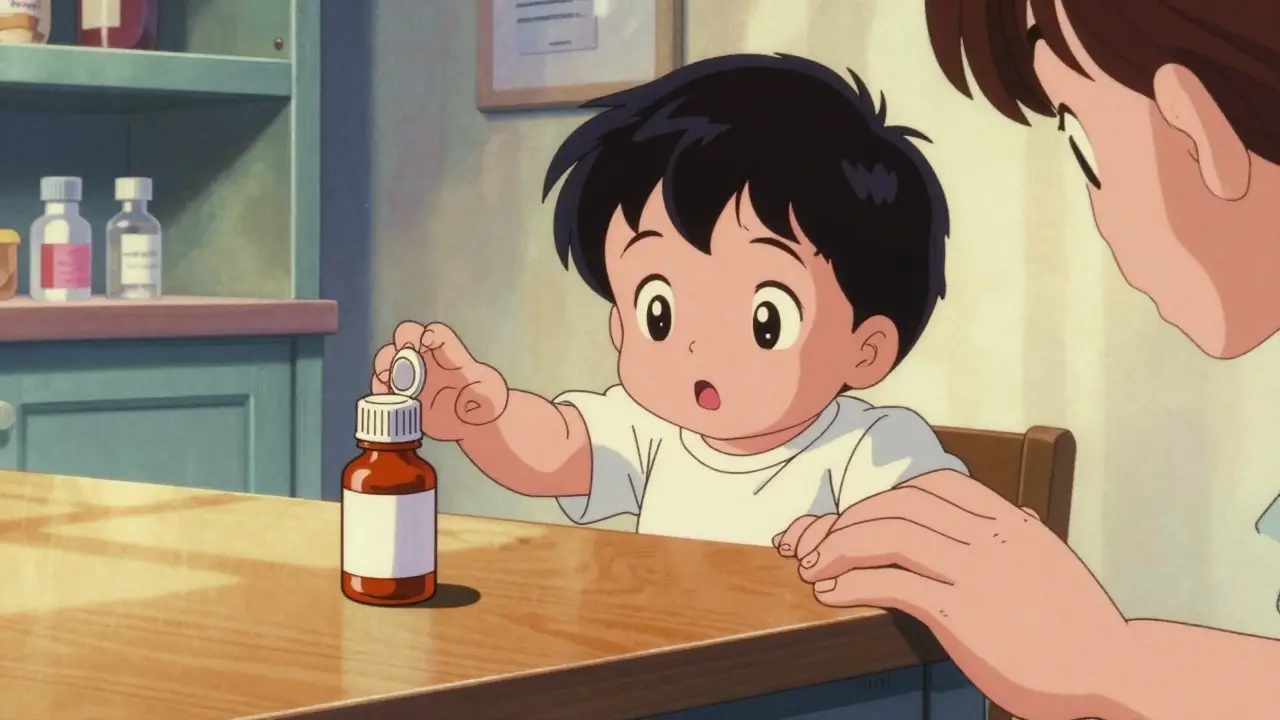
Every year, thousands of children accidentally get into medications they shouldn’t. It’s not because they’re sneaky or curious in a dangerous way-it’s because many medicine bottles look like toys, feel easy to twist, and are often left within reach. That’s where child-resistant containers come in. But they’re not magic. They don’t make medicine safe on their own. They’re just one part of a bigger safety plan.
What Exactly Is Child-Resistant Packaging?
Child-resistant packaging, or CR packaging, isn’t designed to be completely impossible for kids to open. That’s a myth. No container is truly "child-proof." Instead, it’s built to slow down a child under five years old long enough to stop them from getting into the medicine before an adult notices. The goal isn’t to stop every single attempt-it’s to reduce the number of serious accidents. This idea came from real tragedy. Between 1961 and 1966, more than 5,000 children in the U.S. died from accidentally swallowing pills or liquids. In response, Congress passed the Poison Prevention Packaging Act (PPPA) in 1970. Since then, the U.S. Consumer Product Safety Commission (CPSC) has set strict rules: a child-resistant cap must prevent at least 85% of kids aged 42 to 51 months from opening it within 10 minutes. That’s not just a suggestion-it’s a legal requirement for most prescription drugs and many over-the-counter medicines.How Do These Caps Actually Work?
The most common type you’ll see is the push-and-turn cap. You have to press down firmly while twisting. That’s two motions at once. Most toddlers can’t do that. They can twist, or they can push-but not both together. Other designs include squeeze-and-turn caps, where you have to compress the cap while turning it, or interlocking caps that require a specific sequence of pressure and rotation. These caps are made from durable plastics like high-density polyethylene (HDPE) or polypropylene. The threading inside is precision-engineered to hold up to 50+ openings without losing its grip. But here’s the catch: the same mechanism that stops kids also makes it harder for older adults. That’s why the CPSC also tests these caps on seniors aged 50 to 70. At least 90% of them must be able to open and re-close the container properly within five minutes. If they can’t, the design fails.Not All Medicines Are Created Equal
Some medications have stricter rules than others. All Schedule II through V controlled substances-like opioids or ADHD meds-must have CR packaging by law. For over-the-counter drugs, it depends on the active ingredient. For example, any product with 0.08 milligrams or more of imidazoline (a common ingredient in some nasal decongestants) must be in CR packaging. That’s because even a tiny amount can be deadly to a child. Liquid medicines are the biggest problem. They’re harder to package safely because they need to be poured, and many bottles have wide mouths or leaky spouts. In fact, nearly 40% of non-compliant packaging incidents involve liquids. Blister packs can help-especially if the foil requires at least 15 pounds of force to peel-but standard blister packs don’t count unless they’re specifically designed to be child-resistant. Nasal spray pumps are the toughest. The CPSC says even if the bottle has a CR cap, the spray pump itself isn’t child-resistant unless the whole system is redesigned. That’s why some newer nasal sprays now come with a secondary CR overcap or a locking mechanism on the nozzle.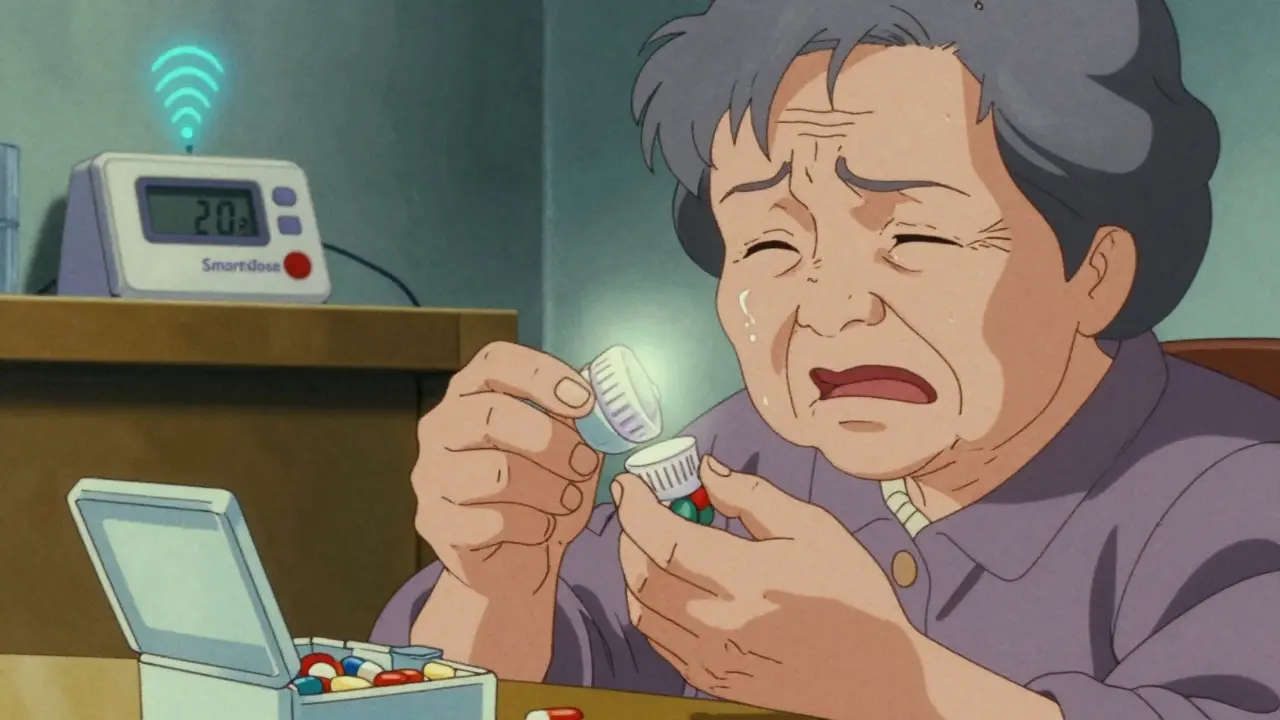
Why Do Some People Struggle to Open Them?
If you’ve ever tried to open a CR cap and felt like you needed a wrench, you’re not alone. About 68% of people with arthritis or hand weakness say they have trouble opening these containers. The average force needed to open one can exceed 5 pounds-twice what most seniors can comfortably manage. That’s why new designs are focusing on senior-friendly (SF) features. Companies like Aptar Pharma have developed caps like the Mini+cr system that achieve 92% senior success rates while still blocking 92% of children. Amazon reviews for these newer models are full of relief: “My 70-year-old mom can finally open her meds without crying,” one user wrote. But not all brands are keeping up. Consumer Reports found that some pharmacy-branded CR caps failed child resistance tests more than 20% of the time.What Happens When the Cap Is Opened?
Here’s the scary part: child-resistant packaging loses effectiveness after the first opening. The CPSC found that 15% of its protective power vanishes once the cap is opened and not re-closed properly. That’s because people don’t always twist it back on tightly. Or they leave it slightly loose. Or they break the seal and forget to replace it. In 2022, there were over 12,800 reported cases of children getting into medicine-even though the bottle was supposed to be child-resistant. In 73% of those cases, the cap was either not fully closed or had been damaged. That’s why the American Academy of Pediatrics stresses: CR packaging is just one layer. The others? Keep medicine locked up. Out of sight. Out of reach. Even if it’s "safe."How Are These Caps Made and Approved?
Pharmaceutical companies can’t just slap on any cap and call it child-resistant. They have to submit their design to a CPSC-accredited lab for testing. The process costs between $8,500 and $15,000 per design. They must prove it passes both the child and senior tests. Then they include documentation in their FDA submission, stating: "We verify in this submission that the following package meets CPSC’s standards under 16 CFR 1700." The FDA and CPSC inspect packaging regularly. If a company ships a product with non-compliant packaging, they can face fines up to $100,000 per violation. That’s why most big manufacturers get it right. But smaller pharmacies or veterinary clinics sometimes slip up. A 2022 survey found nearly half of vet practices were giving out meds in non-CR bags or envelopes-ignoring the law.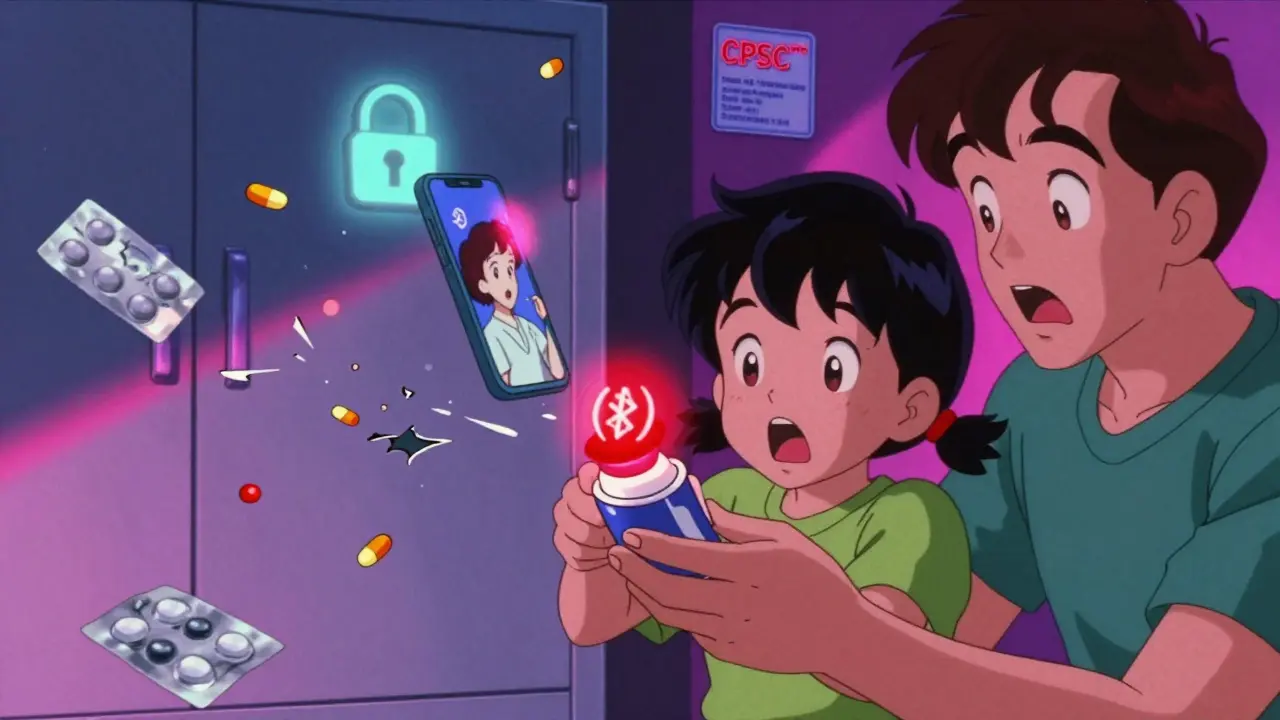
What’s Changing Now?
The world of CR packaging is evolving. In 2023, Aptar Pharma launched the first FDA-cleared smart CR cap called SmartDose. It looks like a regular cap but has Bluetooth inside. It records every time the bottle is opened-and sends a notification to a caregiver’s phone if a child tries to open it. That’s a big step forward. Regulators are also expanding the list of products that need CR packaging. In 2016, e-cigarette refill liquids were added. In 2023, the CPSC proposed new rules for THC edibles with more than 2mg of THC per serving. And they’re looking at laundry detergent pods next-because kids are still eating those, even though they’re brightly colored and smell like candy. Globally, countries are catching up. Brazil and India made CR packaging mandatory for all medications in 2021 and 2022. The EU follows ISO 8317 standards, which are similar but not identical to U.S. rules. The global market for this packaging is expected to hit $4.87 billion by 2028, driven by aging populations and stricter rules.What Should You Do?
If you have kids, or if you live with someone who does:- Always close the cap after use-even if you’re just putting it back on the counter.
- Store meds in a locked cabinet, not on the bathroom counter or kitchen table.
- Don’t rely on CR caps alone. They’re a backup, not a solution.
- If you or a loved one struggles to open them, ask your pharmacist for a senior-friendly version. Many pharmacies can switch to easier caps if you request it.
- Check the label. If it says "Not child-resistant," that means it’s meant for households without young children. Use it only if you’re sure no kids can reach it.
What About the Future?
The future of medication safety isn’t just about stronger caps. It’s about smarter ones. More than 78% of pharmaceutical developers say they plan to combine child resistance with digital tracking-like reminders to take medicine, or alerts if the bottle is opened at odd hours. That’s not science fiction. It’s already happening. But no matter how smart the cap gets, the most important thing remains: keep medicine out of reach. Lock it. Store it high. And never, ever leave it unattended-even for a second.Are child-resistant caps really effective?
Yes, but not perfectly. Since the 1970s, child-resistant packaging has helped reduce pediatric poisoning deaths by 45%. It prevents an estimated 900,000 accidental ingestions each year. But it’s not foolproof-about 12,800 incidents still happen annually, mostly because caps aren’t re-closed properly or are damaged. CR packaging reduces risk, but it doesn’t eliminate it.
Can I ask my pharmacist for easier-to-open caps?
Absolutely. If you have arthritis, limited hand strength, or other mobility issues, you have the right to request non-child-resistant packaging. The law requires pharmacies to provide it if you sign a form acknowledging the risk. Many pharmacies keep these caps on hand for seniors or people with disabilities. Just ask.
Why do some medicine bottles still have easy-to-open caps?
Some products aren’t required to have child-resistant packaging. This includes certain over-the-counter medicines with low-risk ingredients, or products meant for institutional use like hospitals. Labels will say "Not child-resistant" if that’s the case. Never assume a bottle is safe-always check the label and store it securely.
Do child-resistant caps work on toddlers who are clever or strong?
They’re designed to stop most kids under five, but some children figure them out. Toddlers can be surprisingly persistent. If your child has opened a CR cap before, don’t assume it won’t happen again. Always store medicine out of reach, even if it’s "child-resistant." Never rely on the cap alone.
Is it safe to transfer pills to a pill organizer?
It’s risky. Once you remove medicine from its original CR container, you lose the safety protection. If you use a pill organizer, make sure it’s stored in a locked cabinet. Never leave it on the counter or in a purse where a child can find it. The original bottle is the safest container.

John O'Brien - 26 January 2026
These caps are a joke. My 3-year-old opened my dad’s blood pressure meds last week like it was a toy. I swear, kids are smarter than we give them credit for. The only thing stopping them is a locked cabinet - not some plastic cap that twists like a damn Rubik’s cube.
Paul Taylor - 28 January 2026
Child-resistant packaging has saved hundreds of thousands of lives since the 70s but we keep acting like it’s a magic bullet when it’s really just one layer in a whole damn system. You got to lock it up store it high forget about the cap being enough and teach your kids that medicine isn’t candy even if it looks like gummy bears. And don’t even get me started on how pharmacies still hand out non-CR bottles to vets or for certain OTC stuff like laxatives or antihistamines. The law’s there but enforcement is garbage and people get lazy and then someone gets hurt and suddenly we’re all shocked. Wake up. This isn’t rocket science. It’s basic parenting and basic responsibility.
Desaundrea Morton-Pusey - 29 January 2026
So now the government is forcing us to struggle with caps so toddlers can’t get into medicine but we’re still allowed to buy 1000 pills of pseudoephedrine over the counter? Yeah right. This is all about control. They don’t care about kids they care about controlling what we can access. And now they’re talking about putting trackers on pills? Next thing you know they’ll be monitoring when we take our Tylenol. Welcome to the surveillance pharmacy state.
Murphy Game - 30 January 2026
SmartDose caps with Bluetooth? Of course. Because nothing says freedom like your meds reporting your every move to Big Pharma and the FDA. They’re not protecting kids. They’re building a database. Every time you open that bottle it’s logged. Who’s accessing it? Who’s selling it? You think your data’s safe? Think again. This isn’t safety. It’s surveillance dressed up in baby blues and rubber seals.
April Williams - 1 February 2026
Anyone who leaves their meds on the counter deserves what happens. I don’t care if it’s child-resistant or not - if you’re dumb enough to leave pills out like snacks you’re a danger to society. My neighbor’s kid almost died because her mom thought "it’s just one bottle". No. It’s not. It’s negligence. And if you’re too lazy to lock it up then maybe you shouldn’t have kids. Or meds. Or both.
Harry Henderson - 2 February 2026
Stop complaining about hard-to-open caps. If you can’t twist a bottle after 70 you’ve got bigger problems than medicine. Get a grip literally. And if you’re too weak to open your own meds then ask your pharmacist for a senior-friendly cap - they’re not hard to find. But don’t blame the system because you refuse to adapt. Safety doesn’t care how old you are or how sore your hands are. It cares that your grandkid doesn’t die from a misplaced pill.
suhail ahmed - 2 February 2026
Man in India we got these caps too now since 2022. But here’s the thing - in rural areas people still keep medicine in open drawers because they think it’s "just aspirin". The cap helps but culture matters more. You can have the best tech in the world but if grandma keeps pills under her pillow like magic beans nothing changes. We need education not just engineering. And maybe a village auntie who yells at people for leaving meds out. That works better than any Bluetooth sensor.
Candice Hartley - 4 February 2026
My grandma uses the easy-open caps now. She cried when she opened her first one without help. 😭 Thank you, pharmacists, for listening.
astrid cook - 4 February 2026
Why do we even have child-resistant packaging? Because parents are too lazy to lock things up. It’s not the cap’s fault. It’s theirs. And now we’re making everyone suffer because some people refuse to parent. I’m just saying.