
CYP2D6 Medication Interaction Checker
Check Medication Interaction
This tool checks if your medications may interfere with codeine's effectiveness by inhibiting the CYP2D6 enzyme.
How It Works
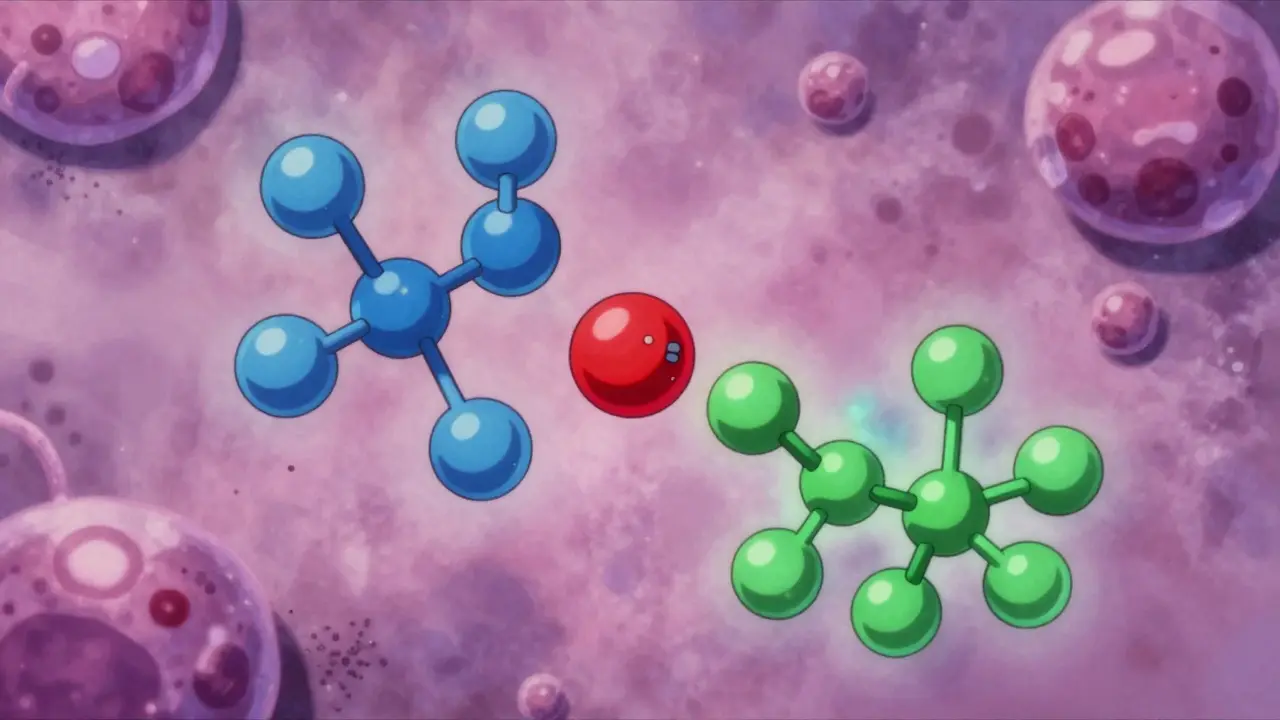
Codeine requires CYP2D6 enzyme to convert to morphine for pain relief.
Fluoxetine and Paroxetine strongly inhibit CYP2D6 (Ki: 0.2 µM and 0.14 µM).
When taken together, these medications prevent codeine from becoming effective.
Interaction Results
Select medications and click 'Check Interaction' to see if there's a potential issue.
How Codeine Really Works
Codeine is a prodrug opioid analgesic that requires metabolic activation by the CYP2D6 enzyme to convert into morphine, its active form. Unlike morphine itself, codeine doesn't work directly. Your liver must change it into morphine for pain relief. About 5-10% of a codeine dose becomes morphine this way. If this conversion doesn't happen, codeine won't help with pain.
The CYP2D6 Enzyme's Role
CYP2D6 is a liver enzyme responsible for metabolizing about 25% of commonly prescribed drugs, including codeine. This enzyme does the heavy lifting for codeine. Without it, codeine stays inactive. Your genes determine how well CYP2D6 works. Some people have poor CYP2D6 activity naturally, making codeine ineffective. But even people with normal activity can have problems if certain medications block CYP2D6.
How Antidepressants Block CYP2D6
Fluoxetine (Prozac) and paroxetine (Paxil) are selective serotonin reuptake inhibitors (SSRIs) used for depression. But they also potently inhibit CYP2D6. Fluoxetine has a Ki value of 0.2 µM, and paroxetine is even stronger at 0.14 µM. This means they bind tightly to CYP2D6, blocking codeine's conversion. A 2004 study by Gasche et al. showed paroxetine reduced morphine levels by 78% and peak concentration by 85%. Essentially, it turns normal metabolizers into functional poor metabolizers.

Evidence from Science and Guidelines
The U.S. Food and Drug Administration (FDA) issued warnings about this interaction. In 2007, they first noted that CYP2D6 inhibitors like fluoxetine and paroxetine reduce codeine's effectiveness. By 2012, they strengthened this warning under the Codeine REMS program. The Clinical Pharmacogenetics Implementation Consortium (CPIC) guidelines updated in 2022 explicitly say to avoid codeine with strong CYP2D6 inhibitors like these antidepressants.
A landmark 1996 study by Somogyi et al. in Clinical Pharmacology & Therapeutics showed quinidine (a CYP2D6 inhibitor) reduced morphine formation by 80%. This set the stage for understanding the interaction. Later studies confirmed it with fluoxetine and paroxetine.
Real-World Impact: Cases and Surveys
A 2020 survey of 1,247 pain management specialists found 78.4% had seen cases where codeine failed due to CYP2D6 inhibitors. Paroxetine was the most common culprit at 63.2%, followed by fluoxetine at 41.7%. On Medscape, Dr. Sarah Chen shared a case: a post-hysterectomy patient on paroxetine got zero pain relief from codeine. Switching to oxycodone fixed the issue immediately.
Pharmacists on Reddit's r/Pharmacy reported similar experiences. One user, u/PharmTechMike, said he's had 15 patients in a year report codeine not working while on Paxil. They all needed to switch to hydrocodone or oxycodone.

Safer Alternatives for Pain Management
When you're taking fluoxetine or paroxetine, codeine isn't the right choice. Here are safer alternatives:
| Opioid | Primary Metabolism Pathway | CYP2D6 Inhibition Risk |
|---|---|---|
| Oxycodone | CYP3A4 (to oxymorphone) | Minimal risk |
| Morphine | Direct-acting | No risk |
| Hydromorphone | Direct-acting | No risk |
| Hydrocodone | CYP2D6 (to hydromorphone) | High risk |
Oxycodone, morphine, and hydromorphone don't rely on CYP2D6. This makes them reliable options. Hydrocodone, however, also depends on CYP2D6 and carries similar risks. Always check with your doctor before switching.
What You Should Do
If you're on fluoxetine or paroxetine and need pain relief:
- Tell your doctor about all medications you take, including antidepressants.
- Ask for alternatives like oxycodone or morphine instead of codeine.
- Pharmacists can screen for this interaction when filling prescriptions. They're trained to spot these risks.
- Genetic testing for CYP2D6 is available but not always necessary. Discuss with your healthcare provider.
Frequently Asked Questions
Can I take codeine with fluoxetine or paroxetine?
No. Combining codeine with fluoxetine or paroxetine blocks the enzyme needed to convert codeine into morphine. This makes codeine ineffective for pain relief. Always tell your doctor about all medications you're taking to avoid this interaction.
What painkillers are safe with fluoxetine or paroxetine?
Oxycodone, morphine, and hydromorphone are safe options. They don't rely on CYP2D6 for activation. Hydrocodone is not recommended because it also depends on CYP2D6. Always confirm with your doctor or pharmacist before switching painkillers.
How do I know if my codeine isn't working due to CYP2D6 inhibition?
If you're taking fluoxetine or paroxetine and codeine provides no pain relief, this is likely the cause. A blood test measuring morphine and codeine levels can confirm it. A morphine/codeine ratio below 0.03 indicates significant CYP2D6 inhibition. Normal ratios are 0.05-0.10.
Is genetic testing necessary for this interaction?
Not usually. Most cases of codeine failure due to CYP2D6 inhibitors are from medications, not genetics. If you're taking fluoxetine or paroxetine, the interaction is predictable and avoidable without testing. However, genetic testing may be useful if you have unexplained poor response to codeine without known inhibitors.
What should I do if my doctor prescribed codeine while I'm on an SSRI?
Contact your doctor immediately. Explain you're taking fluoxetine or paroxetine and ask for an alternative painkiller. Pharmacists can also flag this interaction during prescription filling. Never stop antidepressants without medical advice, but do discuss safer pain management options.




Thorben Westerhuys - 6 February 2026
Codeine is useless when on Prozac!! I had this happen to me! My doctor didn't know, and I was in agony! It's a known issue, but still!! Why don't more people know this??
Laissa Peixoto - 7 February 2026
Interesting point. The CYP2D6 enzyme is crucial for converting codeine to morphine. When inhibited by SSRIs like fluoxetine or paroxetine, the conversion is significantly reduced. Studies show up to 85% reduction in morphine levels. This is why alternative opioids like oxycodone or morphine are recommended. It's a critical interaction that healthcare providers should be aware of.
Lana Younis - 7 February 2026
yo codeine needs CYP2D6 to work. fluoxetine and paroxetine block that enzyme. so if u take them together, codeine is useless. paroxetine reduces morphine by 78% according to Gasche et al 2004. so switch to oxycodone or morphine. hydrocodone is also bad. pharmacists should screen for this. but most docs dont know.
Bella Cullen - 7 February 2026
Yeah, but doctors still prescribe codeine. Why isn't this more common knowledge? It's frustrating.
Sam Salameh - 8 February 2026
As a proud American, I'm shocked this isn't taught in med school. Our healthcare system needs better education on drug interactions. Always check with your pharmacist!
Cullen Bausman - 9 February 2026
Codeine's efficacy depends on CYP2D6 metabolism. Inhibition by SSRIs results in reduced morphine conversion. FDA and CPIC guidelines recommend alternatives. Consult healthcare provider.
Dina Santorelli - 9 February 2026
Ugh, another post about codeine failing. Everyone's been saying this for years. Doctors still prescribe it anyway. It's so frustrating.
divya shetty - 10 February 2026
Dear patient, it is imperative that you disclose all medications to your physician. This interaction is well-documented. Failure to do so may result in inadequate pain management. Please be responsible with your health information. Sincerely, a concerned healthcare professional.
Nancy Maneely - 11 February 2026
OMG this is sooo important! I can't believe people still take codeine with Prozac! My friend's dad had a stroke because of it! Wait no, not a stroke, but he was in so much pain and they didn't know why. It's a disaster waiting to happen. Like, why isn't this common knowledge? Pharma companies should be sued for this!
Phoebe Norman - 13 February 2026
Codeine doesn't work with SSRIs.
Albert Lua - 13 February 2026
Hey everyone, this is a great topic! As someone who's traveled a lot, I've seen different healthcare systems handle this differently. In some countries, they test for CYP2D6 before prescribing codeine. In others, it's not routine. But globally, this interaction is a big deal. Always check with your pharmacist! They're the experts on drug interactions.
Danielle Vila - 14 February 2026
Codeine not working? That's because Big Pharma and the FDA are covering this up! They want you to keep taking codeine so they can sell more antidepressants. But the truth is, CYP2D6 inhibitors like fluoxetine are designed to block it. It's all part of the plan. They don't want you to know about oxycodone alternatives. It's a conspiracy! Check out the studies from the 90s-there's proof. Wake up, sheeple!