Drug Interaction Platform Comparison Tool
Select Your User Profile
Choose the profile that best describes you to get personalized platform recommendations.
Key Facts
- 40% of adverse drug events involve interactions
- 17% of WebMD warnings lack primary support
- 3% error rate for DrugBank
- 15% supplement interactions may be missed
Every year, over 1.3 million people in the U.S. end up in emergency rooms because of adverse drug events. A staggering 40% of those cases involve drug interactions-situations where two or more substances mix poorly in your body. With millions of prescriptions filled daily, knowing how these medications behave together is not just a nice-to-have; it’s a matter of life and death. You might think checking online is enough, but not all digital tools are created equal. Some are built for patients seeking quick answers, while others serve hospital systems with deep clinical data. Understanding the difference between platforms like WebMD, DrugBank, and the role of the FDA is crucial for staying safe.
The Reality of Online Drug Interaction Checkers
Digital drug interaction databases have become the first line of defense for many patients and clinicians. These tools scan combinations of medications, supplements, and even foods to flag potential dangers. But here is the catch: no single tool catches everything. The accuracy depends heavily on the database behind the screen. For instance, WebMD is a consumer health platform that offers a free, easy-to-use drug interaction checker launched in the early 2000s. It processes unlimited drug combinations in under three seconds. This speed makes it popular, with nearly 19 million monthly visits to its checker alone. However, it lacks detailed pharmacokinetic mechanisms-the science of how drugs move through your body. If you need to know *why* two drugs clash at a molecular level, WebMD won’t give you that depth.
On the other hand, DrugBank is a comprehensive bioinformatics and chemoinformatics resource founded in 2006 by researchers at the University of Alberta. Its free version lets you check up to five drugs simultaneously and provides severity classifications (minor, moderate, major) backed by primary literature citations. It details cytochrome P450 enzyme pathways, which are critical for understanding how your liver processes medications. While DrugBank is technically superior for professionals, its free tier has limits. It omits pharmacogenomic interactions-those affected by your unique genetic makeup-which impact 30-50% of patients. Both platforms share a critical limitation: they cannot account for individual patient factors like renal function, which affects nearly 28% of elderly patients.
Does the FDA Offer a Public Drug Checker?
A common misconception is that the U.S. Food and Drug Administration (FDA) runs a public-facing drug interaction checker. The FDA, formally named in 1930, regulates pharmaceutical safety but does not operate a consumer database for checking drug combinations. Instead, it oversees safety through post-market surveillance. They track adverse events via systems like the FDA Adverse Event Reporting System (FAERS). When new risks emerge, the FDA issues safety communications or recalls. For example, after fedratinib was approved in 2019, the FDA issued a safety communication in November 2020 regarding thiamine deficiency cases linked to missed interactions during the drug’s initial market entry. Relying solely on an "FDA checker" will lead you astray because it doesn’t exist for public use. Patients must rely on third-party tools that aggregate FDA-approved labeling data, such as WebMD or Drugs.com, while keeping an eye on official FDA safety alerts for the latest warnings.
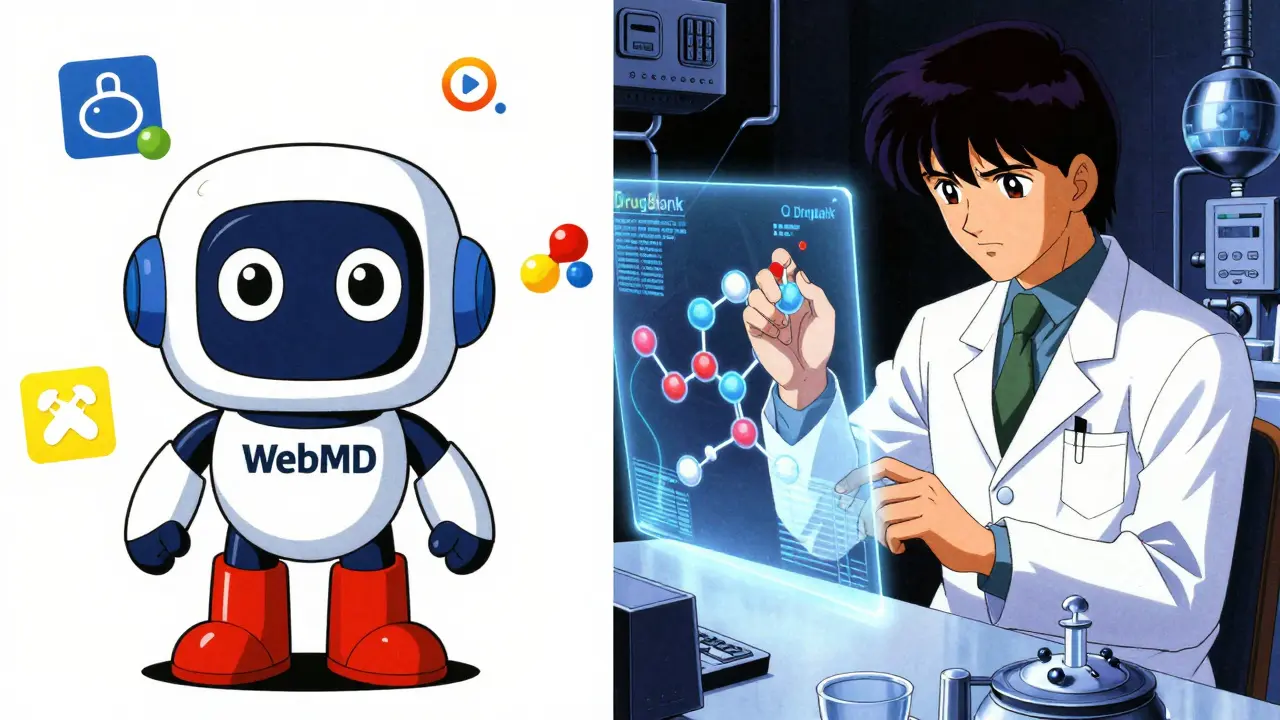
Comparing Top Platforms: WebMD vs. DrugBank vs. Alternatives
| Feature | WebMD Checker | DrugBank (Free) | Medscape |
|---|---|---|---|
| Target Audience | General Public / Patients | Clinicians / Researchers | Healthcare Professionals |
| Cost | Free (Ad-supported) | Free (Limited queries) | Free (Registration required) |
| Max Drugs Checked | Unlimited | 5 Drugs | Variable |
| Depth of Mechanism | Patient-friendly summaries | Detailed pharmacokinetics & enzymes | Clinical depth with references |
| EHR Integration | No | Yes (API for enterprise) | Limited |
| Error Rate (Serotonin Syndrome)* | 17% lacked primary support | 3% error rate | Not specified |
As the table shows, the choice depends on your needs. If you are a patient looking for a quick answer about whether cranberry juice affects your warfarin, WebMD is accessible and fast. However, a 2021 study found that 17% of its serotonin syndrome warnings lacked primary literature support. For a clinician managing complex polypharmacy, DrugBank’s precision is unmatched. Its enterprise API, costing around $1,200 monthly for 10,000 queries, integrates with Electronic Health Record (EHR) systems like Epic and Cerner via FHIR standards. Medscape sits in the middle, offering strong clinical depth but requiring registration, which can be a barrier for casual users. Another alternative, Pillo, specializes specifically in food-drug interactions using a patented algorithm, addressing the fact that 40% of serious interactions involve food.
Critical Limitations and Hidden Risks
Even the best tools have blind spots. One major risk is the "false security" effect. Dr. Robert S. Padginton warned in JAMA Internal Medicine that overreliance on free checkers can be dangerous, especially for drug-condition interactions. For example, NSAIDs are often flagged for bleeding risks, but their danger in heart failure patients is sometimes overlooked by basic algorithms. Additionally, there is a significant lag in updating databases. New biologics and recently approved drugs may not appear in free checkers immediately. Fedratinib, mentioned earlier, caused documented cases of thiamine deficiency because checkers hadn’t yet updated their interaction profiles upon its release.
Supplements are another gray area. WebMD acknowledges that its checker identifies 85% of high-risk interactions but misses 15% involving dietary supplements due to regulatory gaps in reporting. St. John’s Wort, a common herbal supplement, is notorious for interacting with antidepressants, yet coverage varies across platforms. Furthermore, neither WebMD nor DrugBank accounts for off-label uses, which account for 21% of all prescriptions according to FDA data. If your doctor prescribes a drug for a condition it isn’t officially approved for, the checker might miss relevant interactions specific to that usage context.
Best Practices for Safe Usage
To use these tools safely, adopt a layered approach. First, always check both drug-drug AND food-drug interactions. Many users forget that grapefruit, alcohol, or dairy can alter medication efficacy. Second, verify results against primary literature for high-risk combinations. If a checker flags a "moderate" interaction, don’t ignore it; a 2021 Annals of Internal Medicine study showed that moderate interactions still caused 18% of preventable hospital admissions. Third, never use checkers as the sole decision-maker for clinical care. As Dr. Richard H. Dana, Chief Pharmacist at Johns Hopkins Hospital, stated, WebMD is excellent for education but dangerous if used for clinical decision-making without verification. Finally, update your list regularly. Adding a new over-the-counter painkiller or vitamin can change the entire interaction profile of your regimen.
The Future of AI and Drug Safety
The landscape is shifting rapidly with artificial intelligence. Google’s Med-PaLM 2 achieved 89% accuracy in predicting novel interactions in 2023 trials, signaling a future where AI could flag risks faster than traditional databases. However, this brings new risks. Stanford researchers demonstrated in August 2023 that Large Language Models (LLMs) hallucinate 22% of predicted interactions without proper validation frameworks. In response, the FDA released draft guidance in September 2023 on AI checker validation, mandating "explainable AI" for certified checkers by 2026. This means future tools must show the evidence trail for every prediction, not just give a yes/no answer. Blockchain technology is also being explored for patient-controlled interaction records, allowing individuals to maintain a unified, secure history of their medications across different providers.
Is the WebMD drug interaction checker accurate?
WebMD is highly accurate for identifying common, well-documented drug-drug interactions and is widely used by patients. However, studies have shown it may lack primary literature support for some specific warnings (like certain serotonin syndrome cases) and may not comprehensively cover herbal supplements or rare genetic interactions. It is best used as an educational screening tool, not a definitive clinical guide.
Does the FDA have a drug interaction checker website?
No, the FDA does not operate a public-facing drug interaction checker. The FDA regulates drug safety and approves labeling, but it relies on third-party databases and healthcare providers to disseminate interaction information to the public. Patients should use trusted third-party tools like WebMD, Drugs.com, or consult their pharmacist.
What is the most reliable drug interaction database for professionals?
For healthcare professionals, DrugBank is often considered the most reliable due to its detailed pharmacokinetic data, enzyme pathway information, and low error rates (3% in comparative studies). Medscape is also highly regarded for clinical depth. These tools are preferred over consumer-grade checkers because they provide evidence-based severity ratings and integrate with hospital EHR systems.
Can drug interaction checkers detect food and supplement interactions?
Most major checkers, including WebMD and DrugBank, do include food and supplement interactions, but coverage varies. WebMD has expanded its supplement alerts to cover over 1,200 herbal compounds. However, experts warn that 15% of supplement interactions may still be missed due to regulatory gaps in supplement reporting. Always explicitly check for food-drug interactions, as 40% of serious incidents involve food.
Why do some drug interactions appear missing in online checkers?
Missing interactions often occur due to database update lags, especially for newly approved drugs or biologics. There can be an 18-month delay in updating rare interactions in some systems. Additionally, free consumer tools may omit complex pharmacogenomic interactions (based on genetics) or off-label use scenarios, which require more specialized clinical databases to interpret correctly.