
Why Asia Rules the Generic Drug World
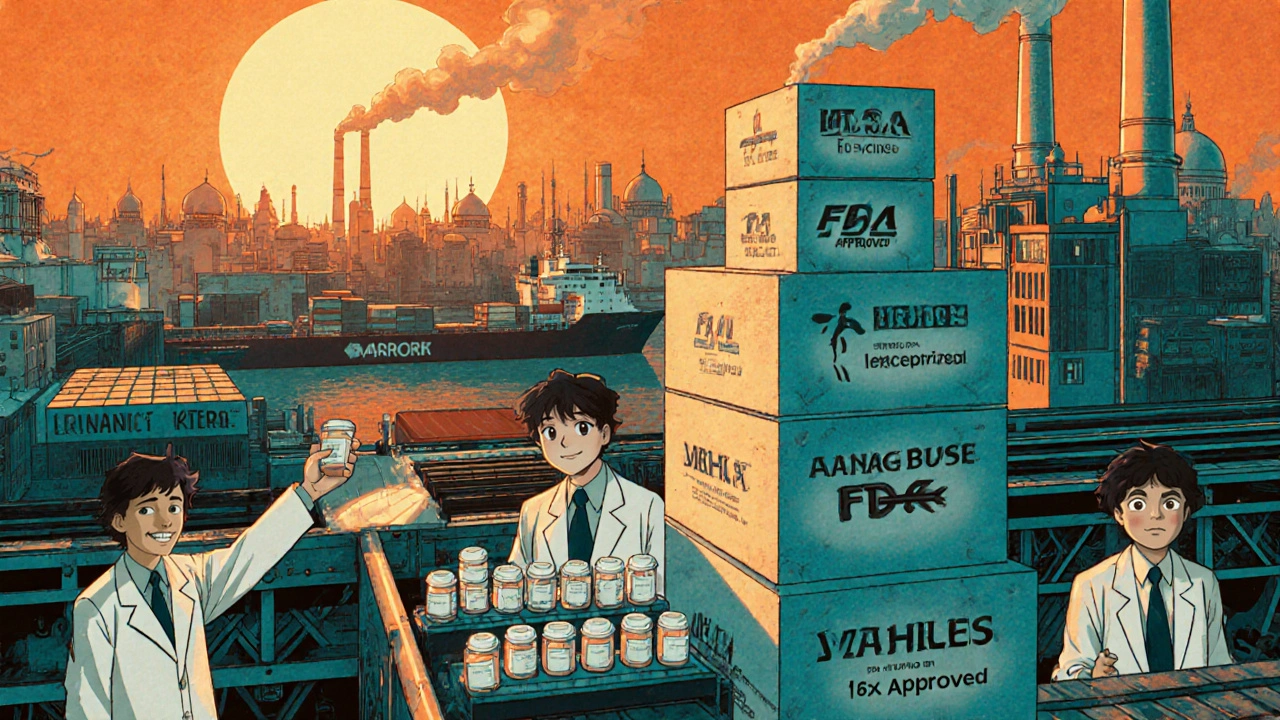
When you pick up a bottle of generic antibiotics, blood pressure pills, or diabetes medication, there’s a good chance it came from Asia. Not just one country - but a network of manufacturing powerhouses led by India and China, with Vietnam, Cambodia, and others rising fast. These aren’t just cheap alternatives. They’re the backbone of global healthcare, supplying over 40% of the U.S. generic drug market and 60% of the world’s vaccines. The question isn’t whether Asia matters in generics - it’s how each country plays its role, and what that means for your medicine, your wallet, and your health.
India: The Volume Champion
India earned its nickname as the “pharmacy of the world” by mastering one thing: making tons of cheap, effective drugs. Its secret? A 1970s patent law change that let local companies copy foreign medicines as long as they used a different manufacturing process. That move turned India into a bulk producer of generics - no patents, no delays, no high prices.
By 2024, India’s pharmaceutical market hit $61.36 billion, with 75% of that coming from conventional generics. It exports $24.2 billion worth of drugs annually, and 87% of those are generics. The U.S. alone gets 40% of its generic drugs from India. That’s why your $5 prescription for metformin or amoxicillin likely has an Indian label.
But volume doesn’t mean value. India makes more pills than anyone - but earns less per pill. It’s a volume game. Most of its manufacturing is in Gujarat and Maharashtra, with over 3,000 FDA-approved plants. Yet only 15% of those can handle complex biologics or biosimilars. India’s strength is in small-molecule drugs: antibiotics, antivirals, heart meds. It controls 35% of the global market for complex oncology generics.
China: The Hidden Powerhouse
China doesn’t just make drugs - it makes the building blocks of them. Around 70% of the world’s Active Pharmaceutical Ingredients (APIs) come from China. That’s the raw chemical powder that goes into every pill. Without Chinese APIs, India’s generic factories would grind to a halt. India imports 68% of its API needs from China, despite spending billions trying to fix that through its “Pharma Vision 2020” plan. So far, it’s only managed to produce 18% of its own API needs.
China’s pharmaceutical market is bigger - $80.4 billion in 2024 - and growing faster in dollar terms. It’s not just copying old drugs anymore. It’s moving up the value chain. In 2024, 10% of China’s pharma output was biologics - complex, high-cost drugs made from living cells. That’s up from 3% just five years ago. China’s 14th Five-Year Plan poured $150 billion into biologics R&D, aiming to make 25% of its exports high-value drugs by 2030.
China’s manufacturing is more centralized. Jiangsu, Zhejiang, and Shanghai are the big hubs. Its FDA approval timeline dropped from 24 months in 2018 to just 9 months in 2024. That’s faster than many Western countries. But quality issues linger. In 2024, the U.S. FDA issued 142 warning letters to Chinese manufacturers - more than double India’s 87. Still, Chinese suppliers are often 20% cheaper than Indian ones. That’s why big U.S. pharmacy chains now split their sourcing: 40-60% from India, 25-35% from China.

Emerging Economies: The New Players
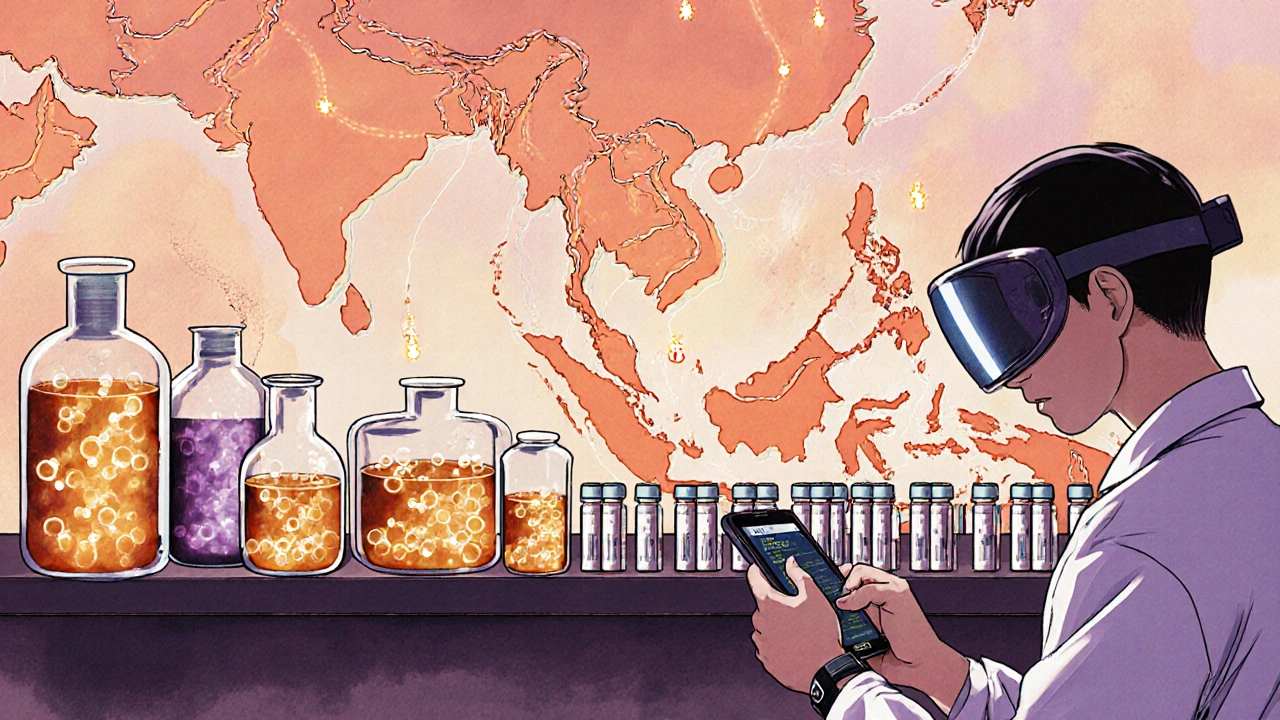
India and China aren’t the only ones. Vietnam’s pharmaceutical market grew 12.3% annually from 2020 to 2024. It’s not making full pills yet - it’s specializing in antibiotic intermediates, the chemical steps between raw API and finished drug. That’s a smart niche. It avoids direct competition with giants and fills a gap in the supply chain.
Cambodia is doing something different. It’s not making drugs. It’s assembling medical devices - syringes, IV bags, glucose monitors. Its medical device sector hit $1.2 billion in 2024, growing 32% year over year. Why? ASEAN trade deals give it preferential access to markets like Australia and Europe. It’s not about drugs - it’s about hardware.
These countries are becoming essential links in the chain. If a factory in Gujarat shuts down, or a Chinese API plant gets FDA flagged, buyers turn to Vietnam or Thailand. It’s not about replacing India or China - it’s about reducing risk.
Quality vs. Cost: The Real Trade-Off
Buyers face a constant tug-of-war: cheaper price or reliable quality?
Indian suppliers win on communication. A U.S. pharmacy chain executive said India’s 24/7 customer support cut their operational issues by 60%. Trustpilot ratings show Indian suppliers at 4.1/5.0 - higher than China’s 3.8/5.0. Indian companies also respond faster to custom requests - 14 days versus China’s 30-45 days.
But Chinese suppliers win on price. One German healthcare company said switching from Indian to Chinese APIs saved them 20% - until the FDA issued 142 warning letters in 2024. Now they’re forced to dual-source, which added 18% to their supply chain costs.
India’s problem? Inconsistent regulation. There are 17 different state and federal agencies overseeing pharma, leading to delays and confusion. Forty-seven percent of procurement officers say they’ve been held up by “state-level regulatory discrepancies.” China’s system is more top-down. Eight national agencies, but they all follow the same rules. That’s why approvals are faster - even if quality control is shaky.
The Future: Self-Sufficiency vs. Global Integration
Both India and China are trying to become less dependent on each other - and on the West.
India’s “Pharma 2047” plan is spending $13.4 billion to build 12 new API parks. Goal: cut API imports from 68% to 30% by 2030. That’s ambitious. But it’s not just about building factories. It’s about training engineers, securing raw materials, and upgrading infrastructure. Right now, India’s logistics cost 12-15% more than China’s because of poor roads and fragmented ports.
China’s “Healthy China 2030” plan is pouring $22.8 billion into biologics. That’s not about making more pills - it’s about making better ones. By 2030, China wants 25% of its exports to be high-value biologics. That’s up from 8% in 2024. It’s betting on innovation, not volume.
Meanwhile, the U.S. is getting nervous. “Project BioSecure,” launched in 2024, demands full traceability of APIs from farm to pharmacy. That means every chemical batch must be tracked - a huge cost for Asian manufacturers. Compliance could add 18-22% to production costs.
What This Means for You
For patients, this means affordable medicine. For governments, it means stable supply. For investors, it means volatility. S&P Global warns that overproduction of APIs could trigger a 15-20% price drop between 2026 and 2027. That’s bad for manufacturers - but good for buyers.
India’s biggest advantage? Its young population. 65% of Indians are under 35. That’s a workforce ready to adopt digital health tools, AI-driven drug design, and biosimilar production. China’s edge? Scale and state funding. Its government can throw billions at R&D without worrying about quarterly earnings.
The bottom line: Asia isn’t just making cheap drugs. It’s reshaping how the world gets medicine. India gives you volume and reliability. China gives you cost and scale. Emerging economies give you backup. And together, they keep the world’s medicine cabinets stocked - even when the West can’t.
How Global Buyers Are Adapting
Big pharmacy chains and hospitals aren’t relying on one country anymore. The new strategy is diversification. Sixty-eight percent of major U.S. pharmacy chains now split their generic drug sourcing between India and China. Some take 50% from India for its responsiveness, 30% from China for its price, and 20% from Vietnam or Thailand as a safety net.
Companies are also investing in dual sourcing for APIs. One U.S. manufacturer now buys 60% of its amoxicillin API from China and 40% from India - not because India is better, but because if one supplier fails, the other keeps the lights on.
Even quality control is changing. Instead of trusting a single batch, buyers now test every shipment - and some are using blockchain to track API origins. It’s expensive, but it’s the new standard.
Who Wins in the Long Run?
India’s market is projected to hit $130 billion by 2030, growing at 11.32% annually. China’s will reach $126.6 billion - but at a slower 7.8%. That sounds like India wins.
But look closer. India’s growth comes from domestic demand - more people buying medicine because they can afford it. China’s growth comes from exports of high-value drugs. China is making more money per pill. India is making more pills.
By 2035, India might catch up in innovation. Its digital health investments - $2.8 billion in 2024 alone - could help it leapfrog into biosimilars and AI-driven drug discovery. China is already there. It’s just slower to grow.
One thing’s clear: the era of cheap, unregulated generics is ending. The future belongs to manufacturers who can balance cost, quality, and traceability. And right now, Asia - led by India, China, and their rising neighbors - is the only place that can do it at scale.
Why is India called the pharmacy of the world?
India earned that title because it produces more generic drugs than any other country - supplying 40% of U.S. generic drugs and 60% of global vaccines. Its 1970s patent law allowed local companies to copy foreign medicines legally, turning it into a volume powerhouse. Today, it has over 3,000 FDA-approved manufacturing plants and exports $24.2 billion in pharmaceuticals annually, mostly low-cost generics.
Does China make more drugs than India?
By volume, India produces more finished generic drugs. But China makes more of the raw ingredients - 70% of the world’s Active Pharmaceutical Ingredients (APIs). China’s total pharmaceutical market is larger ($80.4 billion vs. India’s $61.36 billion) because it sells higher-value products like biologics and patented drugs. So while India makes more pills, China makes more money.
Are Indian generic drugs safe?
Yes, most are. Over 3,000 Indian manufacturing facilities are FDA-approved, and many meet WHO-GMP standards. But quality varies. India has 650 WHO-GMP certified plants, but inconsistent enforcement across 17 different regulatory bodies can lead to delays and batch failures. Buyers often test every shipment to ensure safety, especially for critical medications like antibiotics or heart drugs.
Why does the U.S. rely on Asian generics?
Because they’re affordable. Generic drugs from Asia cost 80-90% less than branded versions in the U.S. Without them, millions of Americans couldn’t afford prescriptions. India and China together supply over 70% of U.S. generic drugs and APIs. The U.S. doesn’t have the labor or regulatory structure to produce them at the same scale or price.
What’s the biggest risk in the Asian generic market?
Overproduction. Both India and China are investing billions to become self-sufficient in API production. That could flood the market, causing a 15-20% price drop in APIs between 2026 and 2027, according to S&P Global. That’s bad for manufacturers - but good for buyers. The bigger risk is quality control slipping under pressure to cut costs, especially as global regulators tighten inspection standards.



Akash Chopda - 24 November 2025
India makes the pills but China owns the powder. FDA warnings? Just noise. They dont want you to know how cheap your meds really are. 40% of US generics? Thats not a coincidence thats a takeover.
Sam Jepsen - 26 November 2025
This is actually one of the most clear-eyed takes I've read on global pharma. Huge respect to India for scaling generics like this and to China for pushing into biologics. We need more of this kind of transparency. 🙌
Natashia Luu - 28 November 2025
The notion that these countries are "helping" the world is a dangerous myth. They are exploiting regulatory arbitrage, labor exploitation, and environmental degradation to undercut Western pharmaceutical standards. This is not global health equity-it is global health imperialism.
akhilesh jha - 30 November 2025
Interesting how India's 1970 patent law changed everything. I wonder if anyone realizes that same law was pushed by the state because foreign pharma was charging 10x for life-saving drugs. The moral high ground the West claims? It's built on price gouging.
Jeff Hicken - 1 December 2025
so china makes the powder and india makes the pills? cool. so why does my blood pressure med still make me dizzy? maybe its not the country its the factory. or maybe its just the fact that we outsource everything and then act shocked when things go wrong.
stephanie Hill - 3 December 2025
I used to trust Indian generics until my mom got a batch that turned her skin yellow. FDA approved? Sure. But who checks the *batch*? The system is a house of cards. And now they're using blockchain? Please. That's just PR with a tech buzzword. They're still cutting corners. And don't even get me started on the child labor in API labs.
Jacob McConaghy - 4 December 2025
Look, I get the fear. But let's not forget: without these supply chains, millions of diabetics in rural Africa and low-income Americans would be out of meds. India and China aren't villains-they're the only ones who can make this work at scale. The real villain is a U.S. healthcare system that can't produce $5 insulin but demands $500 versions. We broke the system. They fixed it.
Vineeta Puri - 4 December 2025
The structural challenges in India's regulatory landscape are profound. With seventeen distinct oversight bodies, the fragmentation introduces unacceptable variability in quality assurance. This is not a critique of Indian manufacturing capacity-it is a call for centralized, standardized, and internationally harmonized regulatory protocols.
Victoria Stanley - 5 December 2025
The real story here is diversification. Smart buyers aren't choosing India OR China-they're using both as insurance. And Vietnam? Brilliant. They're not trying to compete. They're becoming the unsung hero of the supply chain. This isn't about dominance-it's about resilience.
Andy Louis-Charles - 6 December 2025
APIs from China are 20% cheaper. But when the FDA flags a plant, you lose 3 months of supply. That’s why dual sourcing isn’t optional anymore. It’s survival. 💡💊